







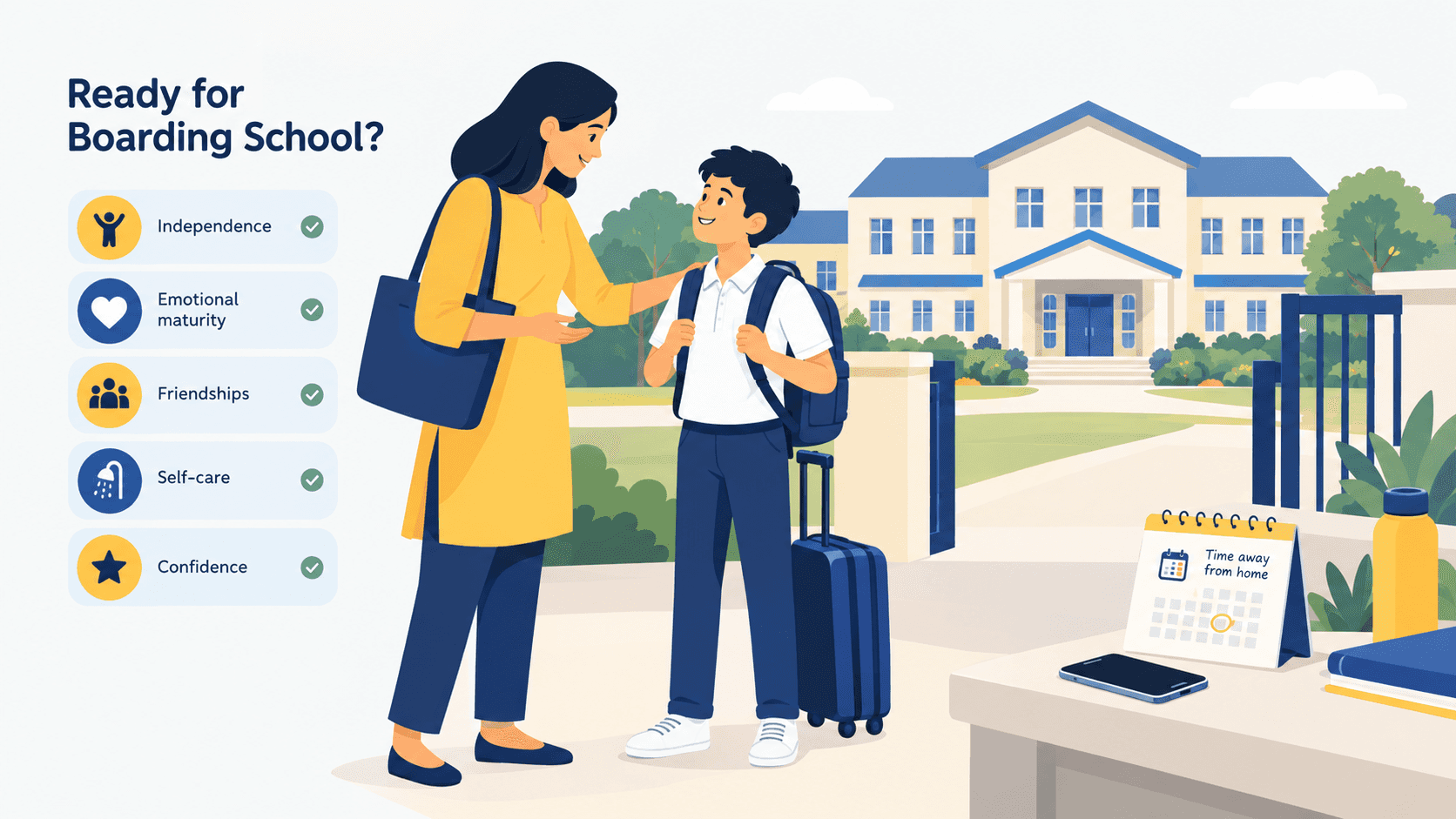

For parents exploring top boarding schools in India, boarding school can open up a very different kind of school experience. A name that may also appear during wider residential-school research is JAIN International Residential School (JIRS), where admissions are designed around a merit-based assessment process. But before comparing campuses, curricula, or facilities, there is a more personal question to answer: Is my child actually ready to live away from home?
Readiness is not simply about age or academic performance. A child can score well in school and still struggle to manage everyday responsibilities without a parent nearby. Another child may be quiet or nervous about leaving home but gradually adjust well because they can solve problems, ask for help, and manage routines independently.
Research on boarding-school transitions also suggests that children's experiences can vary considerably. A 2019 study of students preparing to move to secondary boarding school found that students had concerns about expectations and academics but generally viewed the transition positively when they had motivation and self-regulation.
What Does “Ready” Actually Mean?
A boarding student has to manage many small decisions that parents usually handle at home. Waking up on time, keeping track of belongings, getting ready for class, dealing with a disagreement, and telling an adult when something is wrong are all part of the experience.
This connects with the idea of self-determination theory, which highlights autonomy, competence, and connection as important psychological needs. A child does not need to be completely independent. They need enough confidence to try things themselves while knowing when and how to seek support.
Parents can look for these everyday signals:
|
Readiness area |
What it may look like at home |
|
Self-care |
Packs a school bag, manages basic hygiene and keeps belongings organised |
|
Responsibility |
Remembers homework, deadlines or small household tasks |
|
Problem-solving |
Tries a solution before immediately calling a parent |
|
Communication |
Can explain discomfort, confusion or conflict clearly |
|
Social adjustment |
Can make friends and handle small disagreements |
|
Emotional regulation |
Can recover after disappointment instead of remaining overwhelmed |
|
Flexibility |
Can manage changes to plans, food, routines or activities |
For example, if a child forgets their sports shoes, do they immediately expect a parent to fix the problem, or can they think through what to do next? These small moments often reveal more about boarding readiness than a report card does.
Also Read | Three Boards in one School
The Most Important Test: How Do They Handle Being Away?
A child does not need to be completely free of homesickness before joining a boarding school. Missing family is a normal response to separation. The more useful question is whether the child can continue functioning while missing home.
Short experiences away from parents can provide useful clues. This might be a school trip, staying with grandparents, attending a camp, or spending a weekend with trusted relatives. Research on children's sleepover anxiety recommends looking at previous overnight experiences and how comfortably a child manages routines away from home.
Parents can observe three things during these experiences:
- Before leaving: Does the child express nervousness but remain willing to go?
- While away: Can the child participate, eat, sleep, and communicate with adults?
- After returning: Can the child talk about what went well and what was difficult?
The goal is not to find a child who never feels anxious. It is to see whether the child can experience a difficult emotion without allowing it to control the entire experience.
When Should Parents Consider Waiting?
Sometimes the answer is simply, “Not yet.” Waiting a year does not mean a child has failed. Readiness can develop with practice, especially when parents deliberately give children more responsibility.
Some signs deserve closer attention:
- The child strongly opposes boarding but feels unable to express why.
- They depend heavily on parents for basic daily tasks that they could reasonably learn to manage.
- They struggle to communicate when they are uncomfortable, unwell, or confused.
- Every small change in routine causes significant distress.
- They have little experience being away from home and are not ready to practise it gradually.
- The decision is mainly being made because parents believe boarding school will “fix” discipline, study habits, or behaviour.
That last point is especially important. Boarding school should not be treated as a shortcut for developing maturity. A residential environment can provide opportunities for independence, but the child still needs enough emotional and practical readiness to use those opportunities.
A 2025 study of much younger children entering boarding preschools found associations between prolonged separation, stress responses, and school-refusal behaviour. The study involved a specific population and very young children, so it should not be directly applied to older boarding students. Still, it reinforces a useful principle: the timing and circumstances of separation matter.
Also Read | What is the Duke of Edinburgh Award or IAYP?
A Better Way to Make the Decision
.jpg)
Instead of asking, “Is my child old enough?”, parents can ask, “What can my child already manage without me, and what still needs practice?”
Try a simple readiness experiment over several weeks. Give the child responsibility for packing, managing a small allowance, keeping track of school materials, handling simple morning routines, and solving minor problems independently. Then introduce short overnight stays away from home.
Keep a simple observation table:
|
Situation |
What happened? |
What support was needed? |
|
Overnight with relatives |
Comfortable after initial nerves |
Needed one phone call |
|
Forgot an item |
Found an alternative |
Minimal help |
|
Disagreement with friend |
Talked it through |
Asked for advice later |
|
Change in routine |
Initially frustrated |
Settled after explanation |
This approach turns a large emotional decision into a series of smaller observations.
It is also worth asking the child directly: “What are you excited about?” “What worries you?” and “What would you do if you needed help?” Their answers can reveal whether the idea of boarding school is genuinely theirs or mainly an adult decision.
How JAIN International Residential School Approaches the Transition

For families considering JAIN International Residential School (JIRS) while researching the top boarding schools in Bangalore, the admissions process itself provides several points for understanding the fit between a student and a residential environment. JIRS states that admissions are merit-based and competitive, with limited boarding vacancies. Its process includes an online application, the JAIN Excellence Test (JET), and further interaction with school authorities.
The school also describes its admission criteria as considering academic performance alongside achievements in areas such as sports and cultural activities, while its campus-visit process allows prospective families to interact with school leaders, counsellors and students. This kind of interaction can help families move beyond brochures and ask practical questions about routines, support, communication and student life before making a residential-school decision.
Readiness Is a Process, Not a Deadline
There is no single age at which every child becomes ready for boarding school. Some children become comfortable with independence earlier, while others need more time and gradual exposure to being away from home.
The better question is not whether a child is “brave enough” to leave home. It is whether they have the practical skills, emotional flexibility, and willingness to seek support that can help them settle into a new environment. When parents observe those signals carefully, boarding school becomes less about making a leap and more about making a well-understood transition.
To know more about other boarding schools in India, click on the link below
 as a preferred source on