








Take your child to a toy shop and ask them to choose just one thing. The shopkeeper puts a LEGO set, a doctor’s kit, a cricket bat and a drawing book in front of them. For the first few minutes, your child is thrilled. Then the confusion starts. “I want this one… no, wait, maybe that one.” As a parent, you will probably help by removing a few choices. “You don't really play cricket that much, so leave the bat. You already have a building set, so maybe not LEGO.” Finally, your child picks the doctor’s set and walks out happily. But a few days later, they may discover that they actually love drawing and start asking, “Can we go back to that shop and get the drawing book?”
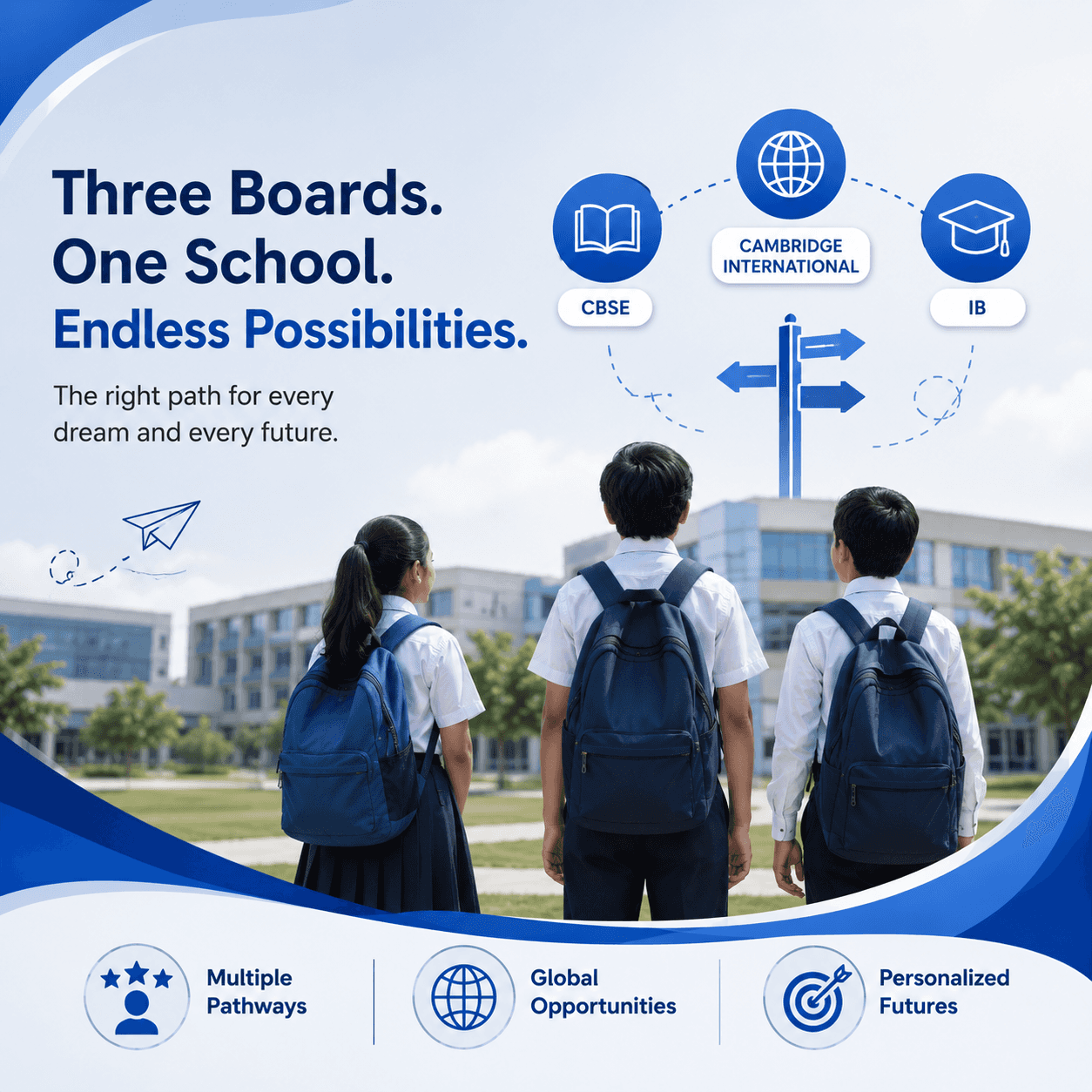
Choosing a school board is a little like this, except the decision has much bigger consequences. Children do not always know at the age of 10 or 12 whether they will eventually want to become a doctor, engineer, designer, researcher, entrepreneur or something completely different. Their interests change. Sometimes, even parents are not sure. So, when a school offers CBSE, Cambridge International and IB, the real benefit is not simply having three names to choose from. It is having different academic routes available under one school. We will see how one of the boarding schools in India is actually helping out students make such decisions.
Check Out | The 10 Hours Your Child Loses Every Week (And How to Get Them Back
Three Boards, Three Different Academic Routes
There is no single board that can honestly be called the “best” for every child. What works beautifully for one student may feel completely wrong for another.
Take Rohan, for example. He enjoys Physics and Mathematics, likes solving questions from textbooks, and is already talking about preparing for engineering entrance examinations in the future. His parents may find the CBSE route worth considering because it is closely connected to the Indian school system and provides a familiar foundation for students planning for examinations such as JEE and other national-level entrance pathways.
Now consider Meera, who spends half her free time watching videos about universities in different countries. She enjoys research, writing and discussing ideas rather than simply memorising answers. Her parents may want to explore an internationally oriented curriculum such as Cambridge or IB.
Then there is Kabir, who is good at academics but has not decided what he wants to do. Today he says he wants to become a doctor. Next month, he is interested in architecture. A few months later, he is talking about studying abroad. For a child like Kabir, parents may want to keep the decision open instead of forcing a career-based choice too early.
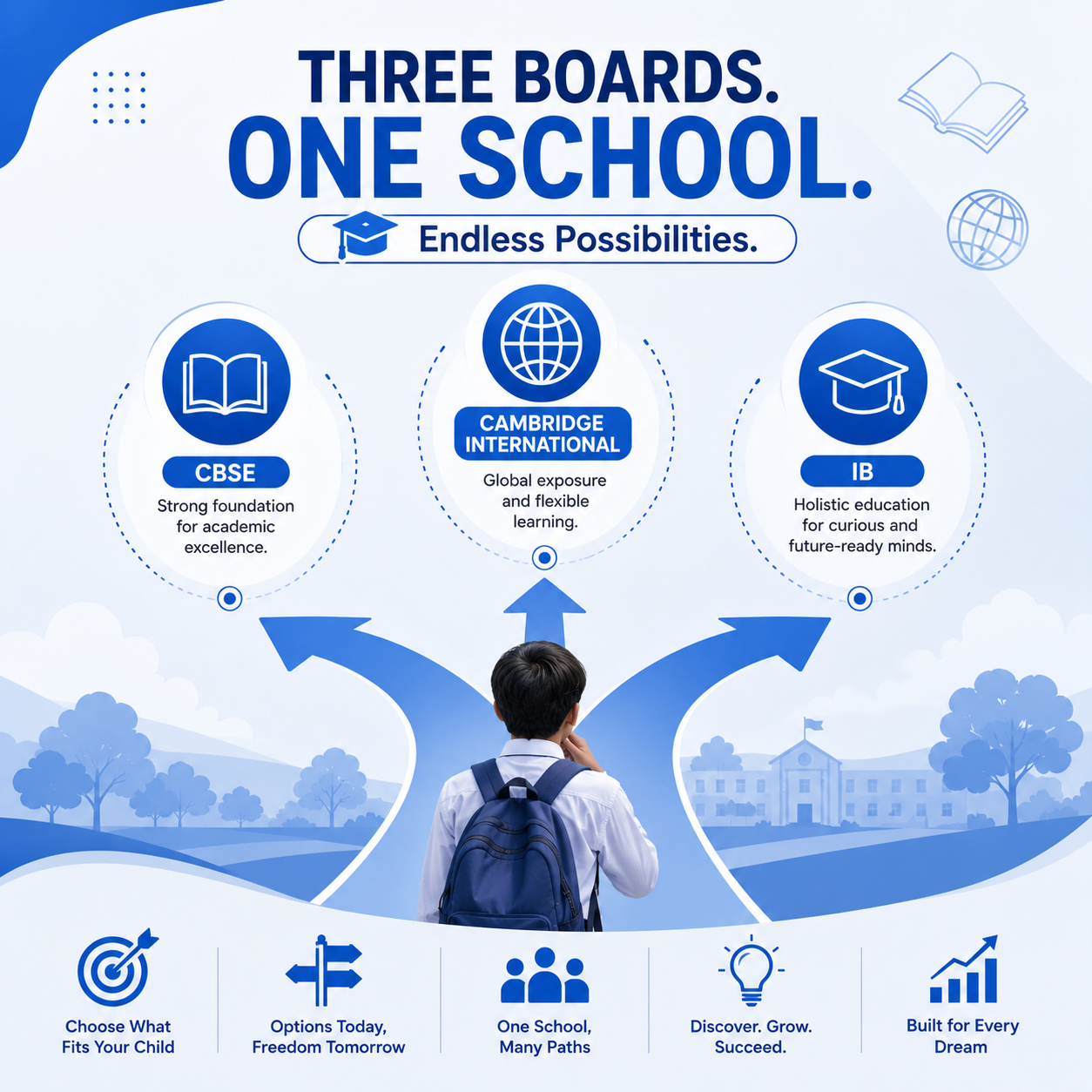
This is why having three boards in one school can be helpful. The board can be chosen around the child rather than the child being forced to fit the board.
What Does Each Board Bring to the Table?
The simplest way to understand the difference is to think about where the child may be heading and how they prefer to learn.
|
Curriculum |
May suit students who... |
What parents should consider |
|
CBSE |
Are considering Indian universities and competitive examinations |
Strong familiarity with the Indian education system |
|
Cambridge International |
Want an internationally recognised curriculum and may consider universities abroad |
Subject choices, assessment pattern and university requirements |
|
IB |
Enjoy inquiry, independent thinking, research and a broader global approach |
Academic workload, subject combination and future university plans |
This does not mean a Cambridge student cannot study in India or a CBSE student cannot go abroad. They absolutely can. A student’s university options depend on many things, including academic performance, subject choices, entrance requirements and the institution they apply to.
So, rather than asking, “Which board is superior?”, parents should ask, “Which board makes sense for my child?”
What If the Child Changes Their Mind?
This is perhaps the most important part.
Imagine Ananya, who enters school convinced that she wants to become a doctor because everyone in the family is a doctor. She chooses her subjects accordingly. By Grade 9, however, she discovers that she is much more interested in design and spends her weekends sketching, creating digital illustrations and working on small creative projects.
Or take Arjun, who initially dreams of studying in the United States. His parents therefore explore an international curriculum. A few years later, he decides he wants to prepare for an Indian entrance examination instead.
Children can change direction. That is normal.
A school that offers multiple curricula gives parents an opportunity to understand different pathways without immediately assuming that one route will work for every stage of the child's life. Of course, changing curricula is not something families should do casually, but having different programmes within the same school can make the conversation easier when circumstances change.
More Choice Is Useful Only When There Is Guidance
There is one catch, though. Three boards do not automatically mean better education.
Think back to the toy shop. If the shopkeeper simply throws 20 toys in front of the child and says, “Choose,” the child may become even more confused. The same thing can happen with school boards.
Suppose one child parents hear that IB is excellent and decide it must be right for her. But Sara dislikes independent research and becomes anxious when she has to manage several open-ended assignments. Or perhaps another child parents choose an international curriculum because they believe studying abroad is the only successful route, even though Vihaan is very clear that he wants to pursue medicine in India.
The board should not be selected because it sounds impressive.
Parents should look at:
- How the child learns: Does the child enjoy structured lessons or prefer exploring questions independently?
- Where the child may study later: India, another country, or is it simply too early to know?
- What subjects interest the child: Science, mathematics, languages, humanities, arts or a combination?
- How the child handles academic pressure: Some children thrive on competition, while others perform better with a more exploratory learning environment.
- Whether the child’s interests are still developing: For younger children, leaving some room for change can be more sensible than making a very specific career decision.
Also Read | The Charm of Boarding Schools: More Than Just a Fiction Movie’s Fantasy
Why Can Three Boards in One School Be Convenient for Families?
Consider a family with two children. The elder sibling who wants to pursue engineering in India, while her younger brother is interested in studying environmental science overseas. Their parents do not necessarily have to look for two completely different schools to find suitable academic pathways.
This is one of the practical advantages of having multiple curricula within the same school environment. Siblings may have different academic needs while still sharing the same campus, activities and broader school community.

At JAIN International Residential School (JIRS), Bengaluru, students can choose between CBSE, Cambridge International and the International Baccalaureate Diploma Programme (IBDP). This school, which is one of the best residential schools in Bangalore, combines these academic pathways with a residential environment and offers support related to a range of higher-education and entrance pathways. This gives families an opportunity to look at curriculum choice as a question of fit rather than simply following what is currently popular.
So, Should You Choose a School With Three Boards?
If your child is still discovering what they enjoy, or if your family wants to keep more than one academic route open, having three boards in the same school can certainly be an advantage. But it should not become a reason to choose the school on its own.
Remember the child standing in the toy shop. The goal is not to give them the biggest pile of toys. The goal is to help them understand what they actually want to play with.
The same thinking applies to education. CBSE, Cambridge and IB are different routes, not three versions of the same thing. The right choice depends on the child’s interests, learning style, future plans and how those plans develop over time.
And sometimes, just like the child who thought the cricket bat was perfect and later discovered a love for drawing, children surprise us. A good school should leave enough room for that discovery.
For more information on JIRS and similar schools, check out this list of the best boarding schools in India.
 as a preferred source on