








Does your bright, chatty 6-year-old still struggle to button his own shirt?
Or, does your sharp 10-year-old dread writing a single paragraph, when she can narrate the same story out loud without missing a beat?
If you have asked yourself either of these questions, you are far from alone. Many parents across the city homes feel confused by these behaviors.
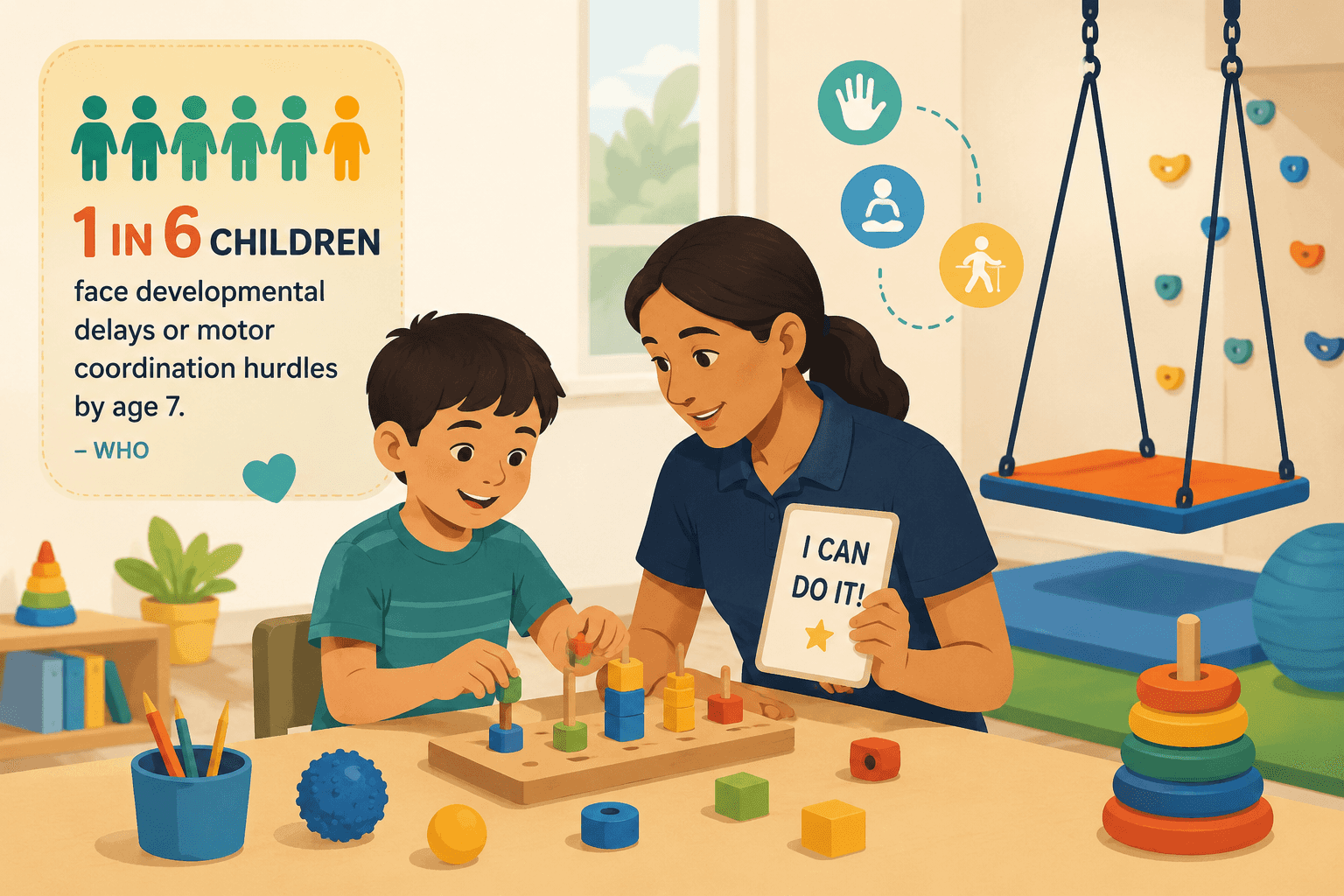
According to the World Health Organization (WHO), developmental conditions affect millions of children worldwide, with nearly 1 in 6 children facing sensory processing delays or motor coordination hurdles by the age of 7. Studies have consistently shown that identifying developmental challenges early can improve a child's ability to participate in school, build independence and carry out everyday activities with greater confidence.
Manav Rachna International School, one of the best schools in Noida, has been working on exactly this gap for a while now, creating inclusive learning environments where children receive the support they need to grow at their own pace. But before we get to what MRIS Noida actually does about it, let us slow down and understand what occupational therapy even is, and why more child development experts are terming it essential.
Also Read | Special Education: Ensuring Every Child’s Right to Learn and Thrive
What is Occupational Therapy?
Simply put, occupational therapy deals with your child's ability to actually do things, like holding a spoon, tying a shoelace or just sitting through a full class period. These small daily tasks are called "occupations" in therapy language, and honestly, that word choice confuses most parents on first hearing it.
An occupational therapist looks at the whole child. They look at how the kids move, how they handle sound, light, or certain textures and how long they can focus before melting down. Then comes a plan, built around what that one child specifically finds hard.
It is important to note that no two plans look alike, simply because no two children struggle the same way.
Why This Actually Matters in the Early Years
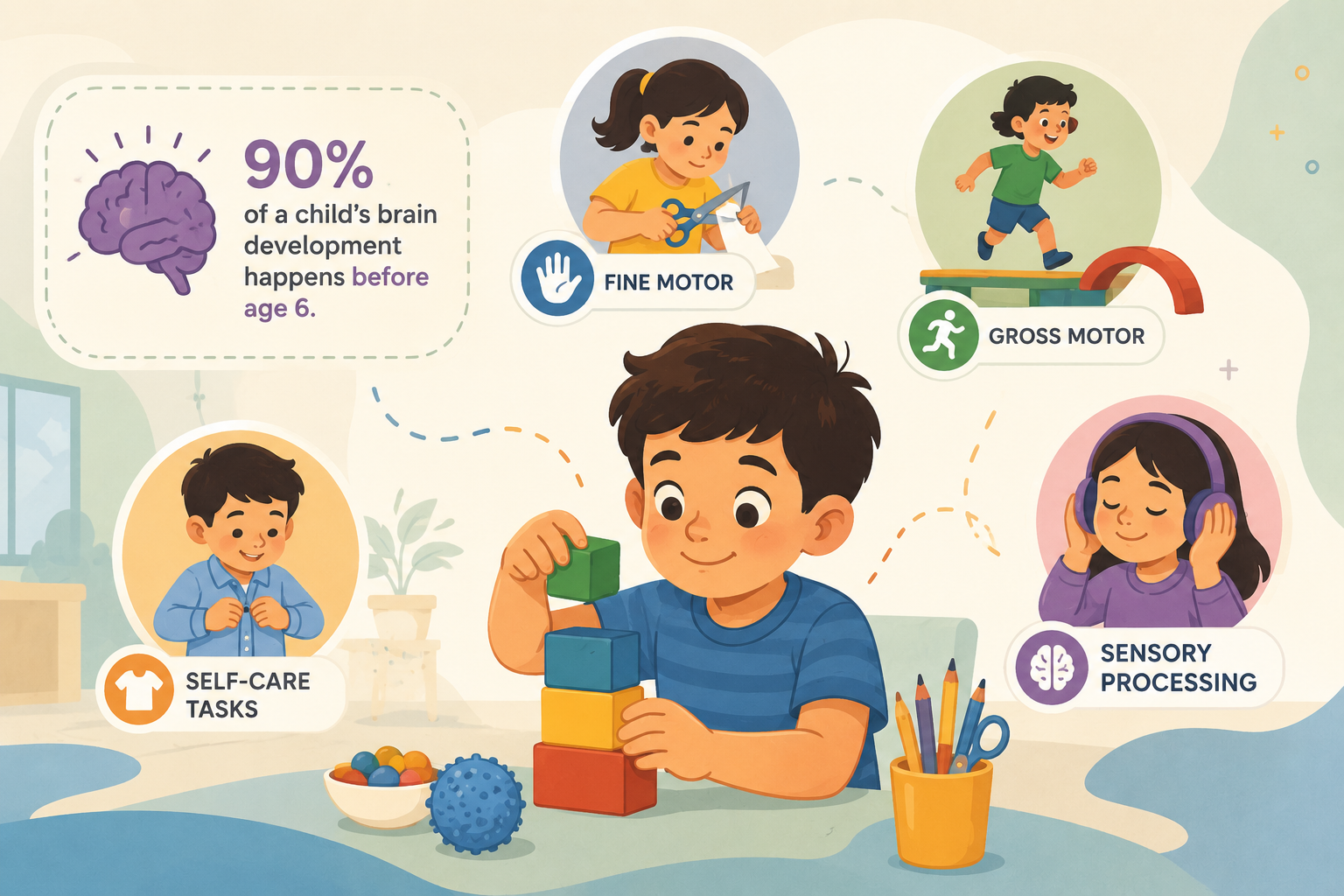
Here is the thing about early childhood: it is when the brain lays down wiring for almost every skill your child will use for the rest of their life. A 5-year-old who cannot grip a pencil properly does not usually just grow out of it on his own. Left alone, small motor or sensory issues tend to get bigger, not smaller, once school demands pile on.
Occupational therapy steps in to support these missing developmental steps. It gives children the sensory regulation and physical coordination that modern indoor lifestyles often leave out. Therapists use structured play activities to help kids grow.
The focus usually falls on 4 main areas:
- Self-Care Tasks: Learning to button school shirts, zip up winter jackets, tie shoes, and eat without spilling food.
- Fine Motor Skills: Using safety scissors correctly, holding pencils without hand pain, and building toy block towers.
- Gross Motor Skills: Keeping balance on playground slides, jumping safely, and sitting straight at school desks.
- Sensory Processing: Getting used to loud classroom bells, bright tube lights, and scratchy clothing fabrics.
When Should Parents Consider Occupational Therapy?
Every child grows at their own natural speed. While there is no strict developmental rulebook, there are certain repeated behaviors and physical struggles that can show that a child needs extra support.
Parents and teachers usually spot these little indicators during regular home routines or class hours:
- Avoids messy play; sand, paint, glue, all of it.
- Tires fast while writing, or presses the pencil way too hard or too soft.
- Cannot sit upright for long; louches, fidgets, slides off the chair.
- Falls apart in noisy places like assemblies, canteens, and birthday parties.
- Struggles with simple sequences, like getting dressed in order.
- Skips group games because the rules feel like too much to track.
Why the School a Child Attends Actually Matters Here
Parents cannot catch everything at home, as it is difficult to watch their own child 8 hours a day with a trained eye. Teachers do exactly that, watching a child function in a group, follow instructions, and sit through transition after transition. These everyday experiences give teachers opportunities to notice patterns that may not be as obvious at home.
A school that trains teachers to spot early signs and keeps specialists on campus instead of just handing out referral slips closes the gap between noticing something and actually fixing it. This is where the choice of school starts to matter, especially for parents raising a child with any developmental difference, however mild it looks right now.
Check Out | The 3 Essential Learning Environments Every Child Needs to Thrive
How Manav Rachna International School, Noida, Supports Every Learner
Manav Rachna International School, Sector 51, Noida, was established in 2013 and is affiliated with the CBSE board, running classes from Pre-Nursery all the way to Grade 12. The school has a student-teacher ratio of 20:1, which allows individual children more personal attention than a crowded classroom usually permits. Its vision is to become one of the best choices in education globally, guided by a mission that puts the child at the centre of learning, aimed at building the understanding, knowledge, and skills needed to shape a better future.
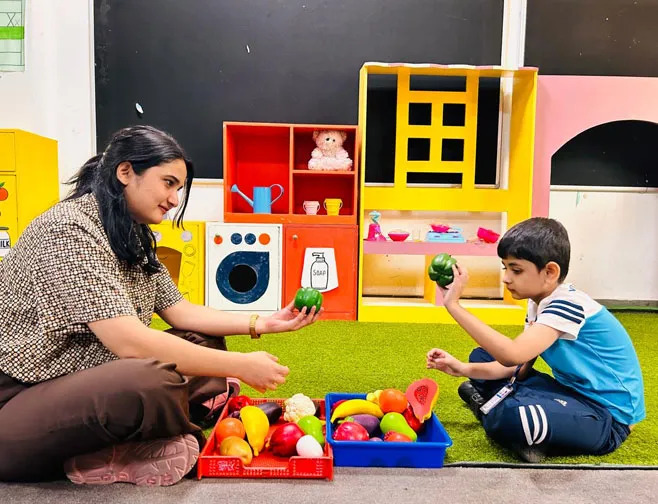
One of the best schools in Sector 51, Noida, MRIS takes a progressive and compassionate stance on inclusive education. You can see this commitment clearly through its specialized Special Educational Needs (SEN) department on campus. The SEN department operates across three dedicated pillars:
- Occupational Therapy: The in-house Occupational Therapy Inclusion Setup offers Early Years students access to a bright sensory playroom equipped with therapeutic swings, balance mats, and climbing tools. This setup allows young children to develop motor coordination and sensory balance naturally during regular school hours.
- Special Education Department: Designs Individualized Education Plans, or IEPs, built around each student's specific needs rather than a single method applied to every child. SEN educators collaborate closely with regular classroom teachers to adapt daily lessons and study materials.
- Student Counselling: Uses a structured pentagonal approach to build emotional resilience and positive mental health. This collaborative framework helps students overcome learning barriers while staying confident and happy.
Beyond this inclusion framework, the regular curriculum at MRIS Noida is built around seven key learning areas: Visual Arts, Performing Arts, Future Skills and Sustainability with Life Skills, Sports and Well-Being, CREST (an interdisciplinary approach built around reasoning and exploration), Numeracy, and Languages and Literacy. Students are also grouped into a mentorship structure with weekly sessions built around confidence, teamwork, and time management.
Schools such as MRIS Noida understand that helping a child with occupational therapy does not mean that the child is "behind" but simply that the child needs a slightly different kind of support to get there, and the earlier that support shows up, the smaller the struggle ends up staying. Thus, through its therapy and counselling setup, MRIS is indeed making sure that a child's quit struggle does not turn into a lasting one.
For more information on MRIS and similar other schools, check out this list of the best schools in Noida.
 as a preferred source on