







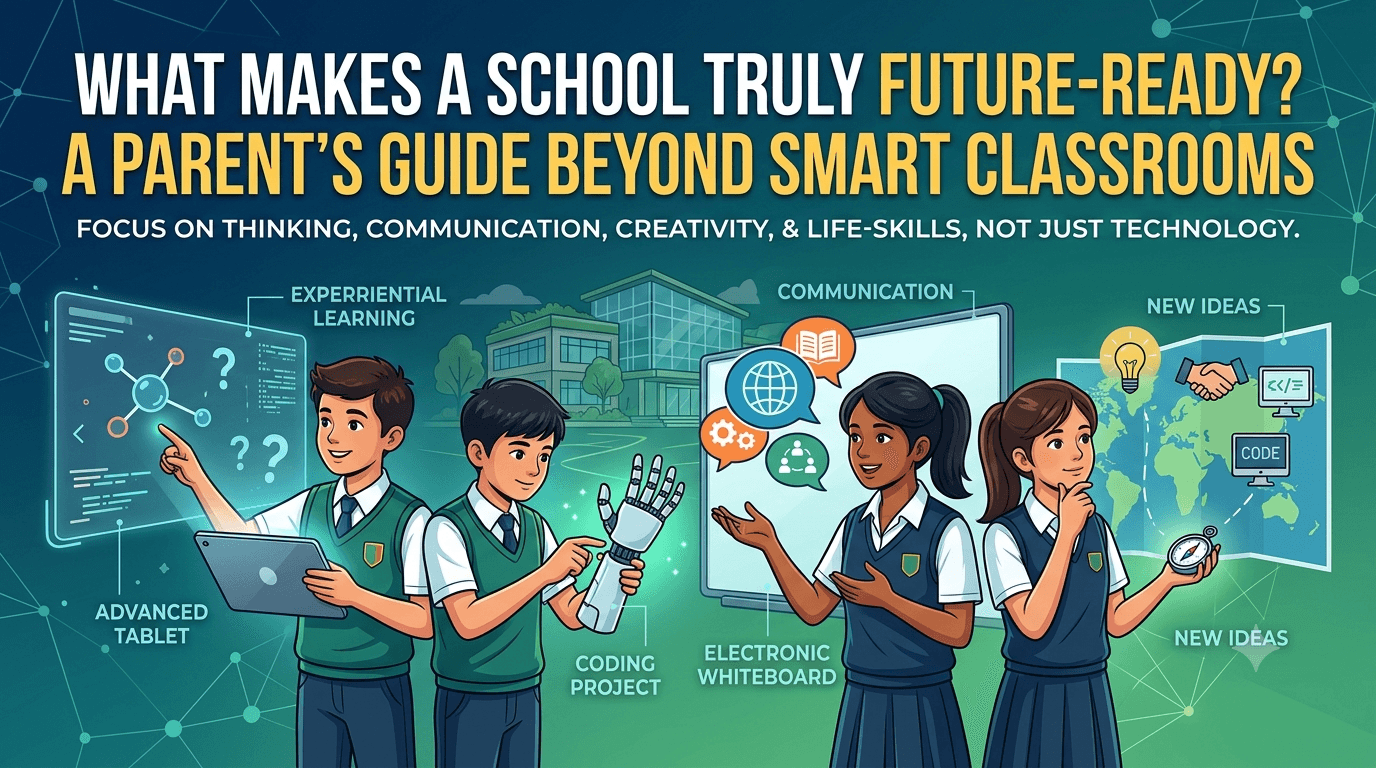

When parents search for the best school in Bangalore, they often come across schools highlighting smart classrooms, digital learning, advanced labs, and new technology. These features can certainly support learning, but they do not tell the whole story.
A truly future-ready school should prepare children for a world that is changing quickly. This means helping them think independently, solve problems, communicate clearly, adapt to new situations, and continue learning throughout life.
So, how can parents tell whether a school is genuinely future-ready? The answer goes beyond the technology visible inside a classroom.
Also Read| From Karate to Coding: What All-Round Education Really Looks Like Today
What Does a Future-Ready School Really Mean?
A future-ready school prepares students for challenges that may not even exist today. Instead of focusing only on memorising information, it helps children understand concepts, ask questions, and apply what they learn.
The goal is not to predict exactly what careers children will have in the future. It is to develop the skills they will need regardless of the career they choose.
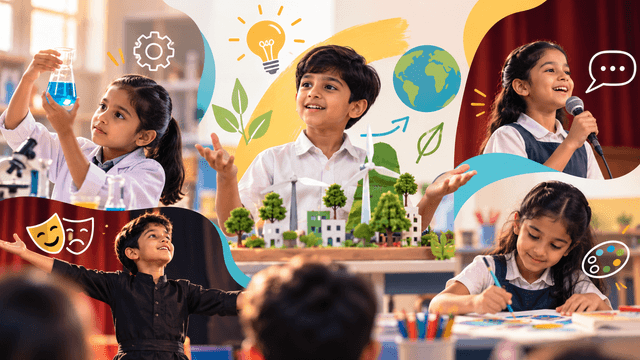
Parents should therefore look for a combination of strong academics, practical learning, critical thinking, communication, creativity and personal development.
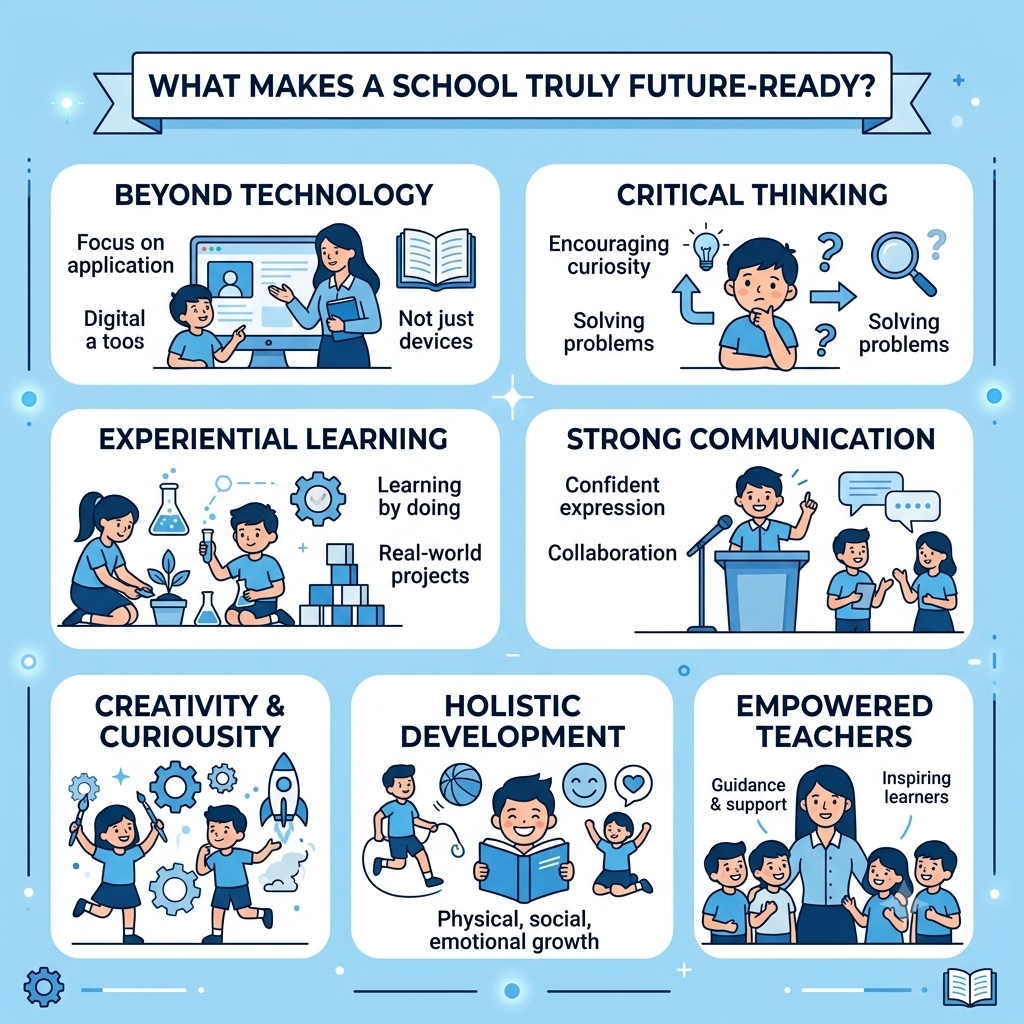
1. Look Beyond Smart Classrooms
Smart classrooms can make lessons more interactive. Videos, presentations, digital simulations, and other tools can help students understand difficult concepts.
But technology itself does not guarantee better education.
Parents visiting a school should ask an important question: How is technology being used?
Is it helping students understand and explore concepts, or is it simply being used to make lessons look modern?
A future-ready school uses technology as a learning tool rather than treating it as a substitute for good teaching.
2. Check Whether Children Are Taught to Think
Information is easier to access than ever. A child can find an answer to a question within seconds. This makes critical thinking even more important.
Children need to learn how to question information, compare different ideas, identify problems, and develop their own solutions.
Parents can look for classrooms where students are encouraged to ask “why” and “how”, rather than only being expected to remember answers.
During a school visit, parents can ask:
- Are students encouraged to ask questions?
- Do teachers allow students to explain their reasoning?
- Are children given opportunities to solve problems independently?
These small observations can reveal a lot about a school's teaching approach.
3. Look for Learning by Doing
Children often understand an idea better when they experience it rather than simply reading about it.
Experiential learning can include projects, experiments, investigations, practical activities, and real-world problem-solving. It allows students to connect classroom knowledge with situations outside the textbook.
For example, learning about plants becomes more meaningful when children observe how plants grow. A mathematics lesson can become more practical when students use numbers to solve a real-life problem.
Parents should therefore ask whether students regularly get opportunities to apply what they learn.
4. Future Readiness Also Requires Strong Communication
A child may have excellent academic knowledge, but being able to communicate that knowledge is equally important.
Future-ready education should give students opportunities to speak, write, listen, present ideas, and work with others.
Activities such as discussions, debates, presentations and group projects can help children become more confident communicators.
Parents should look beyond marks and ask whether their child will have regular opportunities to express ideas and interact with others.
5. Creativity and Curiosity Matter Too
The future will need people who can create new ideas, look at problems differently and experiment with possible solutions.
Creativity is not limited to drawing, music or performing arts. It can also appear in science, mathematics, writing, technology and everyday problem-solving.
A school that encourages curiosity gives children room to explore, make mistakes, ask questions and try again.
Parents can ask themselves: Does the school encourage children to find answers, or does it mainly give them answers?
That difference can have a lasting impact on how children approach learning.
6. Don't Ignore Physical, Social and Emotional Development
Future readiness is not only about academic and professional skills.
Children also need to develop confidence, discipline, teamwork, resilience, and respect for others. Physical activity and opportunities to participate in different activities can contribute to this broader development.
Parents should therefore look for a school that gives importance to academics while also allowing children to develop interests beyond textbooks.
A well-rounded education should help children become capable learners as well as responsible individuals.
7. Teachers Matter More Than Technology
One of the most important things parents can evaluate is the quality of interaction between teachers and students.
A modern classroom can have excellent technology, but students still need teachers who can explain ideas clearly, recognise different learning needs and encourage curiosity.
Parents should observe whether teachers listen to students, encourage participation and provide support when children struggle.
A future-ready school should also invest in teachers and help them keep improving their teaching practices.
A Parent's Checklist for Choosing a Future-Ready School
Before choosing a school, parents can use this simple checklist:
|
What to Check |
What Parents Should Look For |
|
Teaching |
Students participate, question, and discuss |
|
Curriculum |
Strong academics with practical application |
|
Technology |
Used meaningfully to support learning |
|
Teachers |
Supportive, responsive and continuously developing |
|
Communication |
Opportunities for speaking, writing and presenting |
|
Creativity |
Children are encouraged to explore and experiment |
|
Activities |
Students can discover different interests |
|
Development |
Academic, physical, social and emotional growth |
|
Learning environment |
Curiosity and questions are welcomed |
The most important point is to look at the learning experience, not just the list of facilities.
Also Read| From Foundational Learning to Future Innovation
How MVM World School Approaches Future-Ready Learning
For parents considering the best school in Bangalore, MVM World School (MVM), Devanahalli, Bangalore offers several elements that align with the idea of future-ready education. The school follows the CBSE curriculum and states that its educational approach gives importance to innovation and critical thinking, experiential learning, and modern teaching and learning methodologies.
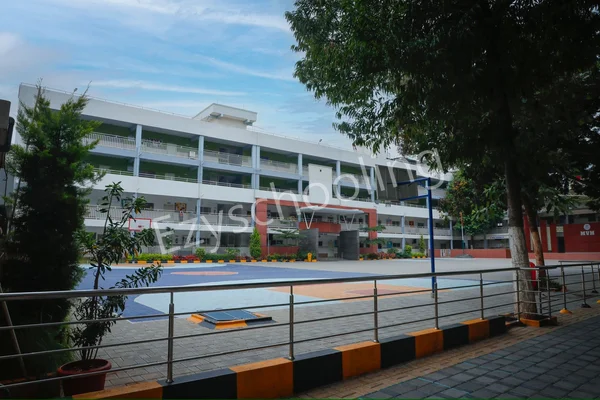
Its stated philosophy also focuses on knowledge application, holistic development, and adapting education to an ever-changing world. The school highlights a culture of curiosity, creativity and critical thinking, while also emphasising continuous teacher training and attention to different learner needs. These elements provide parents considering a top school in Bangalore with useful areas to examine when evaluating how a school prepares children for the future.
The Best Future-Ready School Is Not the One With the Most Technology
Technology has an important place in modern education, but it should not be the only measure of a school's quality.
When comparing schools, parents should ask deeper questions. Are children learning to think? Can they apply what they learn? Are they encouraged to communicate, collaborate, and create? Do teachers understand different learners? Does the school support children's development beyond academics?
These questions can provide a much clearer picture than a list of smart classrooms or digital devices.
Conclusion
Choosing a school is ultimately about choosing an environment in which a child will learn and grow for several important years.
Instead of asking only, “What technology does this school have?”, parents can ask a more meaningful question:
“What kind of learner will my child become here?”
A truly future-ready school does more than prepare children for the next examination. It helps them become curious, capable, adaptable, and confident learners who can face new challenges with the ability to think, learn, and grow.
For more information on this and similar schools, check out this list of the best schools in Bangalore.
 as a preferred source on