








"Mumma, why can't birds get lost in the sky?"
Questions like these often arrive when parents least expect them. One question leads to another, and suddenly a short conversation turns into a long discussion about the world around us. Curiosity comes naturally to children, yet many parents wonder how they can keep that curiosity alive once formal schooling begins.
This question sits at the heart of the Montessori method, an approach that has influenced early childhood education for more than a century. It is also one of the reasons why many parents today are drawn towards the best schools in Faridabad, such as Grand Columbus International School, Faridabad, where learning goes beyond textbooks and encourages children to think, explore, and participate actively in the learning process.
In this article, we look at some of the lesser-known benefits of the Montessori method and why its principles continue to resonate with parents and educators alike.
Also Read | Why the Montessori Method Still Matters
What Maria Montessori Noticed About Children
More than a century ago, Dr. Maria Montessori began asking similar questions while working with children. What she observed shaped an educational approach that continues to influence classrooms around the world today.
Maria Montessori's work began with a simple observation: children are naturally eager to learn when they are given the opportunity to explore. Instead of treating children as passive learners, she viewed them as active participants in their own growth.
She noticed that when children were trusted with responsibility, allowed to make choices, and given time to work through challenges, they often surprised adults with what they could accomplish. Even now, many aspects of Montessori education feel refreshing because they focus on how children actually learn rather than how adults expect them to learn.
The Brain Science Most of Us Never Hear About
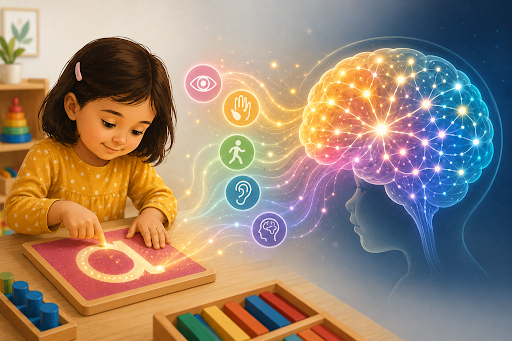
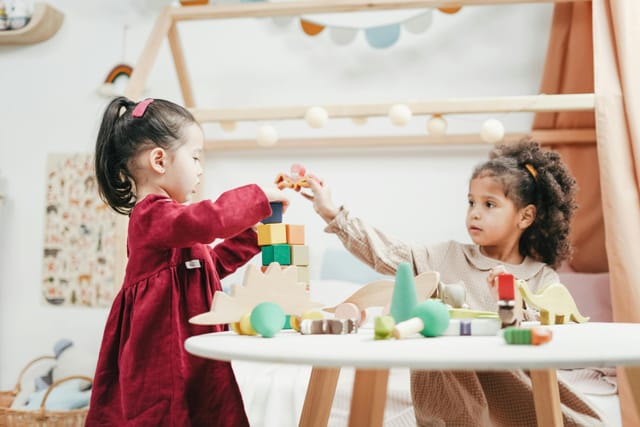
Children think with their hands far more than we give them credit for. When a little one traces sandpaper letters with a fingertip, the body and the brain are working as one team. That kind of memory lasts in a way a flashcard never manages.
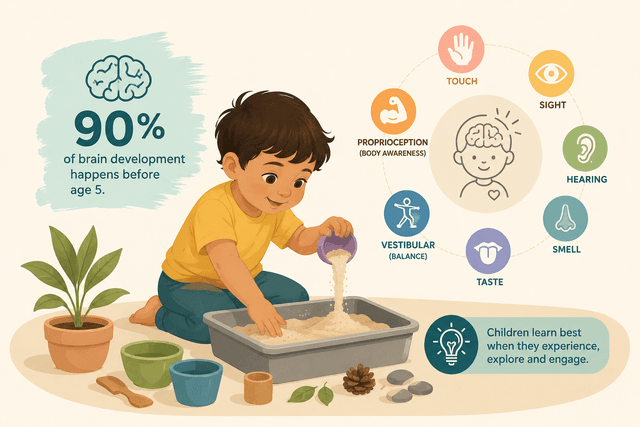
Studies in early childhood education keep pointing to the same thing. This multi-sensory approach strengthens the connections inside a developing brain. A child handling Montessori materials is doing several things at once, seeing and touching and moving and reasoning, and every sense adds another thread to the lesson.
Five Benefits That Tend to Surprise Parents
Test scores are the easy part to talk about. The quieter gifts are the ones that stay with you, and these five are the ones I hear parents mention again and again.
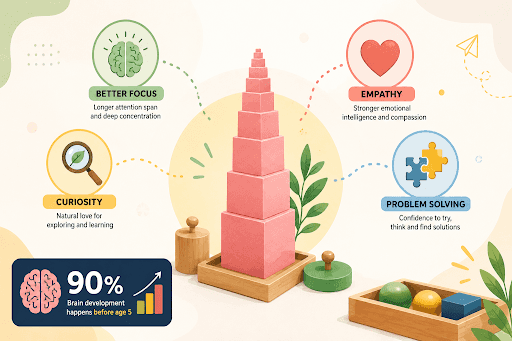
- Motivation from Within: Most schools lean hard on stickers, points, and grades. Montessori children, for the most part, work because they actually want to. Research shows their internal motivation runs higher than that of children in conventional classrooms. They stay curious, they take the first step on their own, and they keep going even when no reward is waiting at the end.
- Growing Emotional Intelligence: Mixed-age classrooms are one of the method's signatures, and honestly, they do something special. Older children naturally guide the younger ones, who in turn look up and absorb. Day after day, this builds patience and empathy. Children even learn to sort out their small squabbles without an adult stepping in every time.
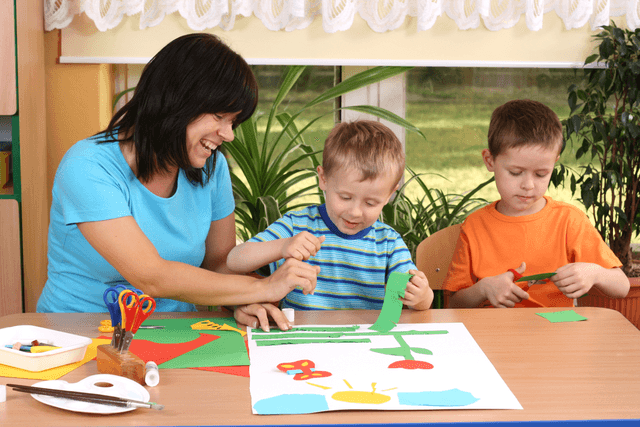
- Practical Skills from Early On: Pouring water without spilling. Buttoning a coat. Putting a shelf back in order. These tiny tasks quietly build focus and independence. A four-year-old who can manage them carries a real sense of capability, and that confidence tends to spill over into reading and numbers later on.
- Problem-solving as Second Nature: Because children move at their own pace, they meet difficulty on their own terms. When something is hard, they simply try again. The studies note that Montessori students often show sharper problem-solving skills than their peers, mostly because being stuck never frightened them in the first place.
- Deeper Concentration: Give a young child a long stretch of uninterrupted time, and observe what happens. They sink into focus so completely that the room around them disappears. This ability is rarer than we assume, and it shapes the way they study for years afterwards.
Check Out | Encouraging Holistic Development with Montessori Learning
Montessori-Based Learning at Grand Columbus International School
Located on an eco-friendly campus in Sector 16A, Faridabad, Grand Columbus International School is home to over 1200 students and 150+ dedicated educators. The learning environment at GCIS encourages active learning, thus pushing students towards active participation, exploration and meaningful engagement, rather than passive memorisation.
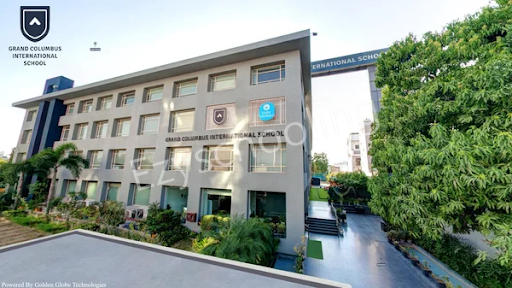
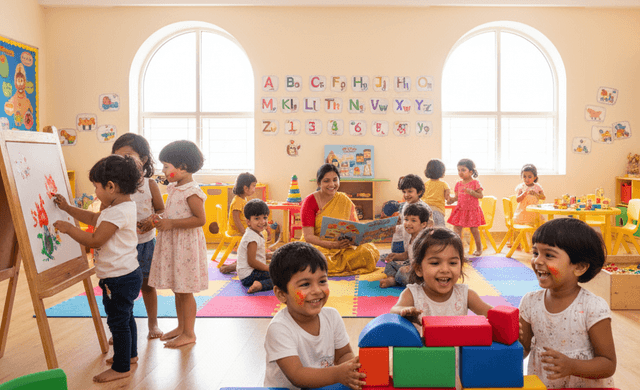
At GCIS, the foundational years run on a playful, child-led rhythm. The youngest ones build their grip on letters and numbers through hands-on activity, exactly the kind of curiosity-first learning Montessori always championed.
The school is also set apart by its LEGO Robo Lab and an Atal Tinkering Lab, where children get their hands on robotics, drones, and STEM projects. The dedicated teachers ensure no single child ever feels left behind in class. As your child grows older, they facilitate a smooth transition into regular academics at this top CBSE school in Faridabad.
The holistic child development approach always remains a top priority for the school management. With 15 plus clubs and activities spanning sports, music, and theatre, children grow in every direction at once. That balance is precisely what Montessori promised all along, a whole child rather than a single high score.
For more information on this and other similar schools in Faridabad, check out this list of the best schools in Faridabad.




 as a preferred source on