









When parents compare Top Schools In Ghaziabad, it is natural to look at marks, facilities, activities and future opportunities. But another question matters: Does the school help children become comfortable with asking questions? Sapphire International School, Ghaziabad, describes its approach as discovery, inquiry, experiential and collaborative learning. Children do not only need information; they need to learn how to explore it.
Also Read| How the Right School Environment Shapes Extraordinary Student Success
Why Are Good Questions So Important?
A child who asks, “Why does the moon follow our car?” may not need a perfect science answer immediately. The child is trying to understand what they notice. If parents ask, “What do you think is happening?”, the child gets a chance to observe, guess and explain.
This is close to the scientific method. Scientists ask questions, form possible explanations, gather evidence and change their ideas when the evidence does not fit. Children can practise the same habit in simple ways.
For example, if a child says, “Plants grow faster near the window,” parents can turn it into a small investigation. Which plant gets more sunlight? What happens if one is moved? How can growth be measured? This shows children that curiosity can lead to discovery.
Research supports this connection. A 2018 study of more than 6,200 children found that greater curiosity was associated with stronger reading and mathematics achievement in kindergarten. The researchers described curiosity as a potentially important contributor to early academic achievement. This does not mean curiosity automatically produces higher marks, but it shows why it deserves space in learning.
How Can Parents Build a Question-Friendly Home?
Parents do not need expensive kits or complicated projects. Everyday life gives children many things to wonder about. A bus ride, grocery bill, broken toy or rainy afternoon can become a small learning opportunity.
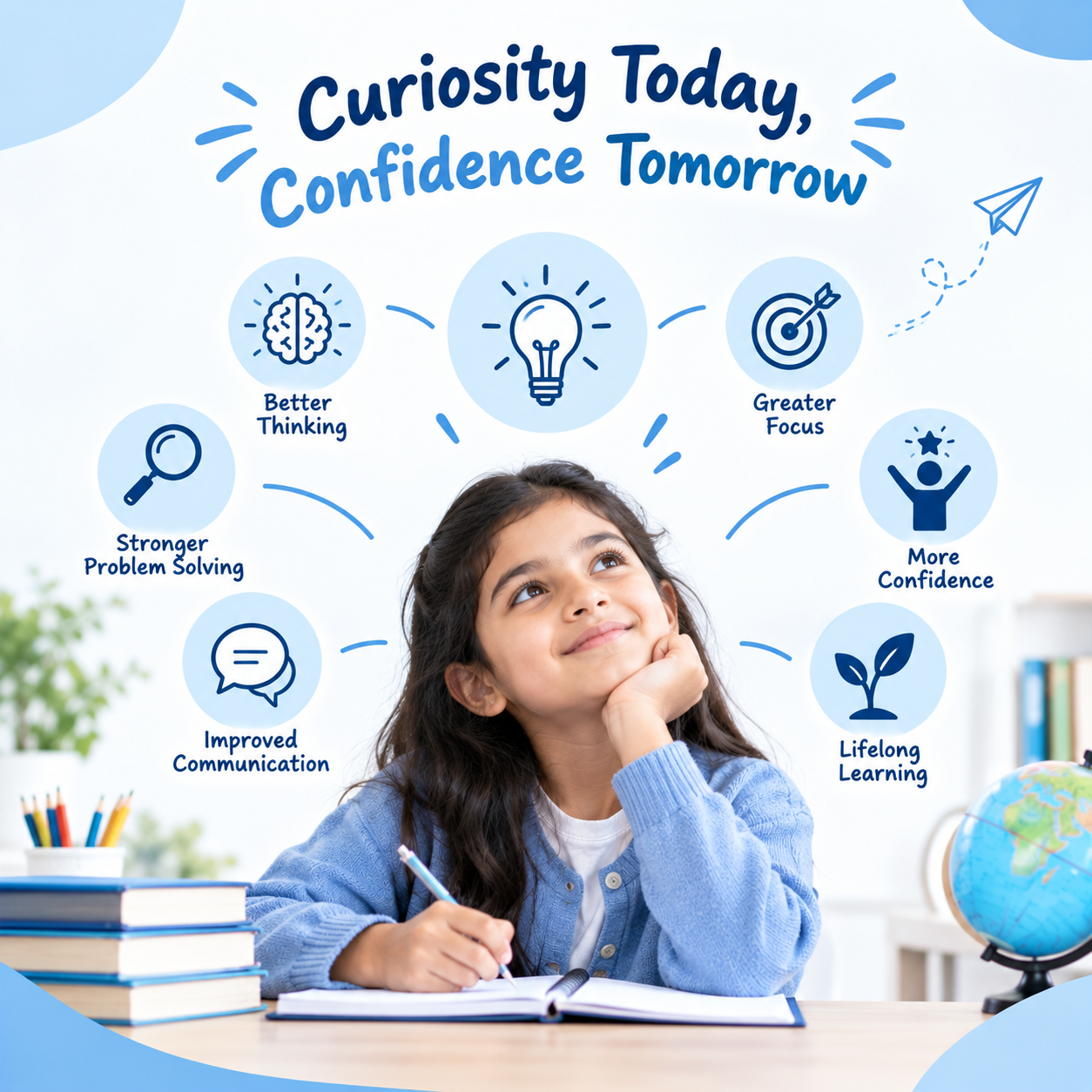
Parents can try prompts such as:
- “What makes you think that?”
- “How could we find out?”
- “What might happen if we changed one thing?”
- “Can you think of another explanation?”
- “What did you learn from trying it?”
Young learners still need guidance, background knowledge and clear explanations. Inquiry works best when children receive enough support to investigate without being left confused.
Once or twice a week, choose one “wonder question” at dinner. It could be, “Why do some things float?” Let everyone suggest an idea, then check a reliable source together. This turns curiosity into a shared habit.
Parents can also make room for questions during ordinary routines. While cooking, a child might ask why water boils. While shopping, they may wonder why one packet costs more than another. While travelling, they may ask why roads have different signs. Instead of treating these questions as interruptions, parents can use them as small openings for learning.
How Do Questions Build Better Thinking?
Questions become more powerful when children explain how they reached an answer. This is where metacognition, or thinking about one’s own thinking, becomes important. The Education Endowment Foundation describes metacognition and self-regulation as approaches that help learners plan, monitor and evaluate learning. Its evidence synthesis reports an average impact equivalent to eight additional months of progress.
Imagine a child solving 48 × 6. Instead of only checking whether the answer is 288, a parent can ask, “How did you work it out?” If the answer is wrong, ask, “Which step should we check?” This makes the mistake a chance to improve the method.
The same habit works beyond maths. After reading a story, ask why a character made a choice. After a cricket match, ask what changed the game. After a failed craft project, ask what the child would change next time. These conversations build reflection, reasoning and communication.
This approach also connects with the idea of growth through reflection. Children begin to understand that being stuck does not mean they cannot learn. It may simply mean they need a different strategy, another question or more evidence.
Also Read| How Parent Portals Strengthen the Home-School Partnership
What Should Parents Look for in a School That Values Curiosity?
Parents can look beyond labels such as “activity-based” or “modern learning” and ask what children actually do during a normal week. The useful question is whether children get chances to think, investigate, create and explain.
|
What to check |
Questions parents can ask |
|
Classroom learning |
Do children explain their reasoning or mainly repeat answers? |
|
Projects |
Do students investigate real questions and make choices? |
|
Science and maths |
Are experiments and problem-solving part of regular learning? |
|
Discussion |
Can children disagree respectfully and give reasons? |
|
Mistakes |
Are mistakes treated as part of learning? |
|
Technology |
Is it used to research, create and solve problems? |
A 2024 systematic review of open inquiry in science examined 24 studies and reported positive effects in areas including conceptual understanding, motivation, attitudes towards science and scientific thinking. It also noted that inquiry needs teacher support and good classroom management.
At Sapphire International School, Ghaziabad, the school says its curriculum includes discovery, inquiry, experiential and collaborative learning, with development areas covering problem-solving, reasoning, communication, creativity and teamwork.

Its Crossings Republik campus also highlights science, arts and innovation, along with STEM, robotics, design thinking, financial literacy and AI at different stages. These features connect with what parents may look for among Top Schools In Ghaziabad and Sapphire International School, Ghaziabad when considering whether children get opportunities to explore ideas rather than only receive information.
Facts are more useful when children know how to question, connect and test them. A child who learns to ask “How do we know?” is practising a habit that can help in science, maths, friendships, digital life and future work. At home, parents can protect curiosity by listening to questions, allowing experiments and giving children time to explain their thinking. When schools and families both make room for thoughtful questions, learning can become something children actively take part in rather than something they receive.
For more information regarding this and other schools in this area

 as a preferred source on