







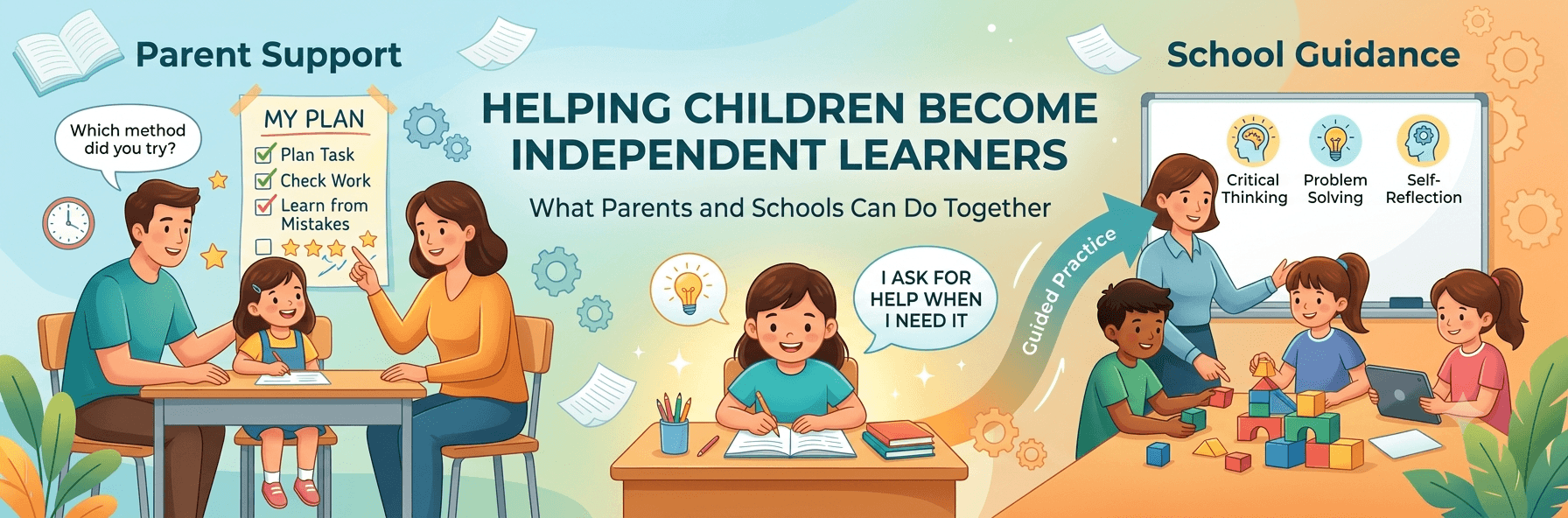

“Did you finish your homework?” “Have you packed your school bag?” “Did you study for the test?” For many parents, these questions become part of the daily routine. While children need guidance, there comes a stage when parents start wondering: When will my child learn to manage these things independently?
Independent learning does not mean expecting children to study alone or solve every problem without help. It means gradually helping them learn how to plan a task, make decisions, ask for help when needed, check their work, and learn from mistakes. This is an important part of growing into a confident learner.
For parents exploring education options, including a Best School in Gurugram, it is therefore useful to look beyond marks and homework. A school's approach to learning can also influence how children develop responsibility and ownership of their education. S D Heritage Pride School in Sector 85, Gurugram, for example, places independent thought, self-directed learning and skill development among the elements of its educational approach.
Also Read| When Children Stop Asking Questions: Why Learning Needs More Than a Textbook
What Does Independent Learning Really Mean?
An independent learner is not a child who never asks for help. In fact, knowing when and how to ask for help is itself an important learning skill.
Independent learning involves children gradually becoming able to:
- Plan how they will approach a task.
- Decide which strategy or resource may help.
- Stay with a challenging problem for some time.
- Check whether their answer or work makes sense.
- Recognise when they need guidance.
- Think about what worked and what they could do differently next time.
These skills are closely linked to metacognition, which means thinking about one's own learning. Educational research suggests that children benefit when they are explicitly taught how to plan, monitor, and evaluate their learning rather than being expected to develop these skills automatically.
This is why simply telling a child, “Be independent,” is unlikely to be enough. Independence needs to be taught and practised.
How Parents Can Build Independence at Home
Parents do not have to step back completely. Instead, they can gradually change how they help.
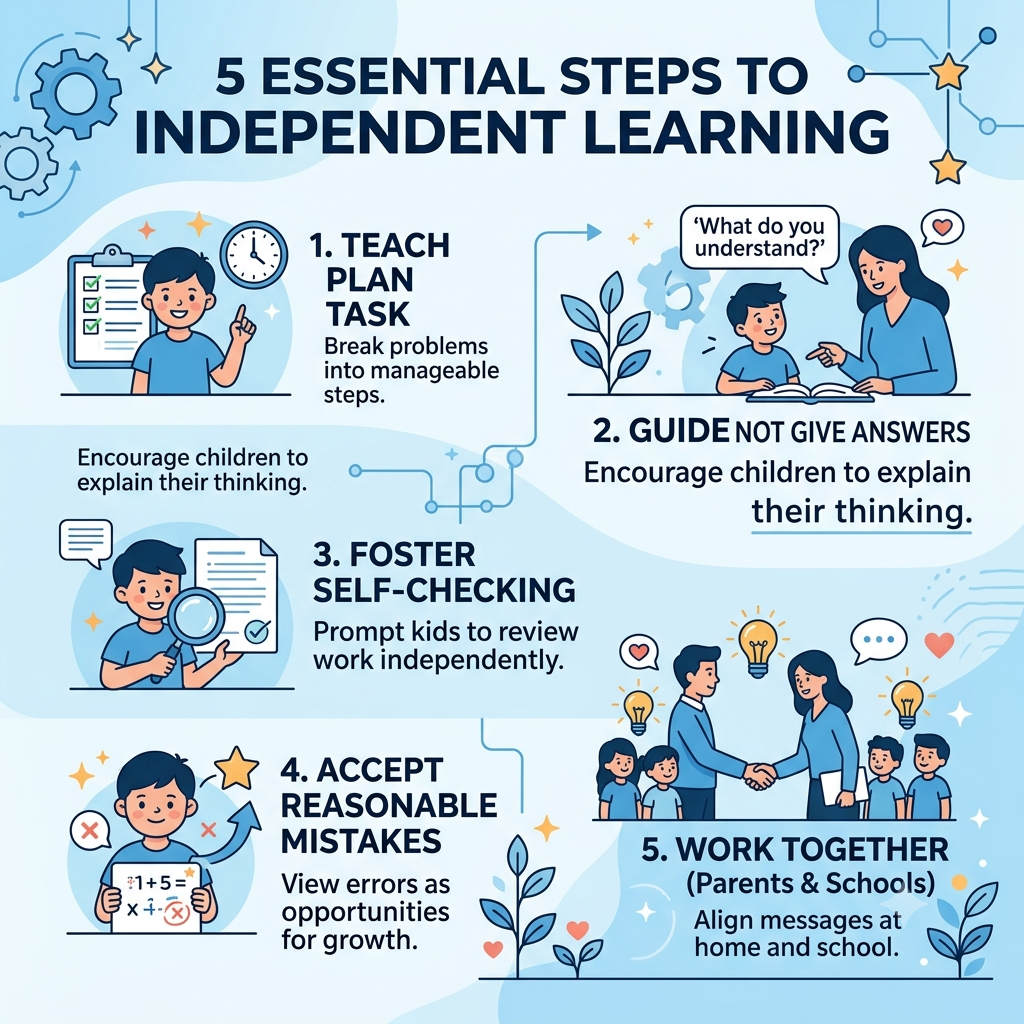
Imagine a child struggling with a mathematics problem. One approach is to immediately show the answer. Another is to ask, “What do you understand from the question?” or “Which method have you tried?”
The second approach gives the child an opportunity to think before receiving assistance.
Parents can try a few simple habits:
- Ask before answering: Give children time to explain what they have already tried.
- Break tasks into steps: Instead of managing the entire assignment, help children decide what they should do first.
- Let them make small decisions: Allow them to organise their study materials, choose a reasonable order for tasks, or prepare their school bag.
- Use reminders strategically: Instead of repeatedly reminding a child, create a checklist that the child can eventually manage independently.
- Encourage self-checking: Before reviewing homework, ask the child to identify anything they want to check themselves.
- Accept reasonable mistakes: Mistakes can show children where they need to change their approach.
The goal is not to remove parental support. It is to gradually transfer responsibility from the adult to the child.
What Schools Can Do to Develop Independent Learners
Children spend a large part of their learning journey at school, so classroom practices matter too.
Teachers can model their thinking by explaining how they approach a difficult task. They can then give students guided opportunities to practise the same process before expecting them to work independently.
Project work, presentations, problem-solving activities and reflection can also give students opportunities to make choices and explain their thinking.
Educational guidance on metacognition and self-regulation recommends a sequence of explicit teaching, modelling, guided practice and reflection to help students increasingly use learning strategies independently.
This approach is different from simply giving students a difficult assignment and expecting them to figure everything out. Good scaffolding provides enough support to help a child get started, while gradually reducing that support as the child becomes more capable.
For parents, this is an important point to consider when evaluating a school. A school that encourages independence should also provide the structure and guidance children need to develop it.
Parents and Schools Need to Work Towards the Same Goal
Children benefit when the messages they receive at home and school are broadly consistent.
For example, if teachers encourage a student to attempt a problem, reflect on mistakes, and find another strategy, parents can reinforce the same habit at home. Instead of asking only, “Did you get the right answer?”, they can ask, “How did you solve it?” or “What would you try differently next time?”
Meaningful parent-child conversations about learning can also encourage children to think about their own learning strategies and problem-solving habits.
A useful partnership can follow a simple pattern:
Teach → Guide → Practise → Step Back → Reflect
The amount of support can change as the child's ability grows.
Also Read| Discover the benefit of Holistic Development
How S D Heritage Pride School Connects With Independent Learning

For parents comparing a Best School in Gurugram or looking at a Top CBSE School in Gurugram, the way a school approaches student ownership can be an important part of the conversation. S D Heritage Pride School in Sector 85, Gurugram, describes an educational approach that includes independent thought, self-directed learning, competency-based education, and project-based learning. Its academic framework also highlights critical thinking, creativity, problem-
solving, and connecting learning with real-world situations. These stated approaches are relevant to the broader goal of helping children gradually take greater responsibility for how they learn, rather than simply completing tasks assigned to them.
Independence Takes Time
A child who still needs reminders at eight may become much more organised at ten, and a teenager may need a different kind of support again. Independence develops gradually through repeated opportunities to make decisions, solve problems, reflect and try again.
Parents do not need to choose between helping too much and not helping at all. The more useful question is: What support does my child need today, and how can I help them need a little less tomorrow?
When parents and schools work towards this shared goal, everyday activities such as homework, projects, revision, and problem-solving can become opportunities to build a skill that extends well beyond the classroom: the ability to take ownership of one's own learning.
For more information on S D Heritage Pride School and similar schools, check out this list of the best schools in Gurugram.
 as a preferred source on