








A child using a tablet to complete homework, watching an educational video, or searching for information online is now a normal part of school life. At the same time, parents may wonder: How much technology is too much? Should children be encouraged to use digital tools, or should screen use be limited as much as possible?
For parents exploring a Top school in Gurugram or looking for the Best school in Gurugram, this is an increasingly important question. Gurugram Global Heights School (GGHS), Sector 102, Gurugram, offers a useful example of why the conversation around technology needs to go beyond simply allowing or banning devices. The real goal is to help children understand when, why, and how technology should be used.
Also Read| Blending Eastern Wisdom and Western Methodology
Why Screen-Time Rules Alone Are Not Enough
A simple screen-time limit may tell a child how long they can use a device, but it does not always teach them how to use it responsibly.
There is a difference between spending 30 minutes creating a presentation for a school project and spending 30 minutes scrolling through random videos. Both involve a screen, but the purpose and learning experience are very different.
UNICEF notes that digital learning can create valuable opportunities for children while also bringing risks that need to be managed. Its current digital-education strategy promotes a balanced approach in which technology supports learning without replacing physical activity, play, and face-to-face interaction.
This means schools can focus on developing digital habits, rather than treating every form of screen use as the same.
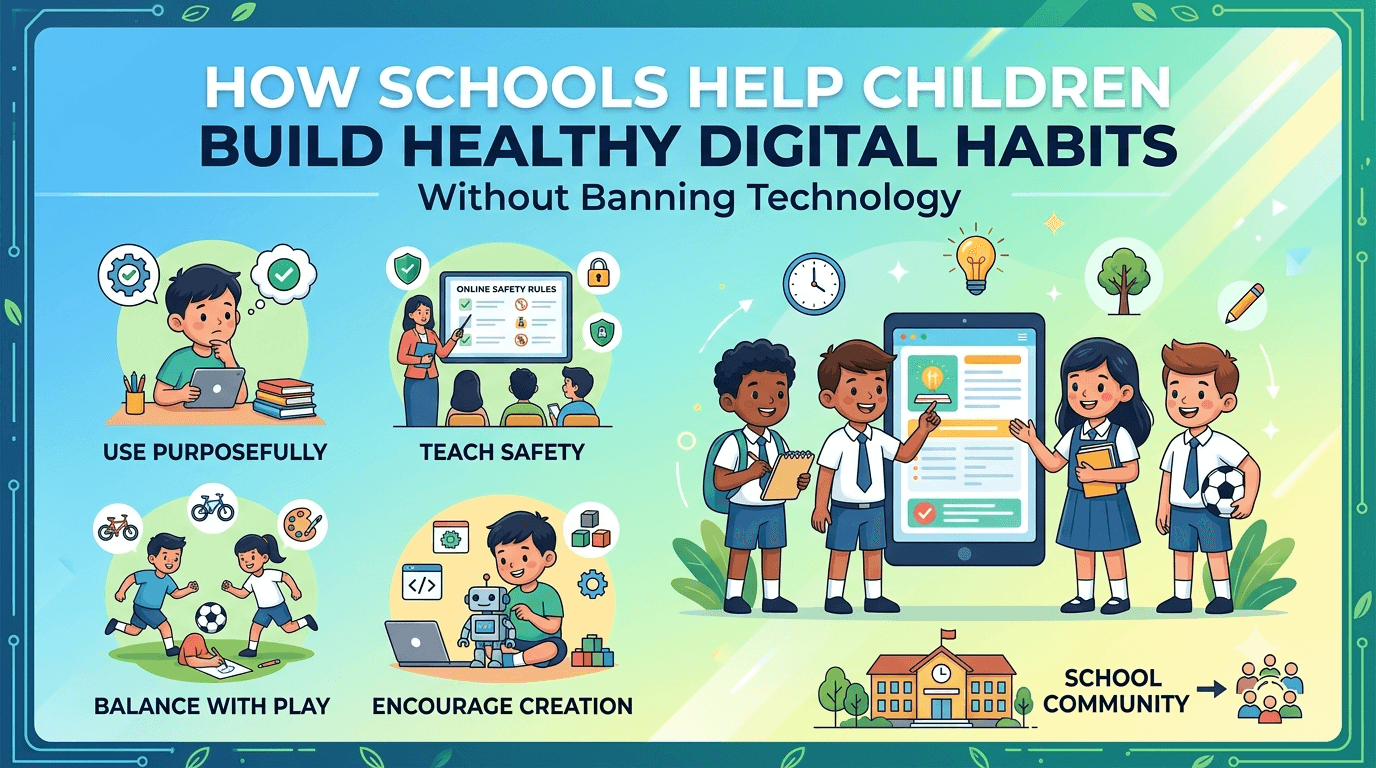
5 Ways Schools Can Encourage Healthy Digital Habits
1. Teach Children to Use Technology With a Purpose
Children should understand that technology is a tool, not simply a source of entertainment.
Schools can encourage students to use digital resources for research, presentations, coding, creative projects, collaboration,n and problem-solving. Teachers can also ask students to explain why a particular digital tool is useful for an activity.
This simple habit encourages children to think before opening an app or website: What am I trying to accomplish?
2. Make Online Safety Part of Everyday Learning
Knowing how to operate a computer is not the same as knowing how to stay safe online.
Children need age-appropriate guidance about:
- Keeping passwords and personal information private
- Identifying suspicious links and messages
- Communicating respectfully online
- Understanding cyberbullying
- Checking whether online information is reliable
- Knowing when to seek help from a trusted adult
UNICEF recommends strengthening children's digital literacy and online-safety skills and highlights risks such as cyberbullying, harmful content, and privacy concerns.
Schools can make these lessons more meaningful by discussing realistic situations instead of teaching online safety only as a list of rules.
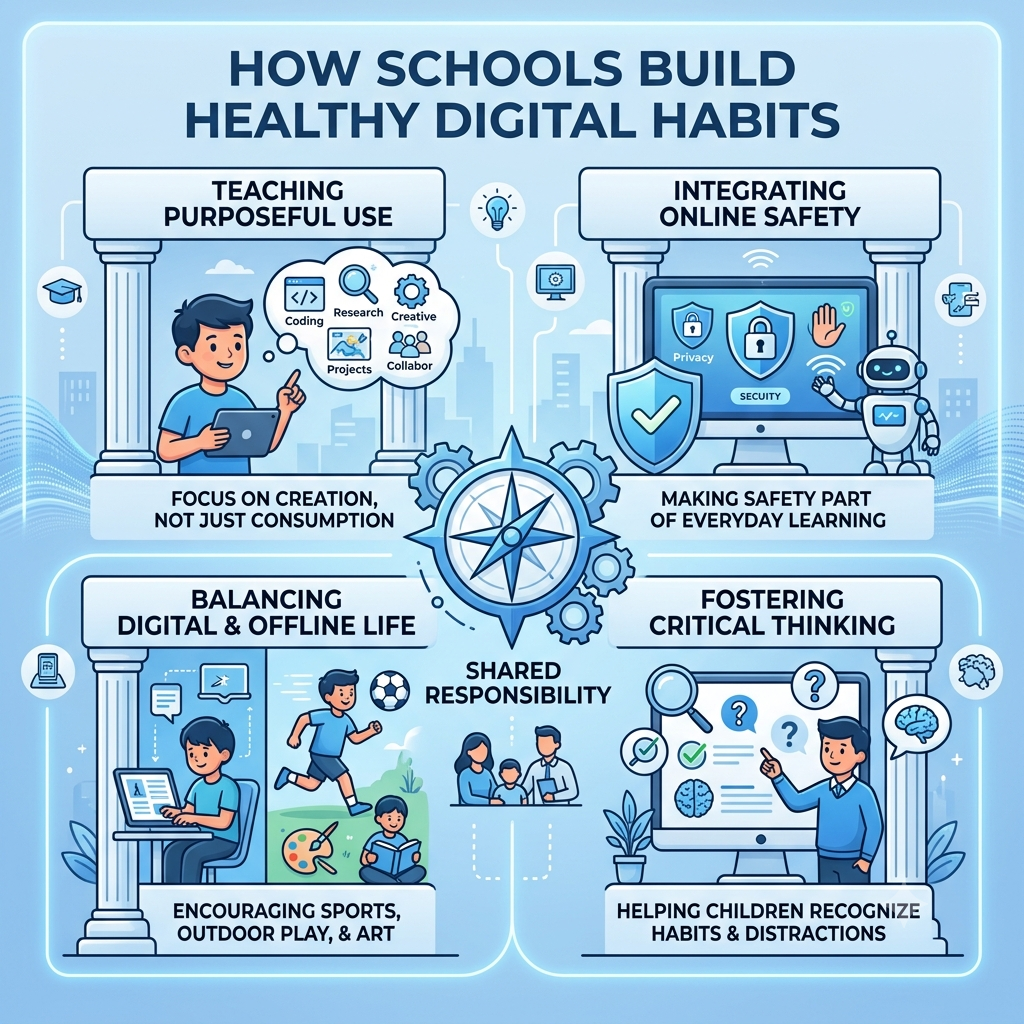
3. Balance Digital Learning With Offline Experiences
A healthy digital environment should still leave room for books, sports, art, music, outdoor play,y and face-to-face conversations.
For example, a science lesson might use a digital simulation to introduce a concept and then move to a hands-on experiment. A language activity could combine digital research with discussion and writing. A creative project could use technology for design while still involving physical materials.
UNICEF's 2025–2030 digital-education strategy specifically calls for technology to enhance, rather than replace, activities such as physical activity, unstructured play and in-person social interaction.
4. Help Children Recognise Their Own Digital Habits
Children also need to learn how to notice when technology is becoming a distraction.
Schools can encourage simple questions such as:
- Am I using this device for learning or entertainment?
- Is this activity helping me complete my work?
- Have I taken a break after working for a long period?
- Am I giving enough time to sleep, exercise, and conversations with family and friends?
Developing this awareness gradually can help children become more independent in managing technology.
Parents can reinforce the same approach at home by creating predictable routines around homework, entertainment, meals, sleep, and device use.
5. Encourage Children to Create, Not Just Consume
One useful way to change a child's relationship with technology is to move from passive consumption to active creation.
Coding, robotics, digital design, research projects and presentations can make technology a means of building something rather than simply watching something.
This approach can also support skills such as creativity, logical thinking, collaboration and problem-solving. UNICEF similarly highlights technology-enabled approaches that encourage collaborative, creative,e and hands-on learning rather than making the device itself the focus.
Also Read| Discover the Magic of Excursions with GGHS’s Unique Approach
What Should Parents Look for in a School's Technology Approach?
Parents do not necessarily need to ask whether a school uses more or less technology. More useful questions include:
- Does the school have clear rules for responsible technology use?
- Are students taught about online safety and privacy?
- Is technology connected to meaningful learning activities?
- Do children still get opportunities for sports, creative work and face-to-face interaction?
- Are there clear procedures for dealing with cyberbullying or misuse?
- Does the school communicate digital-safety expectations to parents?
A balanced approach recognises that children will encounter technology both inside and outside school. They therefore need guidance that can help them make sensible choices in different situations.
How Gurugram Global Heights School (GGHS) Connects With Responsible Digital Learning
For parents considering a Top school in Gurugram, Gurugram Global Heights School (GGHS) provides a relevant example of structured technology use. The school's stated vision describes a child-centred, technology-enabled environment, while its learning spaces include technology-integrated classrooms, a computer lab for coding, digital design and research, a robotics lab and a library with both books and e-resources.

At the same time, GGHS has a published Cyber Policy covering supervised internet use, social-media access, cyberbullying, privacy-related precautions, and responsible use of IT resources. Its Mobile Policy also regulates mobile phones and smartwatches on school premises to support focus and discipline. These measures show how a Best schools in Gurugram can approach technology through both learning opportunities and clear boundaries, rather than treating digital access as an all-or-nothing issue.
Building Digital Habits Is a Shared Responsibility
Healthy technology habits do not develop through one school rule or one parental restriction. Children learn from the routines and behaviour they see around them.
Schools can teach online safety, provide purposeful digital learning and maintain clear boundaries. Parents can support these lessons by keeping communication open, discussing online experiences and modelling responsible device use at home.
The aim is not to keep children away from technology altogether. It is to help them become thoughtful users who know when technology is useful, when it becomes distracting, and when they need help.
In a world where digital tools are becoming a regular part of education and everyday life, that ability to make responsible choices may be more valuable than simply knowing how to operate a device.
For more information on similar schools, check out this list of the best schools in Gurugram.
 as a preferred source on