






Your child spends an hour studying a science chapter and seems to understand everything. But the next morning, when you ask a simple question, they cannot remember the answer. Frustrated, they say, "I studied this yesterday. Why can't I remember?"
Many parents experience this situation, especially during examination preparation. It can be confusing when children spend time studying but struggle to recall what they have learned.
The solution is not always more study hours. Understanding how memory works and encouraging effective revision habits can make learning more manageable. Parents exploring Salvation Tree School(STS), Tech Zone VII, Greater Noida West, or supporting their children at home can focus on developing these everyday learning skills.
Why Do Children Forget Lessons Even After Studying?
Forgetting is a normal part of learning. Children may understand something during a lesson but find it difficult to remember later.
Several everyday study habits can contribute to this problem.
Reading Without Practising Recall
Reading the same chapter repeatedly can make information feel familiar. However, recognising an answer while looking at a textbook is different from remembering it independently.
For example, a child may recognise the definition of evaporation when reading it but struggle to explain it without looking.
Studying Everything at Once
Some children leave revision until the night before an examination.
Although they may remember information briefly, studying large amounts in one sitting can make long-term recall more difficult.
Distractions and Tiredness
Studying while watching videos, checking notifications or feeling sleepy can make concentration difficult.
Children also need enough rest and opportunities to understand concepts instead of simply memorising words.
Four Simple Ways to Help Children Remember Better
Parents can introduce a few practical techniques without making study time longer or more stressful.
1. Encourage Active Recall
Active recall means trying to remember information without immediately looking at the answer.
After your child finishes reading a short section, ask them to close the textbook and explain what they remember.
For example, after studying the water cycle, ask:
- What happens during evaporation?
- How are clouds formed?
- Why does rain fall?
Let your child answer in their own words. If they forget something, encourage them to check the explanation and try again.
The purpose is to practise remembering rather than testing children under pressure.
2. Spread Revision Across Different Days
Instead of revising an entire chapter repeatedly in one evening, encourage shorter revision sessions over several days.
A simple schedule could look like this:
- Monday: Learn a new topic.
- Tuesday: Review the main points.
- Thursday: Answer a few questions without notes.
- Sunday: Revisit anything that remains confusing.
These days are only examples. Parents can adjust the schedule according to homework, school timings and their child's needs.
Regular revision allows children to revisit information before examinations without depending entirely on last-minute preparation.
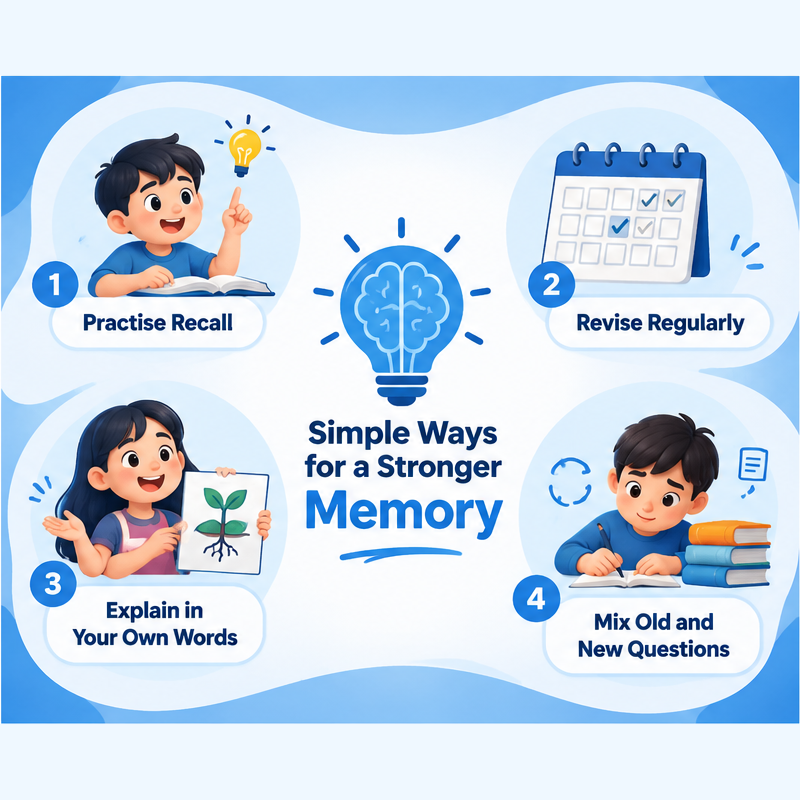
3. Ask Children to Explain Concepts
Children sometimes memorise definitions without fully understanding their meaning.
Encourage them to explain what they have learned as if they were teaching someone younger.
For example, instead of asking your child to repeat the definition of photosynthesis, ask, "Why do plants need sunlight?"
If they struggle, discuss the concept together using simple examples.
Drawing diagrams, giving everyday examples or explaining a process aloud can make revision more engaging.
4. Mix Old and New Questions
Children often practise only the chapter they are currently studying.
Occasionally adding questions from previous lessons can encourage them to remember earlier concepts.
For example, during mathematics practice, include two questions involving fractions alongside exercises on decimals.
Keep the questions suitable for your child's learning level. The goal is to encourage flexible thinking, not create unnecessary difficulty.
How Can Parents Build a Memory-Friendly Study Routine?
Effective study habits do not require a complicated timetable. Small changes in everyday routines can make learning more organised.
Create a comfortable study space. Choose a reasonably quiet place with suitable lighting and fewer distractions.
Keep study sessions manageable. Divide lengthy homework or revision into smaller tasks. Allow short breaks when children become tired.
Protect sleep and rest. Encourage regular sleeping habits rather than keeping children awake late for revision.
Use encouraging language. When your child forgets an answer, avoid saying, "You never remember anything."
Instead, try asking, "Which part do you remember?" or "Should we go through this together?"
Such conversations can make children more comfortable admitting when they need help.
Parents can also include informal revision during daily activities. Asking children to explain something interesting they learned at school may encourage recall without making it feel like another examination.
When Should Parents Pay More Attention to Forgetfulness?
Occasionally forgetting an answer is not unusual. However, if a child consistently struggles to remember instructions, understand familiar concepts or manage everyday learning tasks, parents should explore what might be happening.
Start by speaking with the child's teachers. Ask whether similar difficulties appear in the classroom and whether the child needs additional explanations or learning support.
If the difficulties persist or affect everyday functioning, consider guidance from an appropriately qualified professional.
The aim should be to understand the child's needs rather than assume they are careless or unwilling to study.
Supporting Effective Study Habits at Salvation Tree School, Greater Noida West
Parents searching for a Top School in Greater Noida West or comparing options for the Best School in Greater Noida West may also consider how schools encourage independent learning and healthy study routines. For families exploring Salvation Tree School(STS), Tech Zone VII, Greater Noida West, useful questions include how teachers support children who struggle to remember concepts, how revision is approached and what parents can practise at home. Asking these questions can help families better understand their child's individual learning needs.

Conclusion: Better Memory Habits Begin With Small Changes
Helping children remember lessons is not simply about increasing study hours. It involves giving them opportunities to understand, practise and revisit what they learn.
Start with one small change this week. After your child finishes studying, ask them to close the book and recall three important points.
With patience, regular practice and encouragement, studying can become a more thoughtful and manageable experience.
To know more about other schools in Greater Noida West, click on the link below





 as a preferred source on