








A child today can attend a class on a tablet, watch a science experiment on YouTube, play a game with friends, or search for homework help within minutes. For parents looking at the Top Schools in Greater Noida West, the question is no longer only about classrooms, teachers, and examination results. It is also about how well a school prepares children to use the digital world safely. St. Teresa School is one such school that has recently focused attention on cybersecurity and safety, showing why digital awareness is becoming an important part of a child's education.
Also Read| How School Laboratories Are Changing the Way Children Learn
Why Is Online Safety Becoming a School Issue?
Children do not always understand that the internet is different from the playground. If a stranger speaks to them at the playground, they may immediately feel cautious. Online, however, a person can appear as a friendly classmate, a gamer, or someone with a familiar-looking profile. This makes digital safety less about simply saying “do not talk to strangers” and more about teaching children how to recognise risky situations.
UNICEF points out that children can face risks such as cyberbullying, privacy problems, harmful content and unsafe contact online. It also recommends that digital literacy and online safety skills become part of children's learning.
Consider a simple example. A child receives a message saying, “You have won a new phone. Click here to claim it.” An adult may immediately notice that something feels suspicious, but a child may see it as an exciting opportunity. The important lesson is not simply to delete the message. The child should understand why the message looks suspicious and what to do next.
This is where schools can play an important role. Children spend a large part of their day learning, discussing and practising new skills at school. Digital safety can therefore be taught through real situations instead of being treated as another definition to memorise.
What Should Schools Actually Teach Children About Online Safety?
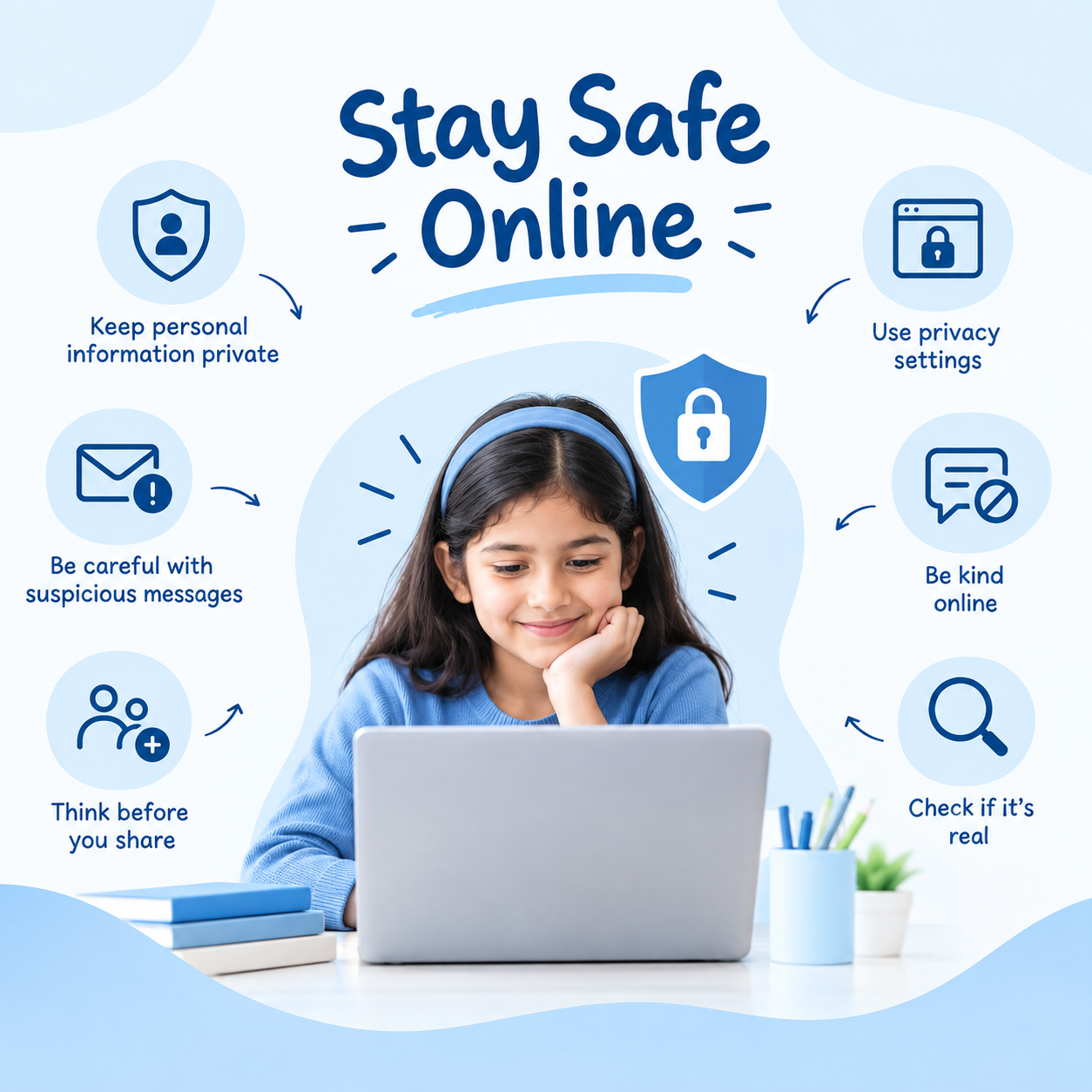
Online safety is much broader than knowing how to create a password. Parents can look for schools that help children understand practical situations such as these:
|
Skill children need |
Everyday example |
|
Protecting personal information |
Not sharing their address, phone number or school details with an unknown person |
|
Recognising suspicious messages |
Questioning an unexpected prize, link or request for information |
|
Understanding digital footprints |
Thinking before posting a photograph or comment |
|
Handling cyberbullying |
Knowing when to save evidence, block/report and approach a trusted adult |
|
Checking online information |
Asking whether a viral claim or video comes from a reliable source |
|
Respecting others online |
Understanding that forwarding an embarrassing photo can hurt another person |
|
Using privacy settings |
Checking who can see posts, photos and profile information |
UNICEF recommends discussing privacy early, establishing family rules, reviewing app permissions and helping children develop critical thinking about online interactions.
There is also an important psychological idea behind this approach: practice makes responses easier to remember. If a teacher discusses a suspicious link only as a definition, a child may forget it. If students are given a simple situation and asked, “What would you do if this appeared on your screen?”, they have an opportunity to practise the decision.
How Can Parents and Schools Work Together?
Schools cannot teach every part of online safety alone. Children's digital lives continue after the school bell, which means parents also have an important role.
A useful approach is to create a “pause before you share” habit at home. Before posting a photograph, forwarding a message or accepting a request, children can ask themselves three questions:
- Do I know who is receiving this?
- Would I be comfortable if a trusted adult saw it?
- Could sharing it reveal something private about me or somebody else?
Parents should also avoid making every conversation about the amount of screen time. The quality of digital behaviour matters too. A child researching a school project, speaking with grandparents, and watching random videos are all “screen time”, but they involve very different activities.
UNICEF also recommends that parents spend time online with children, discuss privacy and model healthy digital behaviour themselves.
For example, if a parent receives a suspicious message, instead of simply saying, “Don't open these things,” they can explain how they checked the sender, avoided the link and deleted the message. This turns an ordinary household moment into a small digital-safety lesson.
Schools can support this further through workshops, classroom discussions, demonstrations, and age-appropriate activities. WHO also notes that children's physical and mental well-being can be affected by digital environments, making safe and healthy online experiences an important part of growing up in a connected world.
Also Read| How the Right School Shapes a Child's Future: Learning Beyond the Classroom
How St. Teresa School Is Bringing Online Safety Into Learning
For parents exploring the Best Schools in Greater Noida West, St. Teresa School, Sector 10, Greater Noida West provides an example of how digital awareness can be connected with school learning.

The school has conducted a Cyber Security & Women Safety Workshop, bringing attention to practical safety awareness rather than leaving the subject only to textbooks. Its learning infrastructure also includes guided lessons in safe and responsible internet use, while its AI & Robotics Lab gives students opportunities to work with modern technologies such as robotic arms, rovers, and sensor-based kits.
This combination is particularly relevant today because learning technology and learning how to use technology responsibly need to go together. A child may learn how a robot works, search for information online, or use a digital learning platform, but also needs to understand privacy, responsible communication, and safe online behaviour.
Conclusion
Online safety is not about keeping children away from technology. It is about helping them understand technology well enough to use it responsibly. Just as schools teach children how to cross a road safely rather than telling them never to leave the house, digital education should help children recognise risks and make sensible choices online.
For parents, this means looking beyond smart classrooms and asking a more useful question: Does the school teach my child how to use the digital world safely, thoughtfully and responsibly? When schools and families work together on this, children can gain the confidence to explore technology while knowing when to pause, question and ask for help.
Want to know more about this and other schools in the nearby area





 as a preferred source on