







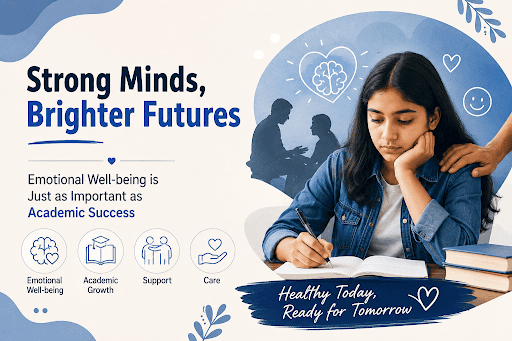

Let me tell you a story of a girl named Rohani. She is the eldest daughter of her family, with one younger brother. She is so bright in her studies and wants to become a doctor one day. But then she came to class 11th, and slowly her marks started falling. The girl who always used to talk and play and study, an all-rounder, suddenly became silent, always studying and staying in her room, not talking to anyone. The NEET exam was conducted, and she failed it miserably. Earlier, she was trying, and that’s why she distanced herself from everyone, but now she is unable to connect with everyone, her old life again. Her parents notice this; her teachers notice this.
Now, if you were in her place, what would you have done? Would you scold her for not passing the exam, or would you ask her to keep studying hard and avoid everything? Because if you were doing all these things, this article is surely for you.
In this article, we will understand how students’ well-being is as important as their academics, or maybe more important than this. And how parents as well as teachers together can do this. We will also use an example of one of the schools in Faridabad, MRIS, to understand how schools nowadays are becoming increasingly aware of this.
Also Read| Sparking an Early Love for Learning at MRIS Sector 21C, Faridabad
Why does emotional well-being matter?
Do you want to know the relationship between emotional well-being, academics, and a child’s career and well-being? Let us take the example of Photosynthesis- which is a biological process by which green plants, algae, and bacteria convert some light, carbon dioxide, and water into chemical energy (glucose) and oxygen.

Now think of a child as a plant: sunlight as academics, water as mental health, and all other factors like oxygen and enzymes as social health, parents' and teachers' guidance.
You should know that even if one of the above is missing, the photosynthesis process cannot happen. Similarly, if any of the emotional, mental, physical, or social parameters is shaken, the whole child's growth is disrupted. In short, emotional wellness is as important as academic growth.
How to Know If Your Child Needs Help?
This is where things become a little difficult for parents because children do not always come and say, “I am stressed” or “I need help.” Especially teenagers. Sometimes you will simply hear, “I'm fine,” followed by a closed bedroom door.
So instead of asking, just observe changes in their behaviour.
Suppose your child was always very talkative but has suddenly become quiet, which is unusual. Or maybe they used to spend time with their friends but have started avoiding everyone. They may also become unusually irritated, have trouble sleeping, lose interest in things they previously enjoyed, or always worry about their marks and future.
Of course, every teenager will have mood swings. One bad day does not automatically mean your child needs help. But if these changes have started affecting their relationship or their studies, sleep, eating habits, or everyday activities, parents should not simply dismiss them as “teenage drama.”
And parents don't always have to wait for the child to explain everything. Sometimes the biggest clue is simply noticing that your child is no longer behaving like themselves.
Also Read| How Toddlers Learn Through Play | Toddlers Curriculum at MRIS Sector 21C Faridabad
How MRIS, Sector 21C, Faridabad, is Helping Students to Manage Not Just Academics, but Also Mental Health
MRIS, Sector 21C, Faridabad, is an example of this broader approach. The school focuses on students' development beyond their academics, with attention to areas such as emotional well-being, counselling, personal development, and creating opportunities for students to express themselves.

And that is exactly why emotional well-being needs to be part of education. We cannot always control whether a child clears an exam, but we can make sure that they have the support to handle whatever result comes their way.
For a student, having access to such support can make a real difference. Suppose a child is struggling with exam pressure but does not know how to talk about it at home. A supportive school environment can give them another safe space where they can express what they are feeling. Similarly, activities beyond textbooks can help students build confidence, interact with others, and discover interests that may otherwise remain unexplored.
At our school, we understand that supporting a child goes beyond academics. We have a dedicated school counsellor and special educator who work closely with our students. They regularly visit classrooms, especially during the settling-in phase, connect with children, understand their needs and help them become comfortable and involved in the school environment.
Our counsellors also conduct age-appropriate sessions on issues that are an important part of growing up—safe and unsafe touch, puberty, inclusion, mindfulness, friendship and how to be a good friend, bullying, and how students perceive themselves and others beyond appearances and labels, etc. These conversations give children the vocabulary and confidence to understand their emotions, respect differences and seek help when they need it.
Importantly, this support is not limited to students. Our counsellors also work with teachers and help them understand the changing needs of today's generation of learners—how children communicate, what they may be experiencing, how to recognise behavioural or emotional changes, and how to respond with sensitivity rather than judgement. In many ways, this creates a stronger support system around the child, where teachers, counsellors, special educators and parents can work together.
Conclusion
Going back to Rohani's story, imagine if the people around her had noticed her changes earlier. Maybe her teacher could have asked why the once-talkative student had suddenly become so quiet. Maybe her parents could have had a conversation with her before the NEET result. Maybe she could have had access to someone she felt comfortable talking to.
We cannot know whether that would have changed her result. But perhaps it could have changed how she experienced that result.
And that, perhaps, is where schools have an important role to play—not in guaranteeing that every child will never struggle, but in ensuring that no child has to struggle alone.
For more information on this and similar other schools, check out this list of the best schools in Faridabad.


 as a preferred source on