








The first month at a boarding school can be exciting, but it can also be surprisingly difficult. A child may be happy during the admission process, enjoy the campus visit, and even look forward to meeting new friends. Then, a week after moving in, the phone call comes:
“I want to come home.” It is easy to assume that the child has made the wrong choice. But often, that is not what is happening.
For many children, the first few weeks are simply an adjustment period. They are learning to sleep in a new place, follow a different routine, share spaces with other students, and manage parts of their day without their parents around.
That is why the first month needs care, patience, and the right support from both the school and the family. We will take an example of one of the boarding schools in India, MVM School, and understand how this school is helping students make this transition smooth.
Also Read| From Karate to Coding: How MVM School Devanahalli is Redefining All-Round Education
Why Do Children Find the First Month Difficult?
There isn't one universal reason. Sometimes it is homesickness, while sometimes it is difficulty making friends. A child may also struggle with food, a new timetable, academic pressure, or simply the feeling of having less control over their day.
Some common challenges include:
|
What changes after joining boarding school? |
What a child may feel |
|
Living away from family |
Homesick or lonely |
|
New classmates and roommates |
Shy or socially uncomfortable |
|
Fixed daily routine |
Restricted or overwhelmed |
|
Different food |
Missing familiar meals |
|
New academic environment |
Worried about keeping up |
|
Shared rooms and facilities |
Missing privacy |
|
Less parental involvement |
Unsure about handling problems alone |
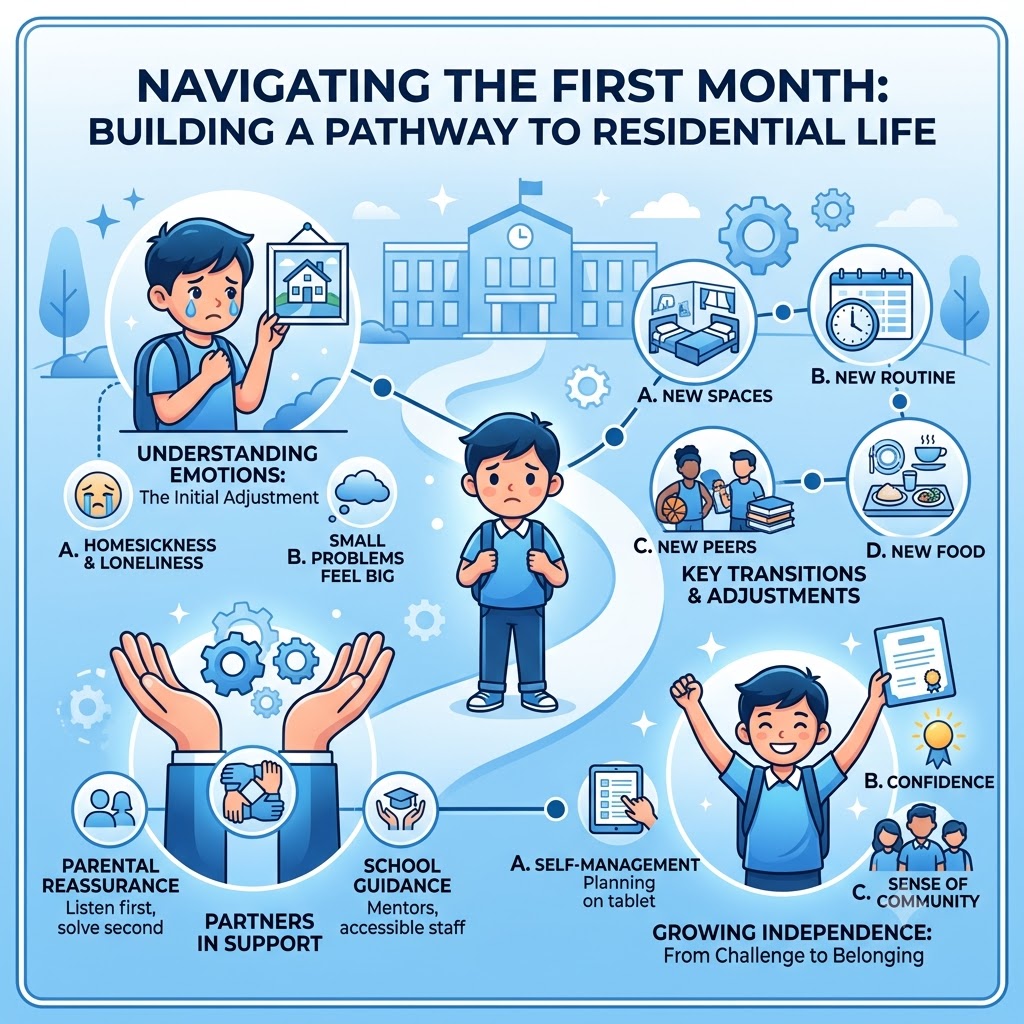
A small problem can also feel much bigger when everything else around the child is new. A student who normally talks to a parent about a difficult day may suddenly have to figure out whom to approach at school. That is where a boarding school's support system becomes important.
Homesickness Doesn't Mean the School Is Wrong
This is one of the first things parents need to understand. A child can genuinely like their school and still miss home. They may enjoy their classes, make friends and participate in activities, yet feel emotional when they see another student talking to their parents.
The first few evenings can be particularly difficult because the day's distractions are over. Parents can prepare children for this before admission by talking about what boarding life will actually look like. Visiting the campus beforehand, discussing the daily routine, and allowing children to ask questions can make the move feel less sudden.
And when the first emotional phone call comes, parents don't necessarily have to immediately arrange a trip home. Instead of saying, “Do you want us to come and get you?”, try asking:
- What was difficult today?
- Did anything make you feel better?
- Did you speak to your roommate or teacher?
- What part of the day did you enjoy?
- Is there something you want us to discuss with your school?
The idea is to listen first, solve second.
Friendships Can Make the Biggest Difference
Think about the difference between arriving at a new place where you know nobody and arriving somewhere where one person already knows your name. That one connection can change the entire experience.
This is why boarding schools need to create opportunities for students to interact outside academics. Sports, music, debates, art, clubs, excursions and group activities give children something to do together. They also make it easier for quieter students to find their place.
For example, a student who finds it difficult to walk up to a group and start talking may feel much more comfortable when everyone is working together on a cricket team, preparing for a quiz or rehearsing for a performance. Sometimes belonging begins with participation.
A New Routine Can Take Time
At home, routines often happen almost automatically. Someone reminds the child to wake up. Breakfast is ready. A parent may check whether homework is complete. The evening has familiar rhythms.
Boarding changes that. Students need to learn when to study, when to relax, when to get ready for the next day, and how to manage their belongings.
This is actually one of the potential strengths of boarding education—but it should be introduced with guidance. During the initial weeks, schools can help students understand routines gradually rather than expecting them to know everything immediately.
Simple things matter:
- Knowing whom to approach when they need help
- Understanding meal and study timings
- Getting comfortable with their room and surroundings
- Having access to academic support
- Knowing the rules and expectations
- Having opportunities to ask questions
Independence grows when children are given support while learning to manage things themselves.
Parents and Schools Have to Work Together
A boarding school cannot tackle homesickness alone, and parents cannot understand everything happening on campus from a phone call. Regular communication between both sides is therefore important. If a child suddenly becomes withdrawn, stops participating in activities, or repeatedly asks to go home, the school should notice the change.
Similarly, parents should share relevant information with the school. If a child is particularly anxious about food, friendships, sleep, or academics, knowing this can help staff respond more appropriately.
A good approach is not to wait until the problem becomes serious. Small concerns are easier to handle than accumulated ones.
What Should a Boarding School Provide During the Transition?
The first month should not be treated simply as another academic month. Students are also learning how to become part of a new community. A supportive boarding environment should ideally provide:
- Accessible teachers, wardens, or residential staff
- Academic guidance when students struggle
- Opportunities to participate in activities
- A safe and comfortable residential environment
- Healthy meals and suitable dining arrangements
- Time for recreation and social interaction
- Clear communication with parents
- Encouragement to become independent gradually
The purpose is not to make boarding life completely problem-free. It is to ensure that when a child faces a problem, there is someone available to help them work through it.
Also Read|From Foundational Learning to Future Innovation: The MVM School Journey
How MVM School, Doddaballapura Supports Residential Life
For parents exploring boarding options around Bangalore, MVM School, Doddaballapura is one school worth looking at in this context. This is among on of the boarding schools in India that offers
The school's residential approach places importance on creating a “home away from home” environment. Its residential facilities include supervised study spaces, resident tutors, indoor and outdoor sports, co-curricular activities, excursions and a school mess designed around students' dietary needs.

These elements are particularly relevant during the early months of boarding.
A student may have a difficult afternoon but enjoy an evening sports session. Another may struggle academically but feel more comfortable after receiving support during supervised study time. Someone who is homesick may gradually feel more settled after developing friendships through activities.
This is why life outside the classroom matters in a boarding school. MVM's approach also draws on a residential model in which teachers provide parental care, and students are encouraged to live together as an extended community. The school describes its residential environment in terms of harmony, supervision and constructive engagement.
The Goal Is Not to Make Children Stop Missing Home
That would be unrealistic. The goal is to help them develop a second sense of belonging. The first month may involve tears, awkward conversations, homesickness and plenty of “I want to go home.” For some children, the adjustment may happen within days. For others, it may take considerably longer.
What makes the difference is how adults respond.
When parents remain reassuring without dismissing genuine concerns, and schools provide pastoral support, structured routines, friendships, activities and academic guidance, children get the chance to gradually become comfortable in their new environment.
And that is one of the most valuable parts of boarding education itself. Children don't just learn to live away from home. They learn to manage themselves, build relationships, ask for help, and slowly become more independent.
For families considering a boarding school in the Doddaballapura/Bangalore region, MVM School - Doddaballapura can be considered for its residential setup and its focus on combining academics with supervised study, sports, co-curricular activities, and a supportive campus community.
Want to know more about this boarding school and others in India

 as a preferred source on