








You know that daydream almost every kid has had at some point? Standing on a stage, cameras rolling, being someone completely different for a bit. Now try bringing up drama club to most Indian parents. You already know what's coming: "Isn't this just going to eat into study time?" And look, it's a fair worry to have. But it's also just... wrong. Theatre isn't time taken away from learning. For a lot of kids, it's where the real learning actually starts.
Oscar Wilde put it perfectly when he said,
"I regard the theatre as the greatest of all art forms, the most immediate way in which a human being can share with another the sense of what it is to be a human being."
That's exactly why drama and filmmaking shouldn't be treated as "extra" activities in school; they build confidence, empathy, and expression in ways textbooks simply can't.
So let's talk about that old myth, the one where theatre gets written off as a time-pass. It isn't, and by the end of this, you'll see why every student should experience it at least once in their school life. Some lessons only really sink in when you live them out on stage, not read off a page.
Many schools in Noida have understood the real value theatre, drama, and filmmaking add to a student's life. That's why schools like Ramagya School are actively integrating it into the curriculum itself, not just as annual day prep, but as a genuine part of how students learn. So, it’s time to pause the yapping and get straight to the point!
Also Read: How MindBox at Ramagya School is Turning Students into Future Innovators
Theatre, Drama & Filmmaking: What's the Difference?
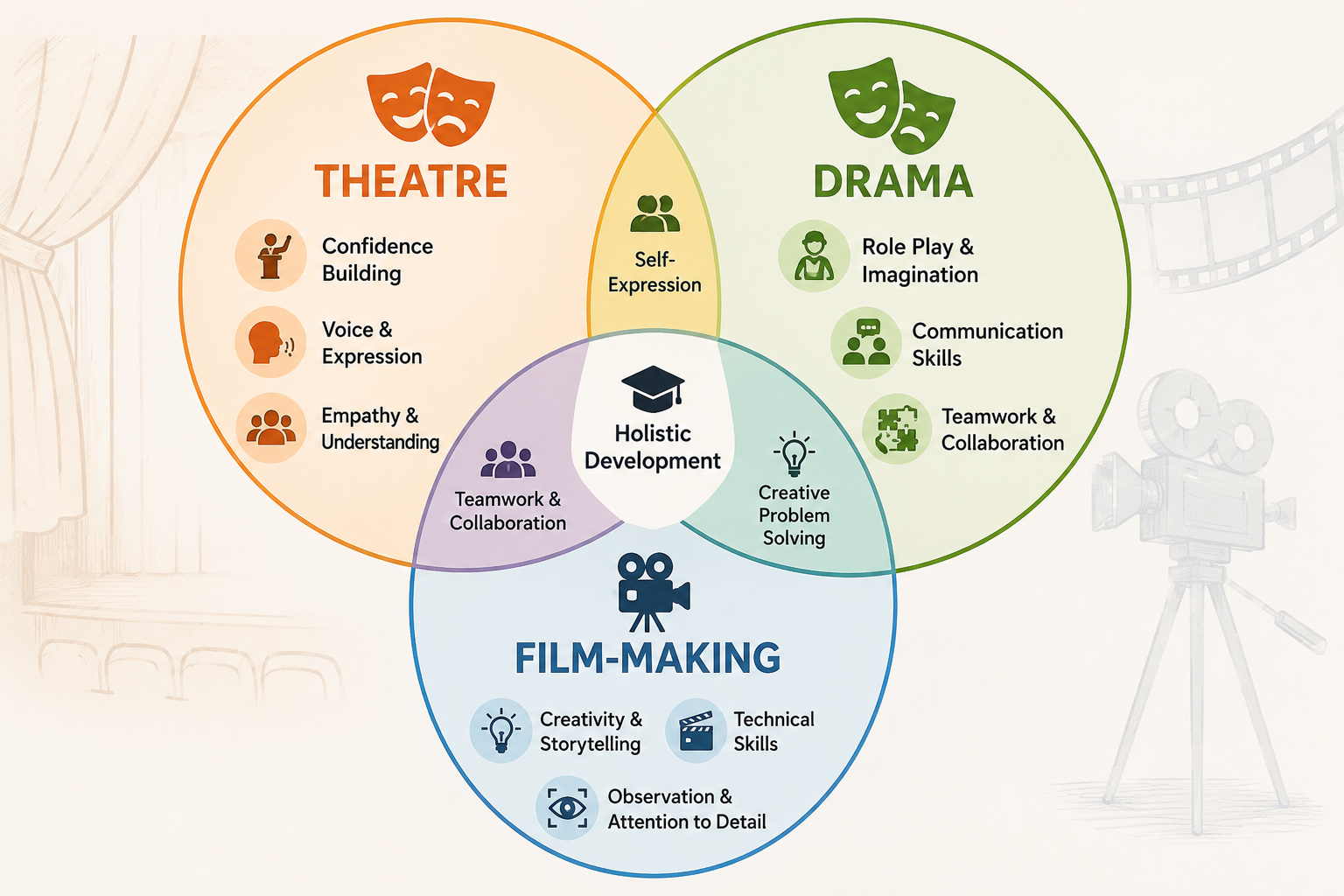
Before we get into why these things matter, let's clear up something people mix up a lot. Theatre, drama, and filmmaking get lumped together as "the same thing" all the time, but they're actually three different skills that just happen to overlap.
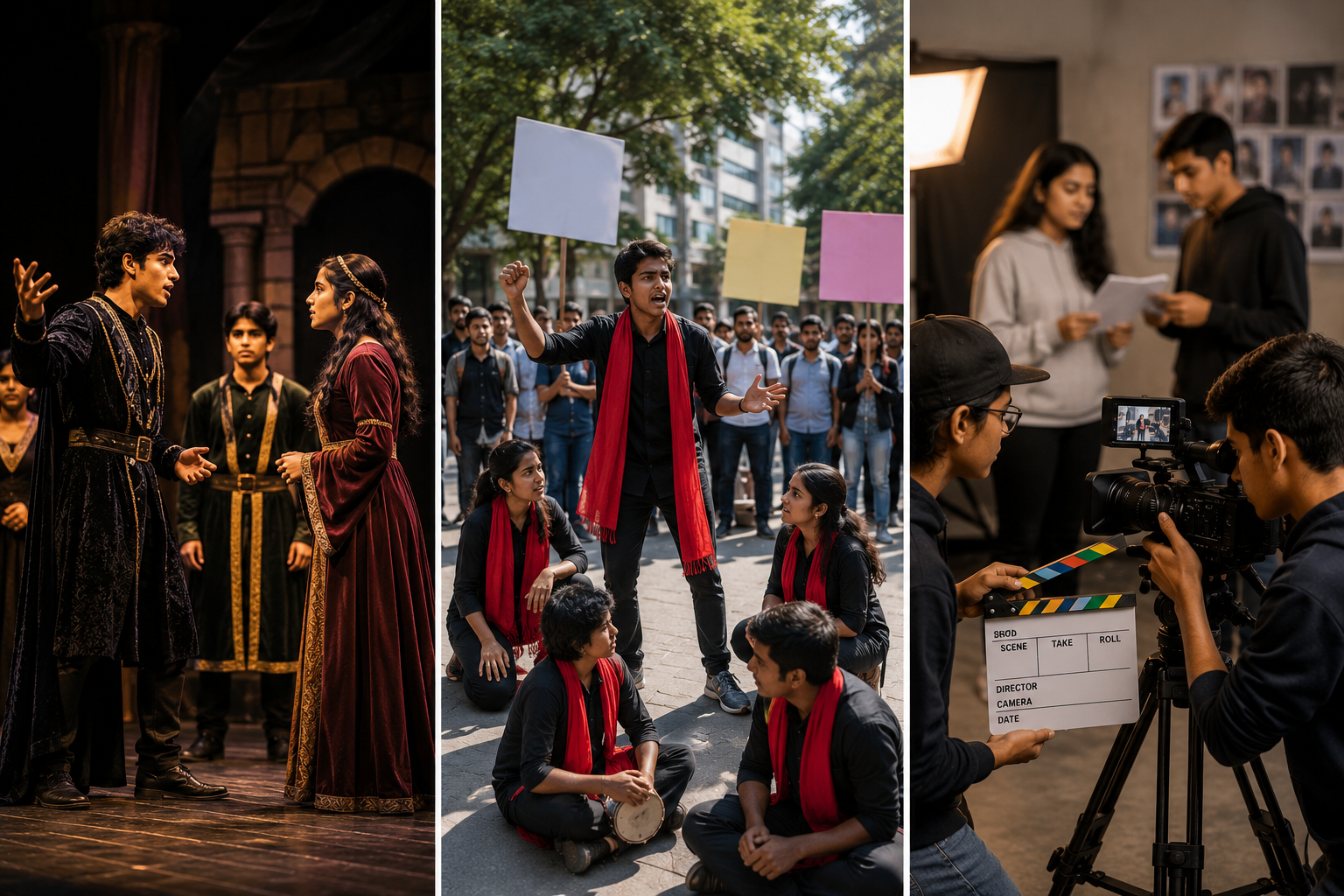
Theatre
Theatre is live. There's an actual audience sitting in front of you, and you have to perform right then and there, no retakes, no cuts, no second chances.
- Students usually write the storyline of the play themselves, working out characters, dialogue, and how the story unfolds
- Then comes the acting, bringing all of that to life on stage
- And behind it all, there's a whole backstage operation running: lighting, sound, stage setup, the stuff audiences never really notice but that holds the whole thing together
There's also this idea called the fourth wall, an invisible wall between the actor and everyone watching. Actors act like that wall is real, so they stay in character and react only to the scene, not to the crowd.
Drama
Drama's a bit different from theatre; it's less about putting on a final show and more about the process itself. You don't even need a stage for it.
- Role-play, stepping into someone else's shoes, a historical figure, a made-up character, whatever the scene calls for
- Improvisation, building a scene on the spot with no script to fall back on
- Mimicry, copying how someone talks or moves, kids doing impressions of a teacher or a public figure
- Character work, really getting into how someone thinks so their reactions feel believable
A drama exercise can happen anywhere, even just in a classroom, kids working through a scene or trying on someone else's perspective for a few minutes.
Filmmaking
Filmmaking's where the camera comes in, and the story gets built after the fact instead of happening live.
- Scripting again, writing the story and dialogue, though shaped around what the camera needs to capture
- Shooting, the actual filming, camera angles, framing, multiple takes when something doesn't land right
- Directing, guiding actors and deciding how a scene should look and feel
- Editing, once the footage exists, cutting it down and piecing it into an actual story
- Sound and post-production, adding music, effects, fixing up whatever needs fixing before it's done
The big difference from theatre is there's no "one shot only" pressure. Everything gets recorded, cut, reshaped, and pieced together until it turns into something polished.
Real Benefits of Theatre, Drama & Filmmaking Learning in School
Here's the thing people miss when they write off drama and theatre as "just extracurricular." These activities are building two completely different skill sets at once: the kind that shapes how a student carries themselves in a room, and the kind that actually shows up on a resume later.
Soft Skills Students Pick Up
- Confidence: Performing in front of people even when you're nervous builds a kind that's hard to teach any other way
- Better communication: Tone, body language, eye contact, all of it gets sharpened with every scene
- Real empathy: Figuring out why a character thinks and feels a certain way, even when it's nothing like your own personality
- Teamwork: A play or film needs a whole team, so relying on others becomes second nature without anyone "teaching" it
- A safe way to express emotions: Some kids find it easier to say things through a character than directly
- Handling failure: Forgetting a line or messing up a scene happens to everyone, and learning to recover on the spot builds real resilience
Technical Skills Students Pick Up
- Scripting and writing: Working out structure and dialogue, building a story from scratch
- Stagecraft: Lighting, sound, set design, understanding what actually goes into a live production
- Camera and editing skills: Especially for filmmaking, shooting, framing, post-production, all genuinely useful in a digital-first world
- Planning and leadership: Managing a scene or a shoot teaches this in a very hands-on way
- Public speaking: projecting your voice on stage translates straight into presenting in a classroom or boardroom later
So the next time somebody says, "Oh, you're doing theatre? Isn't that just a waste of time?", this is your answer. Show them this list.
Also Read: How Schools Today Help Students Find Their True Passion
How Ramagya School Brings Theatre, Drama & Filmmaking to Life

Talking about why these skills matter is one thing, but it hits different when you see an actual school doing it, not squeezed into one day a year, but built into how kids actually learn.
Ramagya School has this thing called the "Experiment" program, basically hands-on learning instead of just theory in a textbook. Drama, filmmaking, photography, visual and performing arts- all of it's in there, and none of it's treated like a side activity.
Drama specifically is used to work on improvisation, role-play, and actual performance, regularly, not just when there's a show coming up. And honestly, that's what makes it work. Kids doing rehearsals week after week aren't just getting better at acting; something else happens along the way too. They start sitting with emotions that aren't even theirs, trying to figure out why a character would react a certain way, and that kind of stuff sticks with them outside of drama class too. There's a physical side to it as well, standing under lights for hours, running the same scene over and over till it clicks, keeping it together when something goes wrong halfway through. It toughens kids up in a way that's hard to fake.
And none of this happens solo. A scene only works if everyone's actually in sync: actors, the backstage crew, whoever's directing, so teamwork isn't something anyone has to explain to them; it just becomes necessary. Filmmaking gets treated the same way: its own space, alongside photography and performing arts, not lumped in under "arts and crafts" like it's an afterthought.
Which is basically the whole point here. When a school treats theatre, drama, and filmmaking as part of daily learning instead of a once-a-year function, kids don't just show up for it; they actually change because of it, emotionally, mentally, and in how they work with people around them. That's the kind of shift more CBSE schools in Noida need to be making.
For more information about this and other schools in the nearby area











 as a preferred source on