







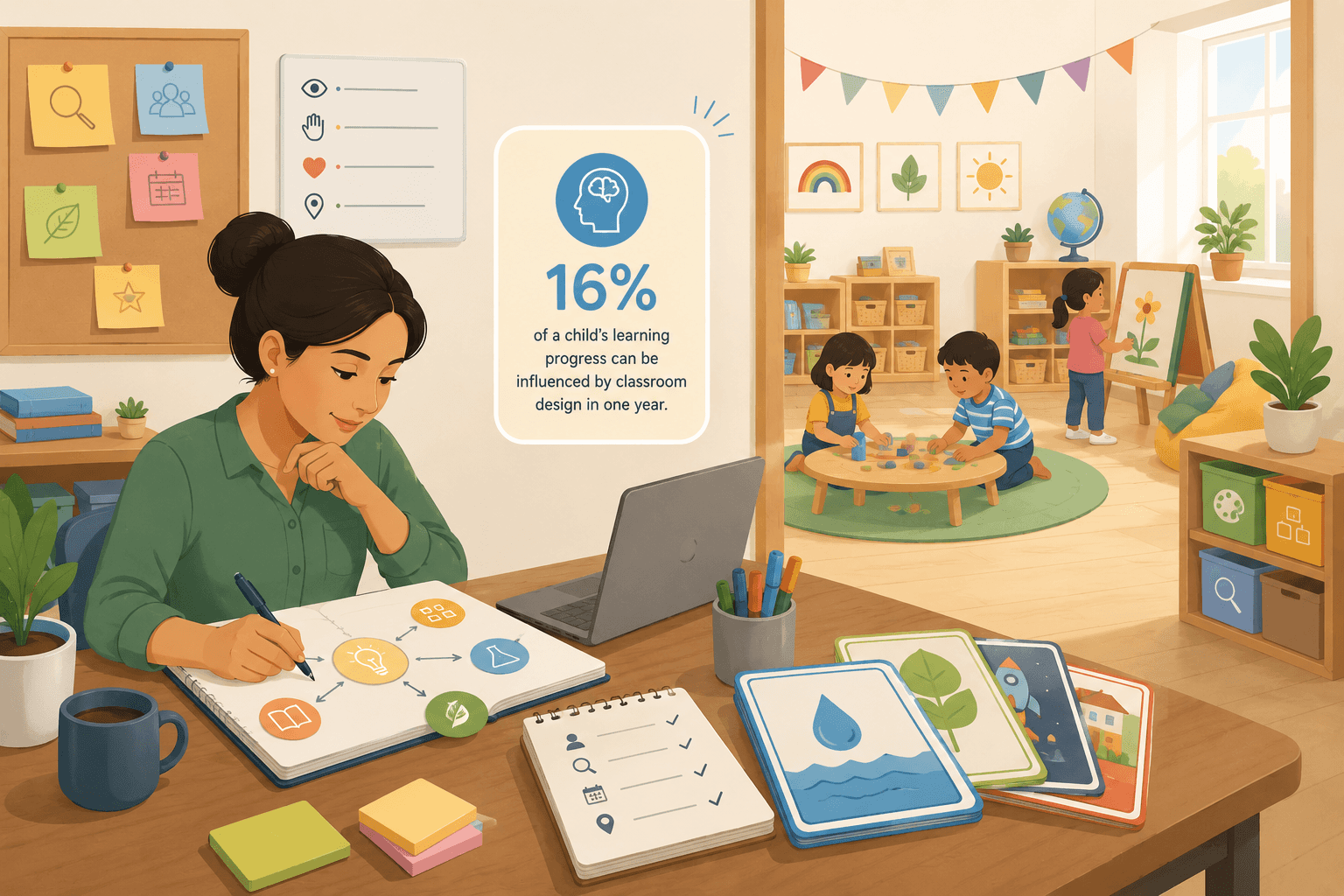

Have you ever walked into a preschool classroom and wondered what makes it feel so engaging? Bright walls, colourful displays, neatly arranged activity corners, and shelves filled with books often create an inviting first impression.
While these elements certainly contribute to the atmosphere, they are only the visible outcome of a much longer planning process. Before your child even walks into the classroom, a teacher has already spent hours deciding what goes on the wall, which subjects get taught together, and what gets quietly left out.
This planning stage stays invisible to most parents. Yet a well-known UK study covering nearly 3,800 primary school pupils found that classroom design alone can explain 16% of a child's learning progress over a single year.
Samurja International School, one of the top schools in Greater Noida, understands this pre-planning phase deeply. The school actively builds theme-based classrooms designed to stimulate young minds naturally. Let us look behind the curtain to see how these engaging environments come to life.
Also Read | Understanding Sensory Play: Why the 7 Senses Matter in Early Childhood
How Teachers Actually Choose a Theme
Choosing a theme always begins with carefully observing the children in their care. Teachers look for common interests among their current classroom batch. They start with a question already sitting in a child's head, like Why does the moon change shape? Where does the sun go at night?
Once a theme makes the shortlist, most trained early years teachers run it through a checklist before committing to it:
- Can children touch, taste or physically explore it, not just hear about it?
- Does it connect naturally to at least three subjects?
- Can it stretch across two to three weeks without repeating the same activity twice?
- Does it fit a season, festival or event already happening around the child that month?
- Is there a real object, person, or place nearby the class can visit or bring in?
Teachers also consider whether a theme offers opportunities for children to relate learning to their own lives. A theme like My Community, for instance, allows children to observe the people around them, recognise different professions, understand shared responsibilities and appreciate the role of public spaces. Since children encounter these experiences every day, classroom discussions become more meaningful, and participation feels natural rather than forced.
Age plays an equally important role in selecting themes. Younger children respond best to ideas they can see, touch and experience directly, whereas older learners are gradually ready to explore broader concepts that require comparison, reasoning and independent thinking. For this reason, an effective theme is never chosen simply because it fits a calendar or a festival. It is selected because it creates opportunities for meaningful conversations, purposeful activities and continuous exploration over several weeks.
Mapping Subjects Around One Idea
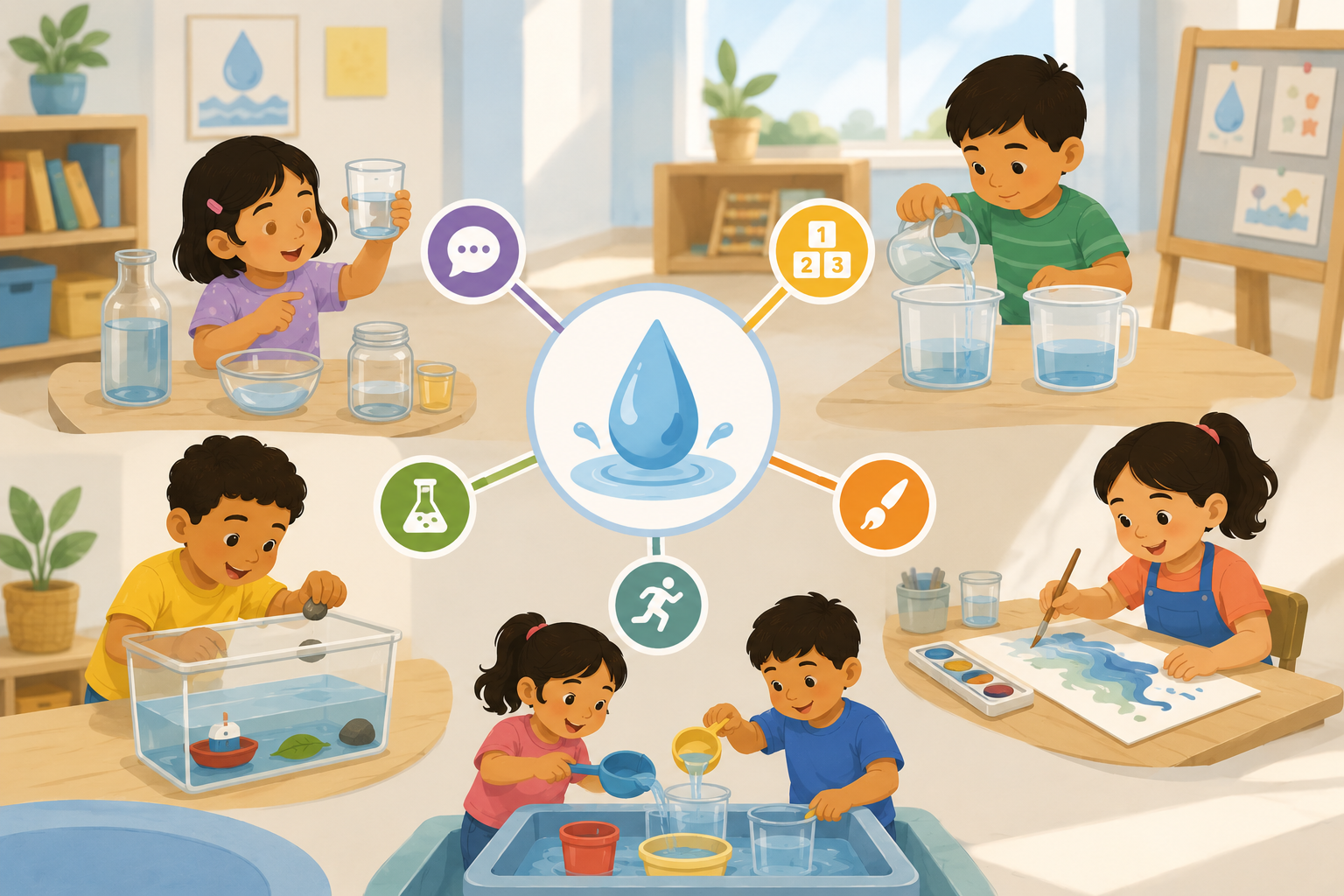
Once a theme is set, the real academic puzzle begins as teachers must integrate all standard subjects into this one central idea. For example, if the theme selected is water, then this is how learning would be planned:
- Language: naming containers, describing textures like wet, damp, dry
- Numeracy: comparing which container holds more or less
- Science: simple sink and float experiments with real objects
- Art: painting with colours that spread, blend and run
- Movement: pouring, scooping and balance games
Although each activity develops a different skill, children experience them as part of one connected learning journey rather than separate classroom periods. They begin noticing relationships between ideas instead of treating every subject as an independent exercise. This approach also gives teachers the flexibility to revisit important concepts in different ways.
Planning Meaningful Activities and Assessments
Assessment is often associated with tests, worksheets and report cards. However, in a well-planned theme-based classroom, assessment is not treated as the final step. Teachers begin thinking about assessment while they are still planning the theme because they first need to decide what meaningful learning will look like. This helps them create activities that naturally allow children to demonstrate their understanding instead of waiting until the end of the unit.
Rather than focusing only on correct answers, teachers observe how children think, communicate and apply what they have learnt in different situations. The teacher might jot down that a child could sort five objects by size but struggled at seven, or that a child used a new word correctly mid-conversation. Or, they can notice a child explaining an idea to a classmate, making an observation during an experiment or asking a thoughtful follow-up question.
These small, specific notes tell a teacher exactly where to adjust the next activity, not just whether a child passed or failed today.
Why the Classroom Itself Is Part of the Lesson
Long before children arrive, someone has already decided what colour the walls will be, where the reading corner sits, and how much open floor space stays free for movement. While this usually seems just like decoration, it is, instead, a way of easing children into theme-based learning.
Colour choice alone gets planned with more thought than most parents realise. Warm tones like yellow and orange tend to raise alertness and energy. Cooler tones like blue, green and soft brown tend to calm a room down. A well-designed theme-based classroom usually mixes both, keeping warm colours near activity corners and cooler tones near reading or rest areas, so the room itself helps steady a child's mood through the day.
Check Out | Explore Theme-Based Learning in the Early Years with MRIS Charmwood
Theme-Based Learning in Samurja International School, Greater Noida
At the heart of this approach is Samurja International School, a co-educational school in Omega II, Greater Noida, established in 2019. The school follows the CBSE curriculum and maintains a student-teacher ratio of 15:1, allowing teachers to give children more personalised attention during classroom interactions. Its vision centres on creating a happy, inspiring and constructive environment where every child is encouraged to reach their full potential.

One of the best CBSE schools in Greater Noida, Samurja takes a very firm stance on effective thematic learning. Administrators actively avoid rigid or overly structured minimalist educational programs. Instead, they champion developmentally appropriate knowledge delivered through highly flexible themes. Teachers at the school design theme-based classrooms utilizing very positive colors. The daily curriculum remains entirely child-centric to foster unhindered creativity.
Samurja International School goes the extra mile for individual student needs. The entire campus maintains a highly hygienic and health-conscious physical environment. Teachers run specialized reading and creative writing readiness programs alongside their themes. The dedicated staff fosters a deeply friendly and caring atmosphere for everyone. This ensures that the transition from home to school remains very smooth.
For more information on this and similar other schools nearby, check out this list of the best schools in Greater Noida.

 as a preferred source on