






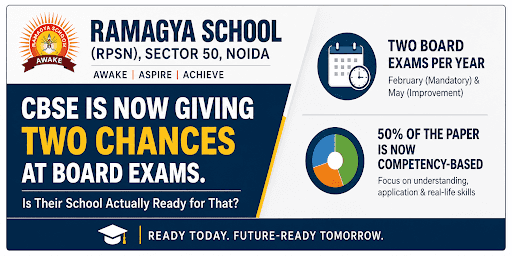

Right now, a lot is happening in India's education system. There are certain mandates that CBSE has made that need to be implemented from this year. One of the most important mandates is the decision that board exams will happen twice a year.
This can be a revolutionary change in India’s education structure, but only if school restructuring is done at the ground level rather than just on paper. And if your kid is in class 9th or 10th, this mandate can heavily impact them. We need to understand how such things are implemented on the ground in schools of Noida, like Ramagya School(RPSN), to get an idea about how parents can select schools while deciding on this particular factor.
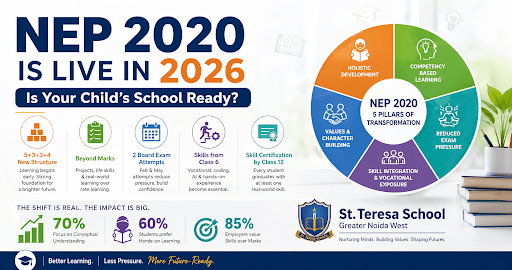
Also Read| India’s NEP 2020 is finally taking full effect in 2026: But do you know how?
What has actually changed, and why is it bigger than most parents realise?
Recently in 2026, CBSE introduced two important changes in the class 10th board structure. These changes are not any other structural level alteration, but are going to shift the fundamental traditional education system.
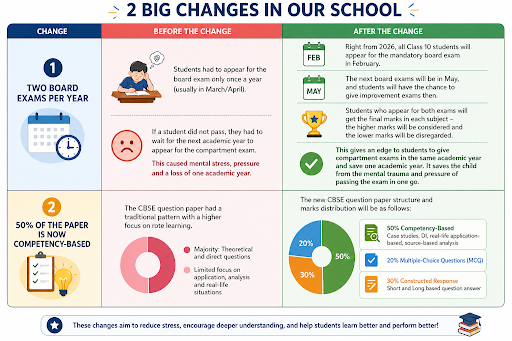
Here are two changes that happened in this school-
- Change 1st: Two Board Exams Per Year
Right from 2026, all the students of class 10th have to appear for the mandatory board exam in the month of February. The next boarding exams will take place in month of May, and students will have the chance to give improvement exams then. Those who will appear for both exams will get the final marks in each subject, that has high marks and less marks will be disregarded.
This gave an edge to students to give compartment exams in the same academic year and save one academic year. This saves the child from the mental trauma and pressure of passing the exam in one go.
- Change 2nd: 50% of the paper is now competency-based
The next change will be in the CBSE question paper structure and marks distribution. It is as follows-
- 50% competency-based questions will be case studies, DI, and real-life application-based source-based analysis.
- 20% of the paper will have multiple-choice questions(MCQ)
- 30% of the will be constructed response- Short and Long based question answer.
In short, half of the exam will carry questions in which rote learning will not help. Children have to build the skills to solve that. As per the 2025 National Achievement Survey, only 37% of class 8th students can apply mathematics to real-life problems. CBSE’s 2026 model can actually help students. This discourages the rote learning model in CBSE, and hence, a transforming change in the education system and the lives of CBSE’s students.
How can these two changes make the students’ lives better?
1st change of board exams twice a year will directly help students to get relief, as they will not just have one chance to clear the exam. Now they can go to take the exam with a free mind. They can study not just for passing that mandatory exam but rather focus on taking that exam with full efficiency without worrying about anything else.
The next change of competency-based paper will lead to discouraging rote learning. They will not just read and learn, but will try to understand the concepts so that they can get 360-degree clarity about the particular topic. If they won’t follow this approach and rely on rote memorization, they might not be able to attempt half of the exam.
But the main question now that arises is, how will students get prepared for these changes? Are they actually getting ready for the changes in their learning environment? Are their schools and tuition classes preparing them? Are they actually going to get improved with these new reforms in CBSE? All these questions can be answered only by asking one question. Understand that students spend half of their time at school, hence you need to ask, “Are schools ready for these changes?”
How to select a school for your kid that can actually help them
If you are looking for a CBSE school for your kid who is in 9th class, make sure you check these things so that their 10th board exam experience becomes better.
- Year-Round Assessment Culture: Schools that have always evaluated students through periodic tests, projects, internal assessments, and class participation — not just pre-board cramming — are structurally aligned with the two-exam model. Their students enter February prepared, not panicked.
- Competency-first Teaching: Classrooms where teachers routinely ask students to interpret data, argue a position, solve an unfamiliar problem, or apply a concept to a real-world scenario produce students who recognise a competency-based question as familiar territory, not a trap.
- Teacher Development with Reform: The new paper pattern requires teachers to write and teach differently. A faculty that regularly attends national and international seminars, engages with updated pedagogical research, and is trained in competency-based assessment can adapt. A faculty that has been teaching the same way for years cannot pivot overnight.
- Student Counselling & Strategic Guidance: The two-exam system introduces a new kind of decision: should my child appear for the May exam? In which subjects? This requires a school with strong academic mentoring — teachers and counsellors who know each student's profile well enough to give meaningful advice, not a blanket answer sent home on a circular.
Also Read| The Best of Three Worlds: A Modern Approach to Early Years Education at Ramgya
How Ramagya School, Sector 50, Noida Was Already There
At Ramagya School — ranked 3rd among Noida's top schools by the Times of India School Survey, listed among Forbes India's Top 30 Great Indian Schools, and featured in Fortune's 'Future 50 Schools Shaping Success' — the 2026 CBSE changes are not a disruption. They are a validation.
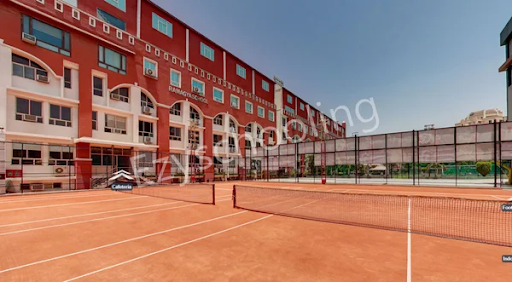
The school's teaching philosophy, built over two decades, rests on exactly what the new system rewards.
Continuous, multi-modal assessment has always been embedded in Ramagya's academic calendar. Students are not evaluated in a single high-stakes window — they are assessed through internal tests, project work, lab work, presentations, and co-scholastic participation throughout the year. The February board exam finds Ramagya students prepared, not startled.
Experiential and inquiry-based learning — through the Atal Tinkering Lab, science and mathematics clubs, hands-on experiments, and project-based learning — has trained students to think across contexts, not just recall within a subject. These are precisely the habits that competency-based questions demand.
Faculty with depth and continuity. Ramagya's teachers average over 15 years of academic experience and regularly participate in national and international seminars and conferences. This is not a teaching staff that needs to be retrained to understand what competency-based education means — it is a staff that has been practising it.
The NIPUNTA programme — Ramagya's exclusive summer internship initiative that places students inside real corporations, hospitals, and law firms — develops exactly the skills the new paper pattern rewards: reading complex situations, extracting relevant information, making reasoned judgements under conditions that have no single right answer. A student who has navigated a real workplace is not intimidated by a case study.
And the proof is not philosophical. Ramagya School achieved a 100% pass rate in CBSE Class X and XII Board Examinations for 2024–25 — results that reflect a teaching culture built for understanding, not last-minute preparation.
This is going to be a big step in India’s Education system that will build the foundational knowledge of the concept rather than rote memorization. Also, this mandate will bring a positive impact on the mental health of the students. So if you are a parent looking for schools in Noida that can help your child to prepare for the 10th board exams in a way that they excel, then schools like Ramagya School, which is fully ready from the base level.
If you have a query regarding this and more such schools in Noida, then
 as a preferred source on