









Reading forms the bedrock of all educational pursuits, serving as the gateway through which children access knowledge across every subject. Research consistently demonstrates that students who develop strong reading skills early in their academic journey are more likely to succeed throughout their educational careers and beyond.
The ability to read fluently and comprehend text effectively impacts performance in mathematics, science, social studies, and virtually every other academic discipline. When children struggle with reading, they often face challenges that extend far beyond language arts classrooms.
Ranked #4 among the best schools in Greater Noida West in the "Best Co-Ed Day School" category, The Millennium School nurtures lifelong learners through a comprehensive, levelled reading program designed to build foundational literacy and critical comprehension skills.
In this article, we explore the critical importance of early reading proficiency, examine essential components of effective reading programs, discuss inclusive teaching strategies, and highlight how The Millennium School's innovative levelled reading programme creates lifelong learners.
Also Read | Empowering Learners Through MLS | The Millennium School's Holistic Educational Approach
Why Early Reading Proficiency Matters More Than Ever

The modern educational landscape demands strong literacy skills more than ever before. Understanding the critical importance of early reading development helps schools create programs that truly make a difference in children's lives.
The Critical Learning Window
Children's brains are most receptive to language acquisition between the ages of five and nine when neural pathways form rapidly. This critical period is ideal for establishing strong reading foundations, as students who miss this window often struggle to catch up later academically.
Cross-Curricular Impact
Strong reading skills influence performance across all subjects, including mathematics, science, and social studies. Fluent readers focus cognitive energy on understanding complex concepts rather than decoding words, gaining significant advantages as academic content becomes more sophisticated in higher grades.
Digital Age Challenges
Technology-driven learning requires students to navigate various text formats and evaluate online information critically. Schools must prepare discerning readers who can analyse and synthesise information from multiple sources while developing strong critical thinking skills for digital literacy success.
Components of an Effective School Reading Program

Successful reading programs share certain essential elements that work together to build comprehensive literacy skills. Understanding these components helps educators create programs that address all aspects of reading development.
Systematic Phonics Instruction
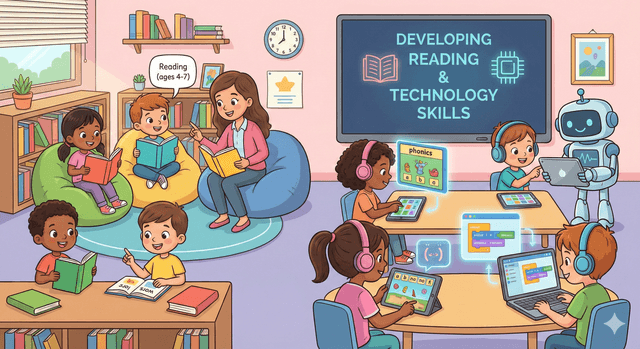
Phonics instruction teaches letter-sound relationships through logical sequence progression from simple to complex patterns. Students begin with basic correspondences before advancing to blends and digraphs, with engaging practice activities providing multiple exposures for automatic application during independent reading.
Comprehensive Vocabulary Development
Strong vocabulary directly correlates with reading comprehension across all subjects. Effective instruction explores word relationships, context clues, and morphological patterns beyond simple definitions. Regular exposure to varied texts combined with explicit instruction creates multiple pathways for word learning.
Fluency Building Through Practice
Reading fluency bridges decoding skills and comprehension by enabling quick, accurate word recognition. Students need extensive practice with appropriately levelled texts and repeated reading of familiar stories to build automaticity and create positive reading associations.
Reading Comprehension Strategies
Comprehension instruction teaches active reading strategies, including predictions, questioning, visualising, and making connections. Programs combine explicit strategy instruction with guided practice, allowing students to observe skilled reading processes before independent application through discussion and reflection.
Creating an Inclusive Reading Environment

Modern classrooms serve students with diverse learning needs, backgrounds, and abilities. Effective reading programs must address this diversity while ensuring that every child receives appropriate support and challenge.
Differentiated Instruction Approaches
Students learn through varied methods requiring multiple instructional approaches. Visual learners benefit from graphic organisers, kinesthetic learners need hands-on activities, and auditory learners thrive with discussions. Flexible grouping allows targeted instruction based on individual needs while avoiding stigma.
Supporting Struggling Readers
Early identification and intervention prevent minor difficulties from becoming major obstacles. Intervention programs must be intensive, explicit, and systematic, with additional practice and clear explanations. Regular progress monitoring guides instructional adjustments based on individual student responses.
Engaging Advanced Readers
Quick skill developers need appropriate challenges through complex texts and in-depth exploration. Independent reading programs allow interest pursuit while developing critical thinking. Extension activities like discussions, writing projects, and research help students apply skills creatively beyond basic requirements.
Assessment and Progress Monitoring

Effective reading programs include robust assessment systems that track student progress and inform instructional decisions. Multiple forms of assessment provide comprehensive pictures of student development.
Formative Assessment Strategies
Daily observations and quick assessments help teachers monitor progress and adjust instruction immediately. Running records, reading inventories, and phonics assessments provide instant feedback. Student self-assessment encourages ownership, while portfolio collections showcase concrete progress evidence over time.
Celebrating Reading Achievements
Recognition programs motivate continued development while building positive literacy associations, focusing on effort and growth rather than achievement levels. Reading logs helps students track progress and develop ownership, while community involvement through family nights creates exciting celebration opportunities.
Check Out | Developing a Love for Reading and LearningThe Millennium School, Greater Noida West: Excellence in Levelled Reading Programme

One of the best CBSE Schools in Greater Noida West, The Millennium School, established in 2018, stands as a CBSE-affiliated school dedicated to creating joyful learning environments. With over 1200 students and 115 committed staff members, the school has earned recognition, including the EW Award for 'School With The Highest Happiness Quotient' and rankings as one of India's most respected education brands.
The school's levelled reading program represents a cornerstone of their educational approach, focusing on building early reading proficiency through structured, age-appropriate progression. This comprehensive system ensures that every child develops strong literacy foundations while fostering a genuine love for reading and discovery.
The program integrates seamlessly with the school's STEAM curriculum, allowing students to apply reading skills across the disciplines of science, technology, engineering, arts, and mathematics. Teachers receive continuous professional development to implement the latest research-based reading instruction methods, ensuring high-quality literacy education for all students.
As part of their NEP 2020-aligned curriculum built on four key pillars - Academic Excellence, Life Skills & Wellbeing, Holistic Beyond Academics, and Sustainability & Global Citizenship - the reading program prepares students to think critically, communicate effectively, and thrive in an ever-evolving global society. Parents consistently report significant improvements in their children's reading abilities and enthusiasm for learning through this structured approach.
For more information on this and other similar schools in the area, check out this list of the best schools in Greater Noida West


 as a preferred source on