




Choosing a CBSE school in Pune involves more than comparing examination results or reputation. Parents must consider teaching quality, academic support, technology exposure, extracurricular activities, total fees and daily commute. Most importantly, they need to understand which school will best support their child's individual needs and interests.
Pune offers a diverse range of CBSE schools, from established institutions to newer campuses that emphasise experiential learning, technology and multidisciplinary activities. For families planning 2027–28 admissions, this guide explains what to compare and highlights schools across the city.
This is not a school ranking. It is a practical starting point for parents making an informed decision.
CBSE Schools in Pune: A Quick Comparison
|
School |
Primary Pune Location |
Areas Parents Can Explore |
|
Kalyani Nagar, Hadapsar, Wagholi |
Experiential learning, coding, communication and financial literacy |
|
|
Multiple locations |
Integrated learning, coding and innovation |
|
|
DAV Public School |
Aundh |
Academics, values and structured learning |
|
Mohammadwadi |
Academics, sports and life skills |
|
|
Hadapsar, Balewadi |
Holistic development and technology |
|
|
Multiple locations |
Academics, activities and school environment |
|
|
Kharadi |
Project-based learning and technology |
|
|
Gokhalenagar, Lohegaon |
Academics, sports and all-round development |
|
|
Hadapsar–Kharadi area |
Innovation, arts, sports and technology |
|
|
Manjari |
Experiential learning and projects |
|
|
Wakad |
Academics and western Pune accessibility |
|
|
Multiple locations |
Technology and skills-based learning |
|
|
Army Public Schools and Kendriya Vidyalayas |
Multiple locations |
Structured education and public-sector school systems |
Locations, curricula, facilities and admission criteria can vary by campus and grade. Confirm details directly with each school.
What Should Parents Look for in a CBSE School?
CBSE provides a common academic framework, but the classroom experience can differ considerably between schools. Teaching methodology, teacher-student interaction, assessments, school culture and extracurricular opportunities all matter.
During a campus visit, ask:
- How much learning happens beyond textbooks?
- How are students assessed apart from examinations?
- What support is available for children who need additional help?
- How are advanced learners challenged?
- Are communication, teamwork and problem-solving actively developed?
- What opportunities are available for sports, arts and leadership?
A school website may describe its programmes, but visiting the campus helps parents understand how students experience them.
Look Beyond Academic Results
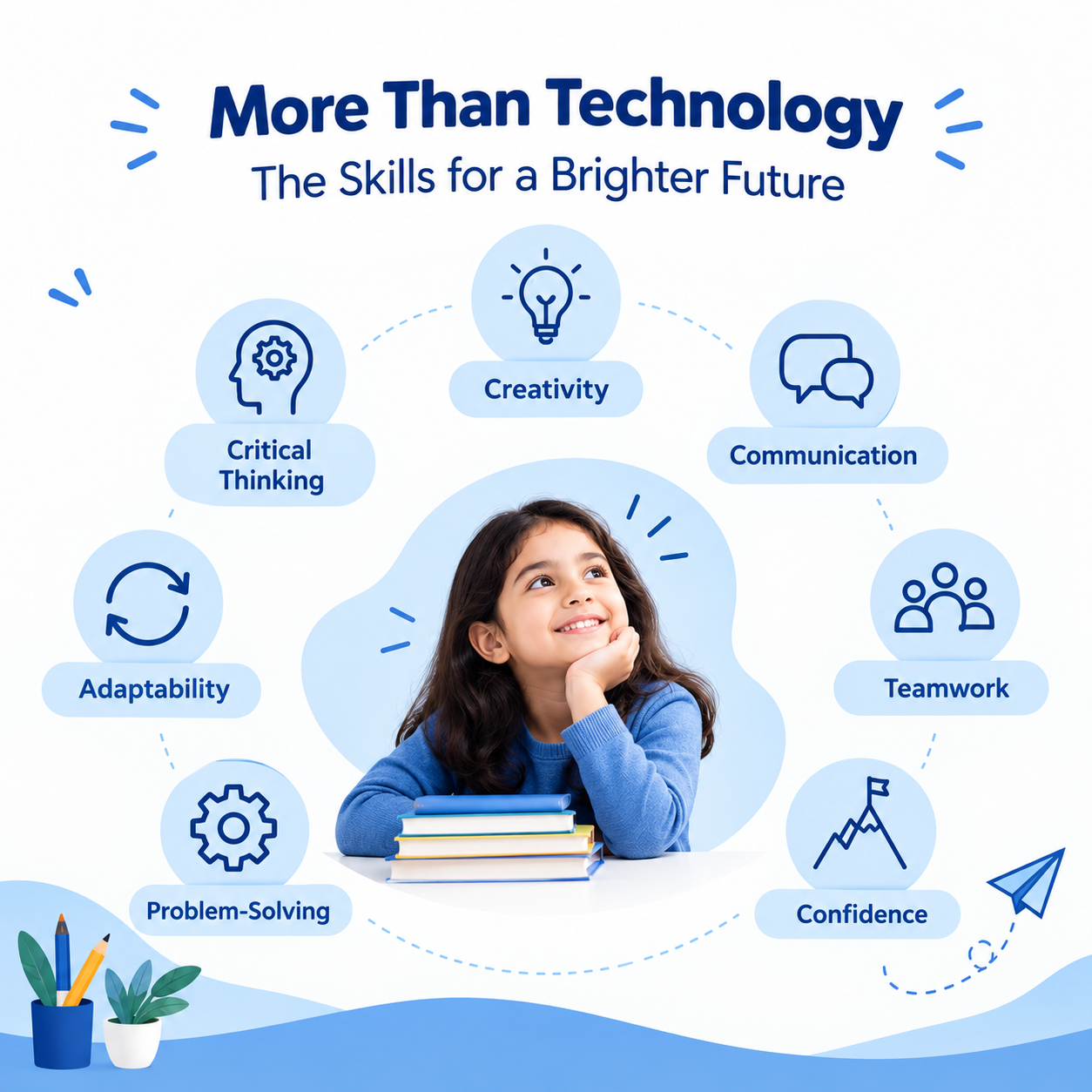
Academic performance is important, but children also need opportunities to develop confidence, communication, creativity and independent thinking.
Projects, experiments, presentations, debates, collaborative assignments and creative activities can help build these skills. Podar International School highlights integrated learning, innovation laboratories, coding and robotics. The Kalyani School describes a child-centred, experiential approach, while Kothari International School emphasises project-based learning and technology integration.
Rather than simply asking whether a school offers extracurricular or experiential learning, parents should ask how frequently students participate and what they actually learn.
Technology, AI and Future-Ready Skills
Technology is increasingly prominent in school education. However, parents should look beyond smart boards and digital classrooms to understand whether students develop practical skills.
Ask how the school teaches coding, digital literacy, computational thinking, research and problem-solving. Find out whether technology is integrated meaningfully into classroom activities.
Lexicon's published teaching approach emphasises inquiry-based, interdisciplinary and experiential learning, alongside communication, problem-solving and information technology. Podar describes programmes involving coding, robotics and innovation laboratories, while Kothari highlights technology integration and its Tinker Lab.
The most useful question is: What will my child actually be able to do with technology after studying here?
Financial Literacy and Life Skills
Education also prepares children to make responsible decisions, communicate effectively and work with others.
Financial literacy, leadership, collaboration and decision-making are valuable skills that extend beyond conventional academic subjects. Lexicon's Money Smart School programme introduces financial-literacy concepts through activities involving saving, budgeting and responsible spending.
Parents should ask whether students receive opportunities to lead projects, speak publicly, collaborate with peers and practise real-world decision-making.
Sports, Arts and Co-Curricular Activities
Sports, music, theatre, dance, art and student clubs can contribute to a child's physical, creative and social development.
Vikhe Patil Memorial School describes an approach that includes intellectual, physical, moral and social development. Amanora School highlights academic, cultural, technological and extracurricular activities.
However, a long list of activities does not guarantee meaningful participation. Ask how much time students spend on sports and the arts, whether activities are accessible to all students, and how children can explore their interests beyond academics.
Location and Daily Commute
Pune's traffic makes location a significant factor when choosing a school. Families in eastern Pune may explore schools around Kharadi, Viman Nagar, Hadapsar, Manjari and Wagholi, while families in western Pune may consider options around Aundh, Baner and Wakad.
Lexicon's campuses in Kalyani Nagar, Hadapsar and Wagholi serve families across parts of eastern Pune. Kothari International School is in Kharadi, The Kalyani School is in Manjari, and DAV Public School is in Aundh.
A long commute can affect sleep, family time and participation in activities. Calculate door-to-door travel time, including school transport, rather than relying only on distance.
Army Public Schools and Kendriya Vidyalayas are additional options, although eligibility and admission requirements may differ from those of private schools.
CBSE School Fees in Pune: What to Compare
Parents searching for CBSE schools in Pune with fees should obtain the latest official fee structure for the relevant campus, grade and academic year. Online figures may be outdated or incomplete.
For 2027–28 admissions, compare the complete annual cost, including:
- Tuition and annual charges
- Transport
- Books and uniforms
- Activities, excursions and sports
- Technology or specialised programme charges
- Applicable one-time fees
Also ask about fee increases, refund policies and additional charges during the academic year. The objective is to understand what the total cost provides in terms of learning, facilities and student support.
Ten Questions to Ask Before Admission
Before choosing a CBSE school, ask:
- What does a typical school day look like?
- How much time is allocated to academics, sports and activities?
- What support is available for different learning needs?
- How are coding, technology and AI introduced?
- What opportunities exist for communication and public speaking?
- How much project-based and experiential learning takes place?
- What is the complete annual cost?
- How long will the daily commute take?
- What subjects and career guidance are available in senior school?
- How does the school build positive student-teacher relationships?
A Parent's CBSE School Checklist
|
Factor |
What to Check |
|
Academics |
Teaching quality and individual support |
|
Learning approach |
Textbook, project-based and experiential learning |
|
Technology |
Coding, digital literacy and AI exposure |
|
Life skills |
Financial literacy, leadership and communication |
|
Sports and arts |
Facilities and actual participation |
|
Student support |
Individual attention and learning assistance |
|
Location |
Daily commute and transport |
|
Fees |
Complete annual cost |
|
Senior school |
Subject choices and career guidance |
|
School culture |
Values, discipline and relationships |
Choosing the Right CBSE School in Pune
Finding the best CBSE schools in Pune is not simply about rankings, ratings or attractive campus photographs. It is about finding the right combination of academics, skills, opportunities, support and everyday learning for your child.

For 2027–28 admissions, shortlist three or four schools, visit their campuses, compare their teaching approaches and understand the total annual cost. Ask the same questions at each school so that your comparison is meaningful.
Most importantly, consider your child's interests, strengths and needs alongside the school's offerings. A child who loves sports may benefit from a different daily environment than one who thrives on technology, creative activities or academic challenges.
Ultimately, the most important question is not simply, “Which is the best CBSE school in Pune?” but “Which school will help my child learn, grow and thrive?”
Start exploring The Lexicon Schools to learn more about their educational approach, campus offerings and admission opportunities for 2027–28.
For more information on this and similar schools, check out this list of the best schools in Pune.
 as a preferred source on