







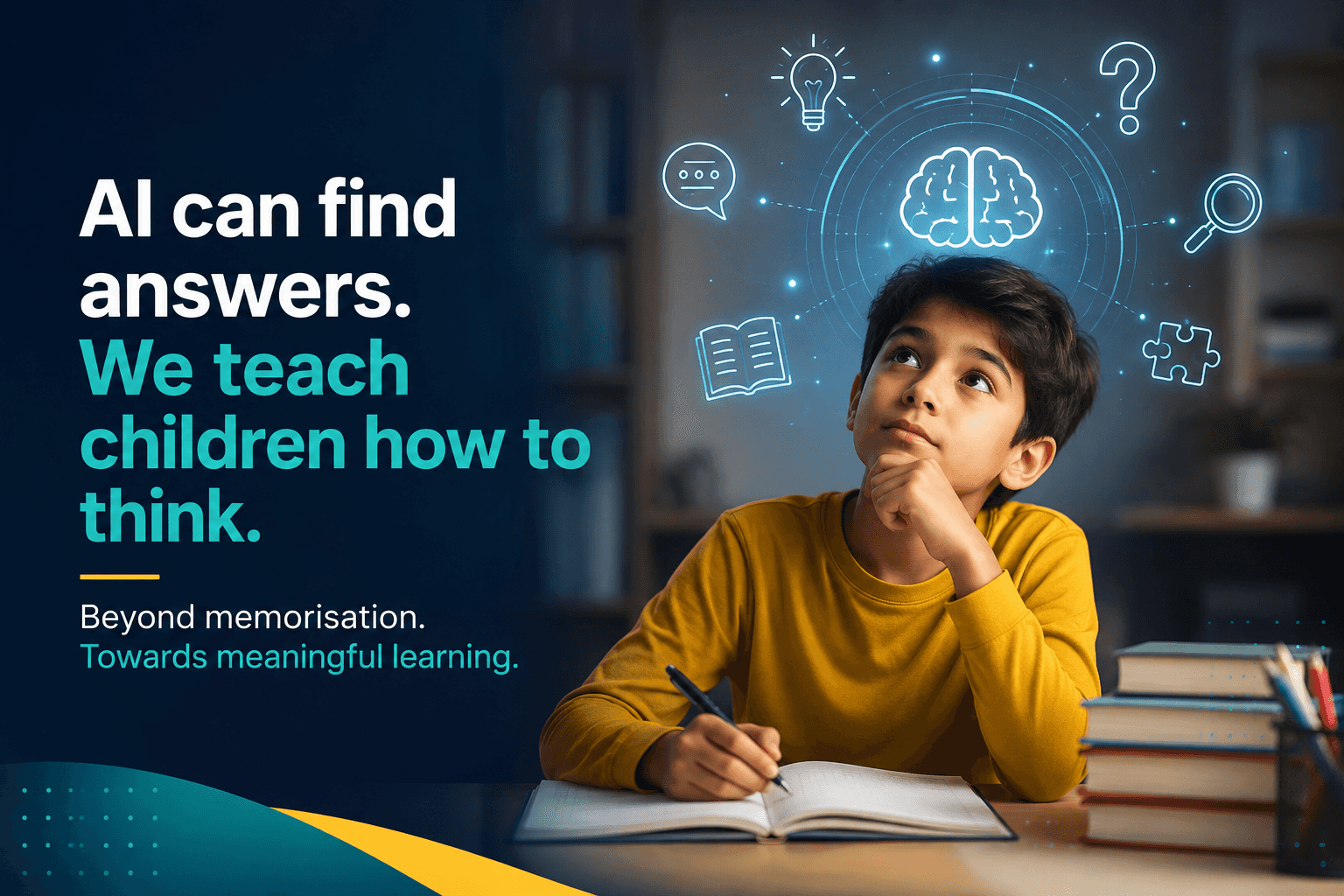

A child has a question about photosynthesis. A few seconds later, an AI tool can explain it, simplify it, create a diagram, and even give examples. A history date, a mathematical formula, the meaning of a difficult word or the definition of a scientific concept can all be found almost instantly. This is changing the traditional model of how children used to remember things. But does that mean memorisation no longer matters?
It is not necessarily important. A child still needs to know multiplication facts, vocabulary, scientific concepts, historical context and the fundamentals of a subject. Without some knowledge in their head, it becomes difficult to make connections or ask meaningful questions. What is changing is the role that memory plays in learning. When information is always within reach, education has to go a step further and teach children what to do with that information. Today, we will understand the depth of this concept by taking one example of one of the top schools in DLF Phase 2, Gurgaon: Vasant Valley School.
Also Read: The Hidden Skills Gap Every Parent Should Know About
AI and the Changing Meaning of Learning
For a long time, knowing something often meant being able to recall it correctly. A student who could remember a definition, explain a concept in an examination, and reproduce the right answer was generally considered to have learned it.
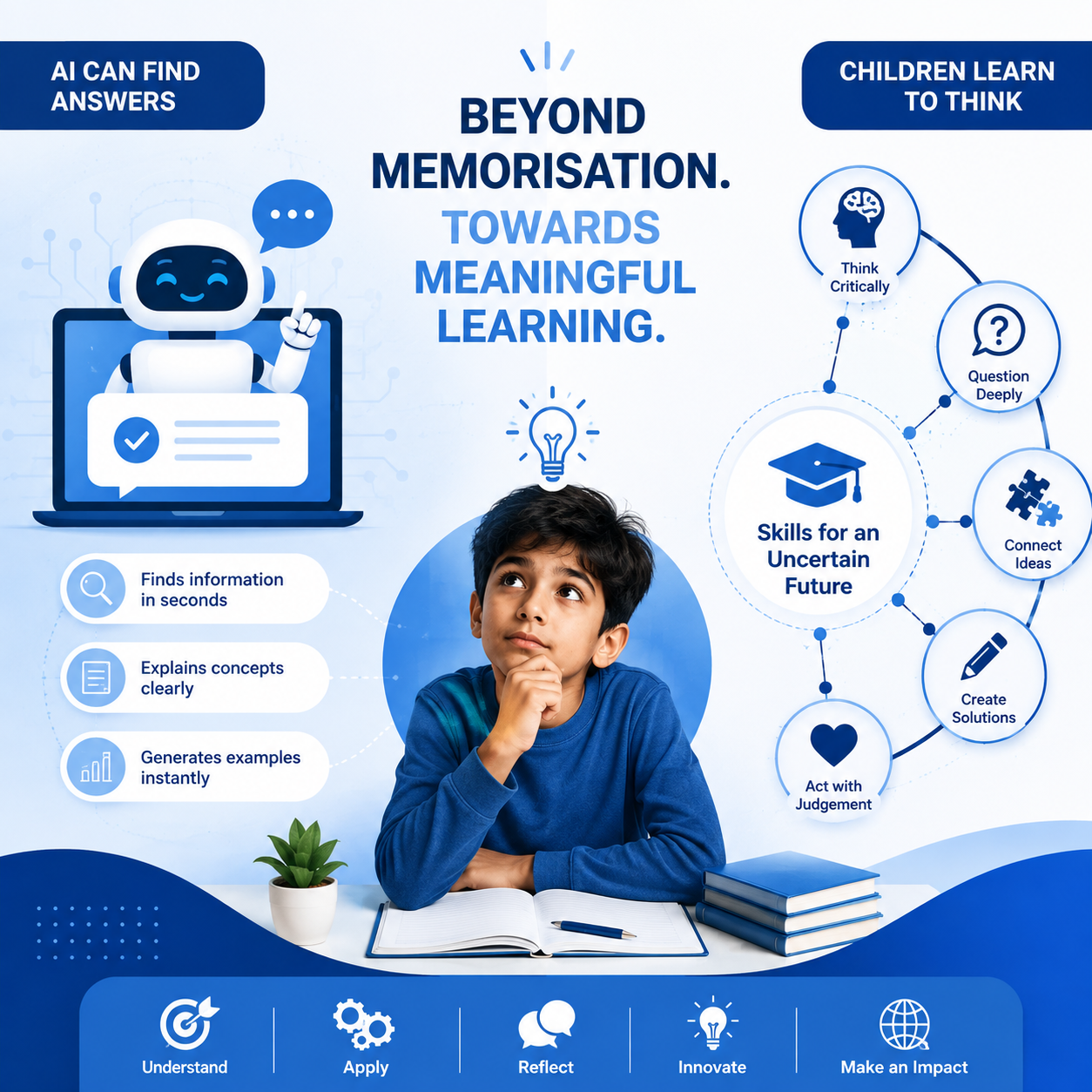
AI makes this distinction a little more complicated. If a child can ask a tool to explain Newton's laws, summarise a chapter or generate ten examples, simply being able to obtain information is no longer a particularly difficult skill. The more important question becomes whether the child understands the information well enough to judge, question and use it.
This is where the difference between knowledge and understanding becomes important. Memorising that plants need sunlight is one thing. Understanding why sunlight matters, observing what happens when growing conditions change, connecting it to photosynthesis and using that knowledge to investigate a real problem is quite another.
The first gives a child an answer. The second gives them a way of thinking.
Why Memorisation Still Has a Place in School
It would be a mistake to assume that an AI-driven future means children now will not remember anything. In fact, basic foundational knowledge can make thinking easier.
A student who has read widely about a subject has more ideas to connect. A child who knows some basic mathematical operations does not have to stop and think and look up every calculation before solving a larger problem. Someone with a strong vocabulary can understand a complicated argument more easily than someone who has to search for the meaning of every other word.
So, perhaps the better question is not “Should children memorise?” but “What is worth remembering?”
Schools can focus on helping students build strong foundations while giving them opportunities to move beyond recall. That might mean asking students to:
- explain an idea in their own words instead of repeating a definition;
- compare two possible explanations and decide which is better supported;
- apply a concept to a situation they have not encountered before;
- question information rather than accepting the first answer they find;
- connect ideas from different subjects;
- create, test and improve something using what they have learned.
The shift is subtle, but important. Memory becomes a foundation for thinking rather than the final destination of learning.
Critical Thinking in the Age of AI
There is another reason thinking skills are becoming increasingly important. AI can produce convincing answers that are incomplete, inaccurate or simply unsuitable for a particular situation. A student who has never been encouraged to question information may accept a fluent answer simply because it sounds confident.
Critical thinking changes that relationship.
Instead of asking only, “What is the answer?”, students learn to ask, “How do we know?”, “What evidence supports this?”, “Could there be another explanation?” and “What might be missing here?”
These questions are useful far beyond AI. They help children read news, evaluate online information, participate in discussions, make decisions and understand different points of view. In other words, the ability to question information is becoming as important as the ability to find it.
Why Learning How to Learn Matters More
One of the biggest changes AI may bring to education is the growing importance of metacognition, or thinking about one's own thinking.
Consider two students preparing for the same examination. One keeps reading the same chapter because it feels familiar. The other notices that they can recognise the information on the page but cannot explain it without looking. They change their study method, practise retrieval, ask questions and identify the areas they still do not understand.
The second student is not necessarily working harder. They are becoming more aware of how they learn.
That ability can stay useful long after a particular chapter, examination or school year is over. Technology will continue to change, information will keep expanding and careers may look very different in the future. A child who knows how to learn, unlearn and learn again is better equipped for that uncertainty.
From Knowing Answers to Solving Problems
The most meaningful learning often begins when there is no obvious answer.
Imagine a class learning about waste. Students could memorise different categories of waste and learn definitions from a textbook. That knowledge matters. But what happens when they are asked to examine the waste generated in their own school, collect information, identify patterns and think about a practical solution?
Suddenly, science connects with mathematics, communication, design and decision-making.
The child is still using knowledge, but knowledge has become a tool rather than a destination. They have to investigate, make choices, deal with incomplete information, listen to other people and perhaps discover that their first idea does not work.
That is the kind of learning that is difficult to reduce to a list of facts.
Also Read: Benefits of Experiential Learning: How Does Vasant Valley School Offer this to students?
How Vasant Valley School Is Preparing Students for an AI-Shaped World
At Vasant Valley School, one of the top CBSE schools in Gurgaon,, this shift is reflected in the way learning is designed. The school's Future Fluent Framework focuses on developing deep knowledge alongside the ability to apply it with judgement and create something meaningful with it. Its approach brings together experiential learning, antifragility and Concept to Creation, rather than treating knowledge and real-world application as separate things.

The school's Thinking Thread brings metacognition, ethical reasoning, adaptability, human judgement and AI literacy across disciplines. Its Adaptive Intelligence programme specifically focuses on helping students understand how they think and learn, including through thinking routines, visible learning and productive struggle.
AI itself is introduced as something students should learn to understand, use and question responsibly. Vasant Valley's AI Literacy programme for Classes 3–12 is aligned with UNESCO's AI competency framework and combines technical understanding with human-centred thinking and ethics.
The school's Concept to Creation model takes the idea further. Students research questions, engage with experts and create responses intended for a real purpose and audience. Its stated 2:1 model gives protected time for applying knowledge through designing, making, presenting and solving, rather than leaving learning at the level of understanding alone.
This also explains why the school's approach does not simply replace books and classrooms with screens. Its own technology philosophy emphasises using technology intentionally while protecting time for reading, writing, discussion, movement, making and human connection.
The Future of School Learning May Be About Both Knowing and Thinking
AI may make it easier to retrieve information, but that does not make knowledge unimportant. If anything, it makes the quality of a child's understanding more significant. Children still need foundations, but they also need the ability to connect those foundations to unfamiliar situations, recognise weak information, ask better questions and make thoughtful decisions.
Perhaps, then, the future of education is not a choice between memorisation and AI. It is about building a better relationship between knowledge and thinking.
A child may not always need to remember every answer. But they should understand enough to recognise a good answer, question a questionable one, and use what they know to find a better solution.
And that may be the more important lesson schools can offer in a world where answers are becoming easier to find.
Want to know more about this school and other schools in this area
 as a preferred source on