







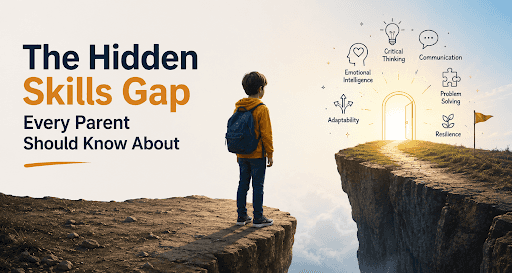

Every parent has had this moment when their child comes home excited, not about a test score, but about a goal they scored, a painting they finally got right, or a speech they didn’t stumble through this time. It feels small in the moment, but it’s not. Because somewhere between board exams and tuition classes, we forgot to ask a basic question: are marks actually preparing kids for what comes after school? Turns out, not entirely. There’s a quiet gap between doing well on paper and being ready for real life, and most schools aren’t built to fill it. This is exactly why parents exploring the Best Schools in Greater Noida West have started looking past the toppers list and asking what else their child gets to build here. It's also why The Millennium School keeps coming up in these conversations, not just for results, but for what happens around them too. Let’s begin with the article!
Also Read: How Self-Regulation Teaches Your Kids to Become More Responsible?
The Skills Gap Nobody’s Talking About Enough
.png)
Every year, lakhs of students walk out of Indian schools and colleges with solid marks and still struggle to land the job they expected. It’s not because they didn’t study hard enough. It’s because marks were never really measuring what employers are now looking for.
What the Employability Numbers Actually Show
The data makes this pretty hard to ignore:
- Mercer | Mettl’s India Graduate Skill Index 2025 found only 42.6% of Indian graduates who apply for jobs are considered overall employable, despite most of them clearing their exams just fine.
- The India Skills Report 2025, prepared by Wheebox along with CII, AICTE, and the Association of Indian Universities, puts overall graduate employability at 54.81%, up from 51.25% the year before, a number that has climbed from just 33% about a decade ago.
This means that even in the best-case estimate, that still means nearly half of all graduates aren’t considered fully job-ready.
Why Good Marks Alone Don’t Cut It Anymore?
So what’s actually missing? If students are scoring good marks, then why is getting employed harder?
- The same research from above shows Indian graduates have an employability of just 46% in learning agility and 50% in soft skills overall, the exact things a report card never tests.
Employers today check whether a candidate can think on their feet, work in a team, communicate clearly, and adapt when the situation keeps changing. None of that shows up in a mark sheet, and increasingly, none of it is being reliably built by mark sheet - focused schooling either.
How Discovering a Skill Early Actually Helps Later in Life
Teaches them failure is recoverable: Once a student messed up a dance step a hundred times before finally getting it right, or lost a match they really wanted to win, failure loses some of its sting. It becomes "try again" instead of "I'm just not good at this."
Discipline shows up on its own: Kids practice a talent because they want to get better, not because someone's making them. That habit of pushing through on their own sticks and later shows up as handling deadlines and responsibilities without needing to be told.
Generates soft skills: Whether it's a team sport, a stage performance, or a group project, kids naturally pick up communication, collaboration, and patience along the way- skills no exam ever really tests.
Builds adaptability early on: Trying a new step, adjusting to a new coach, or switching up an approach after something doesn't work teaches kids to adjust on the fly, exactly the trait employers keep saying graduates are missing.
Gives them a steady sense of identity: During the teenage years, when comparison gets overwhelming, having something a kid is genuinely good at gives them something solid to hold onto.
Shapes career direction: Many adults trace their career back to something they stumbled into as kids, a hobby, a sport, a random interest that stuck.
Closing That Gap: How The Millennium School Approaches Talent & Skill Development

This is exactly the gap The Millennium School, Sector 119, Noida seems to be closing through its Talent Development Programme, a set of clubs built around the idea that every child has a strength waiting to be found, not just academically, but in how they think, create, and express themselves.
Take communication, one of the softest skills employers keep saying graduates lack. VoiceWorks gives students real practice in public speaking and debate, while StageCraft builds confidence through theatre, role-play, and improvisation, the kind of comfort in front of a room that no textbook can teach.
Discipline and resilience get built just as deliberately. SpiritStrong, TMS's Taekwondo club, turns a physical activity into a lesson in self-control, stamina, and respect, the exact grit that shows up later as sticking with something hard instead of giving up on it.
Creativity and problem-solving run through clubs like Palette, where young artists build focus and patience through painting and sculpture; InkSpire, which nurtures original thinking through writing; MathMagix, which turns logical reasoning into something genuinely enjoyable; and InnoSphere, where students tackle real STEM challenges through hands-on experiments.
Even self-expression and teamwork have dedicated spaces. Rhythmix builds musical understanding and emotional expression, NrityaVeda keeps classical and folk dance traditions alive while building poise and discipline, and GrooveLab lets kids move freely while learning coordination and stage confidence.
For parents comparing the Best CBSE Schools in Greater Noida West, this is the real difference worth noticing, not just how a school teaches subjects, but whether it's actually building the exact skills the job market says are missing, years before a child ever needs to prove it.
For more information regarding this and other schools in this area





 as a preferred source on