








There is a lesson most of us learned the hard way. Not in classrooms. Not from a textbook. But somewhere in our mid-twenties, while staring at a bank balance that disappeared faster than we expected, or signing a loan document we didn’t fully understand, or realising that the salary we were so excited about somehow never quite lasted the whole month.
Nobody taught us how money actually works. And if you’re honest with yourself, you’ve probably thought that I don’t want my child to be financially illiterate when they grow up.
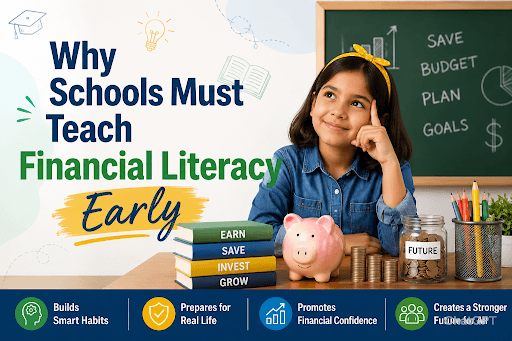
Money is the one subject children will use every single day of their adult lives. And yet, for the longest time, most schools never made space for it. That’s slowly changing. Some progressive schools like Sapphire International School have started treating financial literacy as a dedicated subject.
So when you’re looking at options and comparing the top CBSE schools in Ghaziabad, it’s worth asking, “Does the school teach financial literacy?” This article will show you exactly why this question matters and what the right answer looks like.
What Is Financial Literacy & What Do Schools Actually Teach in This?
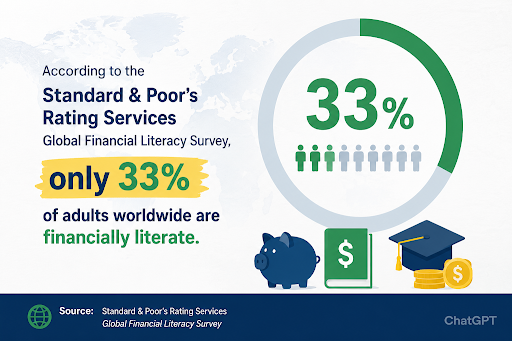
Financial literacy is the ability to understand and manage money well and make informed money-related decisions. This is the Google definition, but at its core, financial literacy is about understanding why saving feels hard even when you know you should. It’s about grasping that a small habit, repeated consistently over years, can quietly build something enormous. It’s about making a decision at 22 that doesn’t come back to haunt you at 42.
When we talk about financial literacy for children, we’re not talking about teaching a 9-year-old to read stock charts. We’re talking about giving them a thinking framework that will shape every financial decision they ever make.
Here’s what schools typically cover in Financial Literacy:
Earning & Value: Where does money come from, and why do different kinds of work pay differently? Children who understand this start respecting money in a way that no pocket-money lecture from a parent ever quite achieves.
Needs vs. Wants: Even most adults blur this line daily. Learning to pause before spending and ask do I actually need this? Is a habit that saves people from a lifetime of financial regret.
Savings & Waiting: The ability to delay gratification to hold off on something you want now for something better later is one of the strongest predictors of financial stability in adulthood. Schools build this through small, relatable exercises.
Budgeting: Planning a class event on a fixed amount, dividing pocket money between spending and saving. These simple activities quietly install the logic of living within your means.
Borrowing & Its Cost: Older children learn that borrowed money isn’t free money. Understanding interest, even at a basic level, is what stops a young adult from treating a credit like a bonus wallet.
The goal behind all this is not to make children financial experts, but to generate an awareness early. So that students can read a bill without anxiety, who know what a savings goal looks like, and who understand that money, managed well, gives you choices.
The Real Benefits of Financial Literacy
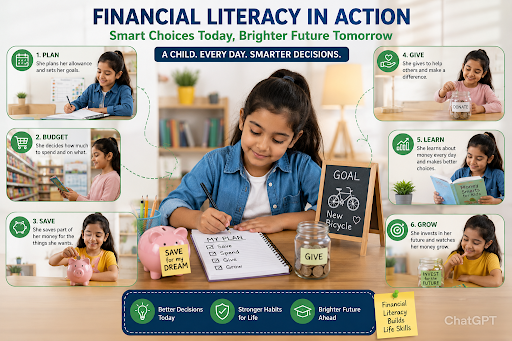
Build Confidence around Money: Money decisions come up with a lot of anxiety. Children who grow up understanding how money works tend to feel less threatened by it. They make decisions from a place of understanding rather than avoidance.
Better Decision-Making: Financial decisions are ultimately just decisions with trade-offs, priorities, and consequences. So, when a child understands trade-offs with money makes them better at making decisions in general.
Less Financial Stress as Adults: Most adult anxiety around money comes from never being taught. Remove the ignorance, and you remove a lot of the fear from their future life.
Better Spending Habits: When the child learns early that every rupee spent is a choice and not a reflex decision. They make better and more informed decisions and take a smarter approach towards spending money on more meaningful things.
Independence: When a child is financially literate, they won’t need someone to explain their salary slip, their tax return, or their bank statement to them. They stop feeling lost and start getting involved more freely.
Also Read: Why Does a Happy Child Learn 10x Faster? What role does schooling play in it?
How Sapphire International School is Teaching Financial Literacy

I bet you might have heard it from a lot of schools that they care about “holistic development.” But actually, there are only a few Top Schools in Sainik Vihar, Ghaziabad that build it into the curriculum in a way that’s measurable and intentional.
At Sapphire International School, Crossings Republik, financial literacy isn’t a one-off workshop or a chapter buried somewhere in a social science textbook. It’s a dedicated skill subject in the Middle stage for students in Grades 6 to 8.
At this age, a child is old enough to understand the concept of saving but young enough that their habits haven’t hardened yet. Introducing financial literacy at this stage is about shaping the lens through which a child will look at money for the rest of their life.
The middle stage at Sapphire sits within a broader curriculum philosophy built around inquiry-based learning. The goal is to encourage the children to ask why rather than just memorise what. Financial literacy taught this way doesn’t look like a lecture on economics.
It looks like a real question: If you had Rs. 500, how would you divide it? Why might it make sense to spend some and save some? What would you do differently next month if you ran out before the month ended?
It’s better to teach them now so they don’t struggle with the same questions as an adult. This is the overall aim behind the Sapphire Financial Literacy subject.
For more information regarding the schools that focus on holistic development
 as a preferred source on