







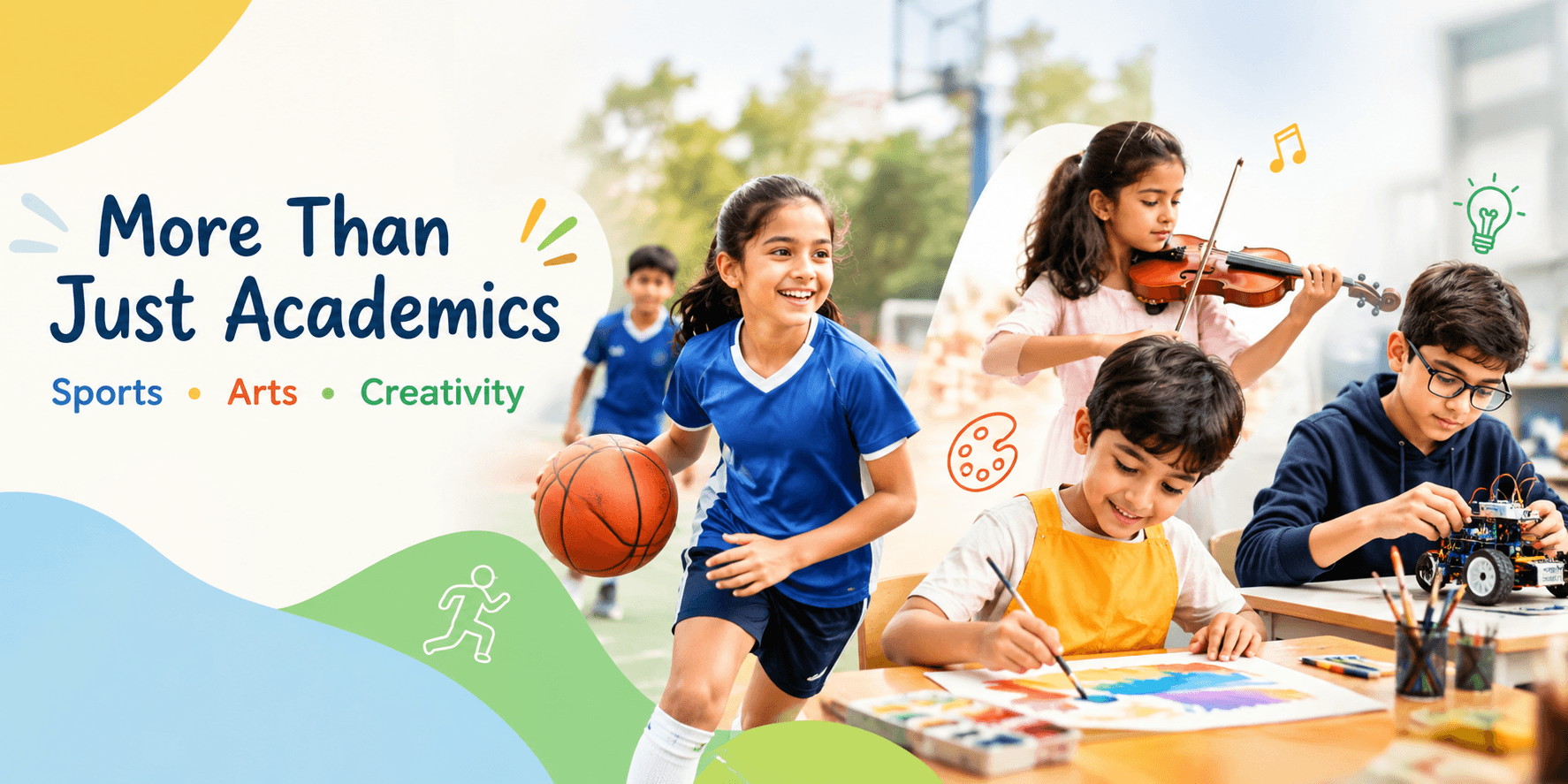

When parents think about their child's school life, marks, homework, examinations, and academic progress often come first. These are important, but is that really all children need from school?
A child's school years are also a time to discover interests, make friends, learn to work with others, become comfortable expressing ideas, and understand how to handle both success and setbacks. This is why Goldenbee Global School (GBGH), Horamavu, Bangalore, and schools like it are increasingly looking at development beyond textbooks and examinations.
A balanced school experience does not mean choosing sports or arts over academics. Instead, it means giving children opportunities to grow in different ways alongside their academic learning.
Also Read| Where Every Child Matters: Inside the Inclusive Education Model of GBGS Bangalore
Why Academic Learning Alone Is Not the Whole Picture
Academic subjects give children important knowledge and help them develop skills such as reading, writing, reasoning, and problem-solving. However, children also learn through experiences that cannot always be measured through a test.
A group project can teach cooperation. A sports match can teach a child how to respond after losing. Performing on stage can help a nervous student become more comfortable speaking in front of others. Designing something can encourage a child to experiment, make mistakes, and try again.
These experiences can complement classroom learning by helping children apply what they know in different situations.
The goal, therefore, is not to reduce the importance of academics. It is to create a school environment where academic learning is supported by opportunities to develop physical, social, emotional, and creative skills.
What Sports Teach Children Beyond Physical Fitness
Sports are sometimes treated as a break from "serious" learning. In reality, regular physical activity can contribute to children's physical and mental well-being. The CDC recommends that school-aged children and adolescents get at least 60 minutes of physical activity each day and notes benefits related to fitness as well as brain health and cognition.
But there is another important side to sports: the lessons children experience while participating.
Sports can help children practise:
- Teamwork: Working towards a shared goal requires listening and cooperation.
- Discipline: Skills improve through regular practice rather than instant success.
- Resilience: Losing a game can teach children how to recover and try again.
- Responsibility: Being part of a team means understanding one's role.
- Confidence: Learning a new skill can give children a sense of achievement.
Not every child needs to become a competitive athlete. The more important question is whether children get opportunities to move, participate, explore different sports, and find an activity they genuinely enjoy.
How Arts Give Children Another Way to Express Themselves
Music, dance, theatre, drawing, and other creative activities give children ways to communicate that are different from traditional classroom work.
A child who finds it difficult to explain an idea in a written answer may express it through a performance, story, design, or musical composition. Working on a performance can also involve listening to others, remembering instructions, practising repeatedly, and presenting something in front of an audience.
UNESCO's 2024 State of Education Report for India, which focuses on culture and arts education, highlights the role of arts education in developing creativity, critical thinking, cultural awareness and empathy.
This is why arts should not necessarily be viewed as optional entertainment. They can become another pathway through which children learn, communicate and understand themselves and the world around them.
Creativity Is Bigger Than Art
Creativity is often associated with painting, drawing, or music, but it has a much wider meaning in education. A child building a robot, writing a story, participating in a debate, designing an environmental project or finding a new solution to a problem is also using creativity.
For parents, this is an important distinction when evaluating a school's extracurricular programme. Instead of simply asking, "Does the school have activities?", it may be more useful to ask:
- Can children explore different interests?
- Are activities offered regularly?
- Do students get opportunities to participate rather than simply watch?
- Can they work with other children?
- Are they encouraged to create, question, and experiment?
- Is there room for both beginners and children who want advanced training?
The quality of these opportunities matters more than the number of activities listed in a brochure.
What Parents Should Look for in a Balanced School
A school that supports development beyond academics does not need to offer every possible activity. What matters is whether children have meaningful opportunities to discover and develop different abilities.
 info - sept.png)
Parents can look for a balance of:
- Physical activities: Sports, games and movement that encourage fitness and teamwork.
- Creative activities: Music, dance, theatre, art and opportunities for self-expression.
- Skill-based activities: Robotics, public speaking, writing, debates or similar programmes that encourage curiosity and communication.
- Participation opportunities: Events, competitions, performances and projects where children can apply what they have practised.
- Healthy balance: Activities should complement academics rather than create unnecessary pressure.
Also Read| Smart Early Education at Goldenbee Global School, Horamavu
How Goldenbee Global School (GBGH), Horamavu, Bangalore Connects Learning with Activities
For parents researching a Best School in Bangalore or comparing a Top School in Bangalore, it is useful to look at what opportunities children actually receive beyond their regular lessons.

At Goldenbee Global School (GBGH), Horamavu, Bangalore, the school's student-life programme includes structured Post School Activities covering sports such as basketball, skating, football, cricket, swimming, judo and gymnastics, alongside music, dance, speech and drama. The school also has G-EMBARK clubs covering areas such as robotics and AI, literature, public speaking, Model United Nations and environmental innovation. The Horamavu campus also identifies sports, arts, innovation and co-curricular opportunities as part of its broader learning environment.
A School Experience Should Leave Room to Grow
Children do not develop only when they are solving textbook questions. They grow when they practise, perform, collaborate, compete, create, make mistakes and try again. Academics will always remain an important part of school education. But sports can teach perseverance, arts can encourage expression, and creative activities can help children approach problems with curiosity.
For parents, the bigger question is therefore not whether a school prioritises academics or extracurricular activities. It is whether the school creates enough space for both. A well-rounded school experience gives children the opportunity to learn what they are good at, discover what they enjoy, and gradually become more confident in who they are.
For more information on this and similar schools, check out this list of the best schools in Bangalore.
 as a preferred source on