








MRIS Sector 46, Gurgaon, has always been among the few schools in Gurgaon that take initiatives from time to time to improve the quality of education of the young generation, so that they can cope with the changing times and with the changing technology and advancements. The implementation of the Maker Shala, Fashion Shala, Tinker Shala, with hands-on skills exposure through robotics, AI, AgriTech, and HealthTech; such changes are not done just for the senior students but also for the kids enrolled in the early childhood development ecosystem. One such example of an initiative is Nestlings.
Now, what is Nestlings? How does it work? Parents can understand it all by reading this article.
Also Read| Preparing Students for Real-World Success at MRIS, Sector 46, Gurugram
What Is Nestlings by Manav Rachna?
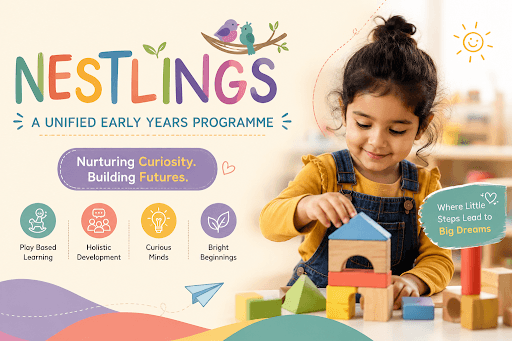
Nestlings by MRIS, one of the top schools in Gurgaon, is an early-years programme started with the idea that a child's first learning experiences should be very engaging, so that they are exploratory and help them to develop and grow holistically.
Rather than looking at early education only as learning letters, numbers and filling worksheets, the programme places greater focus on children's experiences to build curiosity, interaction and exploration.
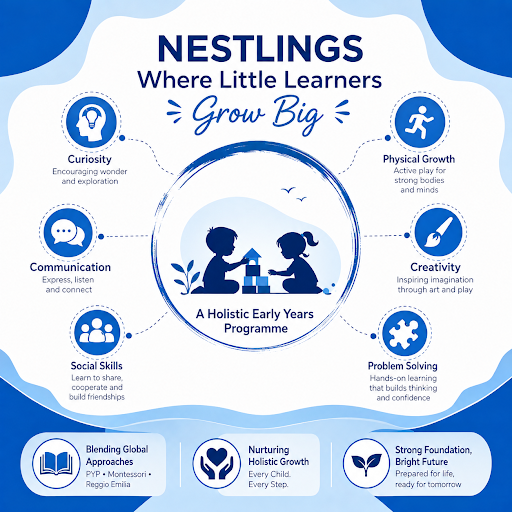
According to MRIS, Nestlings works through three different educational approaches: the IB Primary Years Programme (PYP), Montessori and Reggio Emilia. These approaches are brought together to create a strong foundation during the early years of learning.
This makes Nestlings different from any other preschool programme. It mainly focuses on creating an environment where children can learn through experiences while developing the crucial skills they need for their future education.
Why Has MRIS Introduced Nestlings?
The early years are an important stage in a child's development. During this period, children begin developing their communication, social, emotional, physical, and cognitive abilities.
This means early education is not simply about preparing a child to read or write. It is also about helping children:
- become curious about their surroundings
- communicate their thoughts and feelings
- interact confidently with others
- develop independence
- experiment and solve simple problems
- express themselves creatively
- build positive learning habits
MRIS's broader educational philosophy also focuses on combining academics with experiential learning, innovation, creativity and real-world exposure. Nestlings extends this approach to the early-childhood stage.
What Do Children Learn at Nestlings?
The main aim of the early-years programme is not limited to academic learning, but to help children develop a broader skill set of abilities with the help of age-appropriate experiences, which include the following-
Communication- Children get opportunities to express themselves, to listen and to interact with others through different activities.
Physical development- Movement and active play help to build coordination and motor development in kids.
Curiosity- Children are encouraged to ask questions and explore their surroundings. Hence, learning becomes active, and they start developing holistically.
Social development- Group activities and interaction with other students and teachers can help children understand the basics of cooperation and sharing beautifully, and they will naturally build relationships with others.
Creativity- When children are given a set pathway, they lack creativity. Hence, through nestlings, children are guided but not ordered, which leaves room for them to choose the path and be as creative as they want, through art, creativity, and imagination.
Problem-solving: Hands-on activities allow children to experiment, make choices, and discover solutions.
How Is This Initiative by Manav Rachna International School More Important Than It Looks?
When we think about early education, we assume that children must be learning A, B, C, numbers, rhymes, and writing. But is that all a young child needs to learn? The early years are also when children learn to communicate, to share, to ask questions, to solve small problems, and to become comfortable trying new things. This is where an initiative like Nestlings becomes important.

For example, imagine a child playing with building blocks. Instead of simply telling the child how to make a tower, the teacher lets them play with them. In this process, they observe the shapes of the blocks and slowly start understanding the lock-and-key arrangement of the different blocks, which helps them make the unfamiliar shapes. In the end, they become more familiar with those blocks and finally start making shapes.
This problem starts becoming a solution. The tower falls, but the child tries again, uses bigger blocks at the bottom, and finally manages to build it. It may look like simple play, but the child has just learned about patience, balance, problem-solving, and learning from mistakes.
This is the kind of everyday learning that can make early education more meaningful. Nestlings focuses on giving young children opportunities to play, explore, interact, and learn through experiences, rather than putting academic pressure on them too early. And when children enjoy learning from the beginning, they are more likely to grow into curious, c. That is what makes this initiative more than just another preschool programme; it is about getting the foundation right from the very start.
Want to know more about this and other nearby schools? Visit
 as a preferred source on