






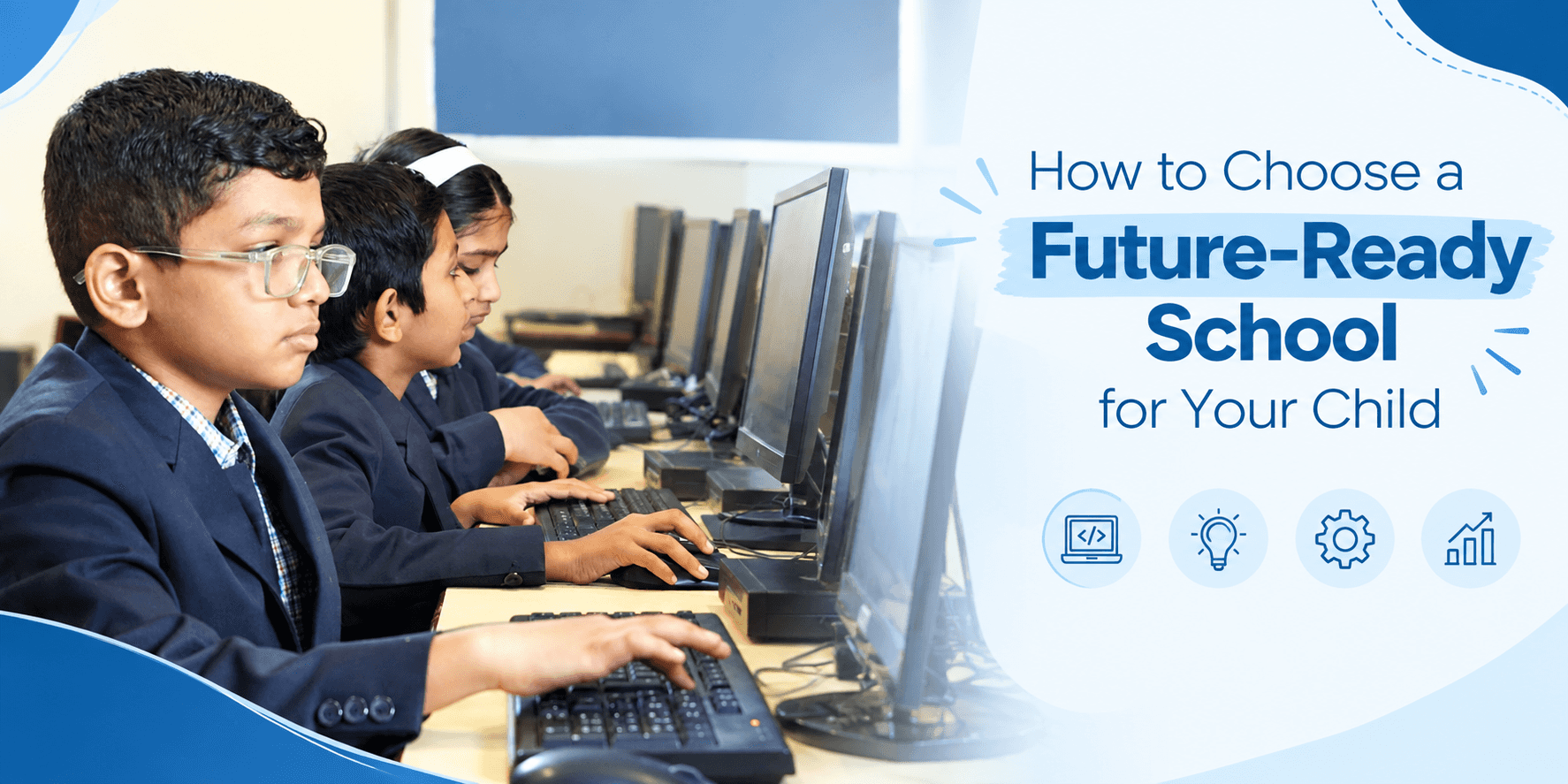

Choosing a school is one of the biggest decisions a parent makes.
Pune offers parents a remarkably wide choice, from long-established schools with decades of history to newer institutions focused on technology, experiential learning and global education. Families can choose between different boards and educational philosophies, while also considering factors such as location, fees, academic expectations, sports, arts, technology and student wellbeing.
That choice, however, creates another problem.
How do parents decide which school is actually right for their child?
Searching for the “best school in Pune” may produce rankings and lists, but a ranking cannot tell a parent how a particular child will experience a school.
A better approach is to understand what makes a school future-ready and then examine what students actually get to do there.
What Makes a School Future-Ready?
A future-ready school does not mean a school that abandons academics.
Strong foundations in mathematics, science, languages, social sciences and other subjects remain essential. The difference is that children also need opportunities to apply what they learn.
Technology and artificial intelligence are changing how people work and access information. Children will need to navigate a world in which knowing something is only one part of the challenge. They will also need to know how to question information, solve unfamiliar problems, communicate ideas, work with others and continue learning.
For parents comparing schools in Pune, ten areas are particularly useful to examine.
10-Point Checklist for Evaluating Schools in Pune
|
What parents should examine |
Questions worth asking |
|
Academic foundations |
Is my child developing strong subject knowledge? |
|
Experiential learning |
Does my child learn by doing, investigating and creating? |
|
Critical thinking |
Are students encouraged to question and analyse? |
|
Communication |
Do students regularly speak, present and express ideas? |
|
Technology and AI |
Are children learning to use technology responsibly? |
| Financial literacy |
Do students learn practical money-management concepts? |
|
Leadership |
Do children receive meaningful responsibilities? |
|
Sports |
Does every child get meaningful opportunities to participate? |
|
Arts and creativity |
Can children explore and develop creative strengths? |
| Emotional development |
Does the school help students build confidence and resilience? |
This is not a ranking system. It is a framework parents can use when comparing schools.
Key Schooling Options in Pune: CBSE, ICSE and IB
Pune's education landscape includes schools following different curricula and educational approaches.
Parents may encounter CBSE, ICSE and IB schools, among other options. Each has its own structure and approach, and the right choice depends on factors including the child's learning style, family priorities, future plans and the kind of educational environment the family wants.
But the board is only one part of the decision.
Two schools following the same board can provide very different experiences.
Parents should therefore look beyond the curriculum label and ask:
How is the curriculum actually delivered?
Does the child spend most of the day listening and reproducing information, or are there opportunities to investigate, discuss, present, create and solve problems?
Does the school provide opportunities for students to participate in sport and the arts?
Do students take responsibility for anything?
Can children develop interests outside their strongest academic subject?
These questions can reveal more about a school than a board name alone.
Pune's School Landscape: Many Different Choices
Parents in Pune may consider established institutions such as The Bishop's School, St. Mary's School, Delhi Public School Pune, Symbiosis International School, Vidya Valley School, Mahindra International School and The Lexicon International School, among many others.
These schools have different histories, curricula, locations and educational approaches. The purpose of comparing them should not be to declare one universal winner, but to understand which environment is likely to suit a particular child.
Location matters too.
Families living in East Pune may consider schools around Kalyani Nagar, Viman Nagar, Kharadi, Hadapsar and Wagholi, while families in other parts of the city may look at schools around Aundh, Baner, Balewadi, Kothrud, NIBM and Hinjewadi.
The daily journey is part of a child's school experience.
A school that looks attractive on paper may not necessarily be the right choice if a child spends several hours each day travelling to and from campus.
Don't Just Ask What a School Offers. Ask What Your Child Will Actually Do.
This may be the most useful principle for parents visiting schools.
A prospectus can list dozens of facilities and programmes. What matters is how students actually use them.
If a school says it teaches technology, ask:
What will my child actually create, investigate or solve using technology?
If it offers sports, ask:
How frequently will my child participate?
If it offers leadership, ask:
What responsibilities can an ordinary student actually take on?
If it promotes experiential learning, ask:
What will my child actually build, investigate, present or experience?
And if a school talks about confidence, ask:
Where will my child get opportunities to speak, perform, compete, make decisions and recover from mistakes?
A school's infrastructure is an input.
The opportunity a child gets to use it is the outcome.
Case Study: How Schools Like The Lexicon International School Apply These Frameworks
One useful way to understand the difference between educational philosophy and actual school practice is to examine how a school translates these ideas into the student experience.
The Lexicon International School is one example from Pune.

Its Wagholi campus is a CBSE-affiliated senior secondary school. The official CBSE affiliation record lists the school under affiliation number 1130282, with its affiliation period currently extending to March 31, 2028. Lexicon also operates schools in Kalyani Nagar and Hadapsar.
What makes the school relevant to this discussion is the breadth of capabilities it says it seeks to develop alongside academics.
Its published educational approach includes inquiry, exploration, teamwork, communication, information technology, problem-solving and management skills. The school's description of experiential learning also emphasises multidisciplinary and multisensory learning rather than limiting education to textbooks and classrooms.
The school's published curriculum provides concrete examples of this approach. Curriculum documents include activities involving coding, ICT, art integration, projects and financial literacy, demonstrating how these areas can be incorporated into everyday learning rather than existing only as broad statements in a prospectus.
Financial literacy is another example.
Lexicon's campuses have participated in the National Centre for Financial Education's Money Smart School programme. The school's published information describes activities around saving, budgeting and responsible spending.
The larger lesson for parents is more important than the individual programme.
When evaluating any school, parents should ask whether concepts such as financial literacy, technology, leadership or experiential learning are merely listed among activities, or whether students actually get repeated opportunities to practise them.
That is the difference between offering a programme and building a capability.
Why Experiential Learning Matters
A child can learn a concept from a textbook.
But applying that concept to a project, experiment, presentation, investigation or real-world problem requires another level of thinking.
Experiential learning can give students opportunities to:
- ask questions
- investigate problems
- work with others
- make decisions
- present ideas
- learn from mistakes
- connect classroom knowledge with real situations
The objective is not to replace academic learning.
It is to make knowledge usable.
Parents should therefore ask not simply:
“Does this school offer experiential learning?”
but:
“How often does my child actually learn through experience?”
Why Financial Literacy and Confidence Matter for 2027
Two areas deserve particular attention as parents think about the education children will need in the coming decade: financial literacy and confidence.
Children eventually have to make decisions about money, yet many practical financial habits are learned outside formal education.
Age-appropriate financial education can introduce concepts such as saving, budgeting, responsible spending, needs versus wants and entrepreneurship.
Similarly, confidence is not simply a matter of personality.
Children can gradually develop confidence by participating, speaking, making decisions, trying difficult things and discovering that mistakes can be corrected.
A child who is initially nervous about public speaking may become more comfortable after repeated opportunities to present.
A child who struggles in a sport may develop persistence through practice.
A child who makes a mistake can learn that a disappointing outcome does not define their ability.
These experiences can contribute to a child's ability to handle unfamiliar situations later in life.
Questions Parents Should Ask During School Campus Visits
A school visit should be more than a tour of buildings.
Parents can ask:
What opportunities does every student get to speak or present?
How are students exposed to technology and AI?
What does experiential learning look like in an ordinary school week?
How many students participate in sports and creative activities?
What leadership responsibilities are available to students?
How does the school respond when a child makes a mistake or struggles academically?
How does the school support student wellbeing?
Can quieter children find opportunities to participate and lead?
What practical skills do students develop before they graduate?
How does the school communicate with parents when a child is struggling?
These questions can produce much more useful information than simply asking whether the school has a particular facility.
The School Day Matters More Than the Brochure
Parents should observe students during a campus visit.
Do children appear engaged?
Are they asking questions?
Are students presenting their work?
Do they interact comfortably with teachers?
Are children participating in activities rather than simply watching?
Are students trusted with responsibilities?
Can children pursue interests outside their strongest academic subject?
These observations can reveal the culture of a school in ways a brochure cannot.
Parents should also consider practical factors such as fees, commute, class size, academic expectations, transport and the individual needs of their child.
The right school needs to work for the child a family actually has, not an imaginary child represented in a prospectus.
A Better Way to Choose Among the Best Schools in Pune
Instead of asking only which school is ranked highest, parents can make their own shortlist using five questions:
1. What will my child learn?
Look at academic foundations and curriculum.
2. What will my child actually do?
Look at projects, sports, arts, presentations, clubs and practical experiences.
3. What capabilities will my child develop?
Look at communication, leadership, problem-solving, independence and confidence.
4. How will my child be supported?
Ask about teachers, wellbeing, counselling and parent-school communication.
5. Does the school fit our family?
Consider location, fees, transport, timings, culture and your child's individual needs.
This approach does not produce a universal ranking.
It produces something more useful: a school choice based on the child.
What Should Parents Ultimately Look For?
The phrase “best school in Pune” sounds as though there must be one definitive answer.
There isn't.
Pune has many schools with different strengths, educational philosophies, curricula and student experiences.
The more meaningful question is:
What will my child be able to do after ten or twelve years in this school that they could not do when they arrived?
Can they think independently?
Can they communicate clearly?
Can they work with others?
Can they use technology responsibly?
Can they manage money?
Can they take responsibility?
Can they handle setbacks?
Can they discover something they are genuinely good at?
Can they remain curious?
For parents comparing the best schools in Pune for 2027, these questions may ultimately matter more than any single ranking.
A future-ready school is not simply one with modern buildings, impressive technology or a long list of activities.
It is a school where children are given repeated opportunities to learn, participate, experiment, communicate, lead, create, fail, reflect and try again.
And when parents visit a school, perhaps the most important question is also the simplest:
“What will my child actually get to do here?”
The answer may tell them more than any ranking ever could
To get the list of Top Schools in Pune, Visit our page
 as a preferred source on