







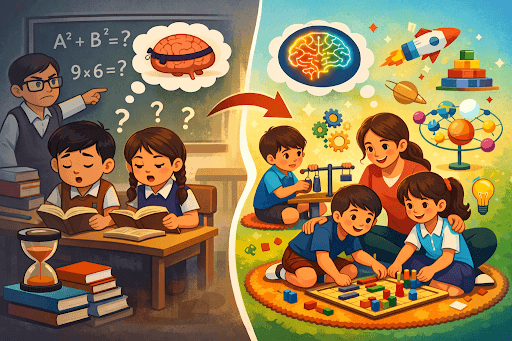

Have you ever noticed how students can recite formulas perfectly yet struggle to explain why they work? This gap between memorisation and understanding is one of the biggest challenges in traditional learning. When concepts are taught only to be remembered, not explored, students often lose confidence and curiosity along the way.
Modern education is now shifting its focus from rote learning to reason-based understanding, where students actively engage with ideas instead of passively absorbing information. Approaches that encourage exploration, visualisation, and hands-on learning are helping learners make sense of concepts in ways that feel meaningful and lasting.
This article explores the philosophy behind the Jodo Gyan approach, how activity-based and experiential methods strengthen conceptual clarity, and how Ramagya School, one of the best schools in Noida, takes pride in integrating Jodo Gyan pedagogy to help students build strong number sense, logical reasoning, and confidence through joyful, concept-driven learning
Also Read | Cultivating Compassion and Responsibility Through CSR Initiatives at Ramagya School
Understanding the Jodo Gyan Approach: Learning Through Connections
The Jodo Gyan approach is built on a simple yet powerful idea, learning becomes meaningful when students understand how concepts connect. Instead of memorising procedures or formulas in isolation, learners are encouraged to explore relationships between numbers, patterns, and real-life situations. This shift helps students see mathematics and other concepts as logical systems rather than abstract rules.
At the heart of Jodo Gyan is experiential learning. Students engage with concrete tools such as blocks, number lines, counters, and visual models that allow them to physically interact with ideas. By touching, moving, and observing, learners develop a clearer understanding of how concepts work and why they make sense.
This approach also places strong emphasis on questioning and reasoning. Students are encouraged to explain their thinking, test different methods, and learn from trial and error. Mistakes are treated as learning opportunities rather than failures, creating a classroom environment where curiosity and confidence grow together.
By focusing on connections rather than memorisation, Jodo Gyan helps learners build a strong foundation of conceptual clarity. Students don’t just arrive at answers, they understand the journey that leads to them, making learning more engaging, logical, and long-lasting.
Why Moving Beyond Rote Learning Matters in Today’s Classrooms
Rote learning may help students remember information temporarily, but it often falls short when learners are asked to apply knowledge in new or unfamiliar situations. In today’s fast-changing world, education must equip students with the ability to think, reason, and adapt, not just recall answers. Moving beyond memorisation is essential to building these skills.
When learning is rooted in understanding rather than repetition, students begin to:
- Develop strong conceptual foundations: Instead of memorising steps, learners understand the logic behind concepts. This makes it easier to apply knowledge across subjects and in real-life contexts.
- Build logical and critical thinking skills: Reason-based learning encourages students to analyse problems, explore multiple solutions, and justify their answers, strengthening cognitive flexibility.
- Gain confidence in problem-solving: Students who understand concepts deeply are less afraid of making mistakes. They approach challenges with curiosity and confidence rather than hesitation.
- Stay engaged and motivated: Hands-on and interactive learning makes classrooms more dynamic. When students see meaning in what they learn, their interest and participation naturally increase.
By shifting the focus from rote to reasoning, classrooms become spaces where learners actively construct knowledge. This approach not only improves academic outcomes but also prepares students to navigate complex challenges with clarity and confidence.
How Hands-On and Activity-Based Learning Strengthens Understanding

Hands-on learning plays a crucial role in helping students move from abstract ideas to clear understanding. When learners actively engage with materials, models, and activities, concepts stop feeling distant and begin to make sense in tangible ways. This approach allows students to experience learning rather than simply listen to it.
Activity-based learning supports conceptual clarity by:
- Making abstract concepts visible: Tools like manipulatives, visual models, and concrete objects help students see how ideas work. Concepts such as number relationships, patterns, or operations become easier to grasp when learners can observe and interact with them.
- Encouraging active participation: Instead of passively receiving information, students take part in discussions, experiments, and problem-solving tasks. This involvement deepens understanding and keeps learners mentally engaged.
- Supporting different learning styles: Every student learns differently. Hands-on activities cater to visual, auditory, and kinaesthetic learners alike, ensuring that concepts are accessible to all.
- Reinforcing learning through experience: When students apply ideas during activities, the learning stays with them longer. Experiences create stronger memory connections than repetition alone.
By strengthening understanding through action and exploration, activity-based learning builds a solid foundation for reasoning, confidence, and independent thinking, key outcomes of a concept-driven classroom.
Building Number Sense, Reasoning, and Confidence Through Jodo Gyan
One of the strongest outcomes of the Jodo Gyan approach is the development of number sense, the ability to understand numbers, relationships, and operations intuitively rather than mechanically. When students grasp how numbers connect and behave, problem-solving becomes logical instead of intimidating.
Through concept-driven practices, Jodo Gyan helps learners:
- Strengthen number sense: Students learn to see numbers as flexible and meaningful. They understand quantities, comparisons, and relationships instead of memorising fixed procedures, which improves accuracy and speed over time.
- Develop logical reasoning: By exploring multiple ways to reach an answer, students learn to reason, justify, and explain their thinking. This nurtures analytical skills that extend beyond mathematics into everyday decision-making.
- Gain confidence through understanding: When learners know why something works, their fear of getting answers wrong reduces. Confidence grows naturally as students trust their own reasoning and problem-solving abilities.
- Encourage independent thinking: Rather than relying on memorised steps or constant validation, students become active thinkers who test ideas, make connections, and learn through exploration.
By focusing on understanding over memorisation, Jodo Gyan creates learners who are not only academically capable but also confident, curious, and ready to apply their knowledge meaningfully.
Check Out | Healthy and Hygienic Learning: Promoting Well-Being at Sapphire International School
Ramagya School: Bringing Jodo Gyan to Life in Everyday Learning
Ramagya School, one of the best CBSE schools in Noida, takes pride in adopting progressive teaching methodologies that place understanding at the heart of learning. With the integration of the Jodo Gyan pedagogy, the school actively moves classrooms away from rote memorisation and towards deep, meaningful conceptual clarity

At Ramagya School, learning is designed to be experiential, interactive, and joyful. Students are encouraged to engage with concepts using concrete tools, visual representations, and hands-on activities that allow them to see how ideas connect in real-life contexts. This approach ensures that learners do not simply arrive at answers but understand the reasoning behind them.
How Jodo Gyan Is Practised at Ramagya School
- Use of concrete learning tools and manipulatives that help students physically explore numbers, patterns, and relationships, making abstract concepts easier to understand.
- Visual models and representations that support learners in mapping connections between ideas, strengthening both clarity and retention.
- Activity-based classroom practices where students experiment, discuss, and reflect, transforming learning into an active process rather than passive absorption.
- Encouragement of reasoning and explanation so students articulate their thought processes, build logical thinking, and gain confidence in their understanding.
- A supportive learning environment where curiosity is welcomed and mistakes are treated as opportunities for growth rather than setbacks.
Through the Jodo Gyan approach, Ramagya School nurtures learners who are confident thinkers, strong problem-solvers, and active participants in their own learning journey. By reinforcing conceptual understanding through hands-on and connected learning, the school ensures that education remains meaningful, engaging, and rooted in real understanding.
By embracing Jodo Gyan in everyday practice, Ramagya School demonstrates its commitment to building not just academic skills, but reasoning ability, confidence, and a lifelong love for learning.
For more information on this and other such schools in the area, check out this list of the best schools in Noida.

 as a preferred source on