









There was a time when a school's quality could be measured almost entirely by what happened within its own walls. A strong principal, experienced teachers, a good library, a clean campus — that was roughly the checklist. That time has passed. The world students are preparing to enter is interconnected in ways that make any single institution's internal resources, however good, fundamentally insufficient on their own. The most forward-thinking schools today are defined not just by what they teach but by who they learn from, partner with, and connect their students and teachers to. One of the best schools in Greater Noida West, The Wisdom Tree School, has built this understanding into its foundation — constructing a network of educational associations designed to do something a school cannot do alone: bring the world into the learning environment, systematically and substantively.
Also Read| How Risky Play builds Resilience in students
Why Schools Can't Go At It Alone Anymore
The Limits of a Single Curriculum
A curriculum, however well designed, is a snapshot. It reflects the knowledge and priorities of the people and institutions that built it at the time they built it. The world it prepares students for, however, is a moving target — evolving in its professional demands, its technological landscape, its cultural expectations, and its understanding of what learning itself should look like. A school that operates entirely within the boundaries of a single curriculum, without any external input refreshing its pedagogical approach or broadening its intellectual frame, is quietly falling behind the schools that are actively importing better ideas from the wider world.
This isn't a criticism of any particular board or syllabus. It's an observation about how knowledge works. The best international schools understand that even a strong, well-structured national curriculum needs to be in conversation with global research, global practice, and global expertise — and that this conversation has to be ongoing, not occasional.
What Educational Partnerships Actually Do
When schools form genuine collaborations with external organisations — educational bodies, research institutions, professional academies, arts organisations, sports academies — the benefits aren't abstract. They're specific and practical. Teachers access pedagogical frameworks they wouldn't have encountered otherwise. Students engage with experts and methodologies beyond what any single faculty member can provide. Curriculum gaps get filled not through internal improvisation but through structured input from organisations that have spent decades refining their expertise. The learning environment stops being self-referential and becomes genuinely open — which, for a student growing up in a connected world, is precisely the kind of environment that prepares them well.
The Real Benefits of Global Collaboration

Teacher Training and Professional Development
Teachers are the most important variable in any school's quality. But teacher quality isn't fixed. It can be developed, deepened, and regularly refreshed — and the most effective way to do that is through structured exposure to the best teaching research and practice available internationally. When schools partner with world-class training organisations, teachers don't just learn new techniques; they encounter different assumptions about what learning looks like, what good assessment involves, how to design for different learning styles, and how to stay current in a changing pedagogical landscape. A teacher trained through an internationally grounded program brings something back to the classroom that an in-house workshop cannot replicate: genuine exposure to how the best educators in the world think.
Curriculum Enrichment Through Global Intellectual Input
Some of the most durable academic knowledge doesn't live in textbooks — it lives in the work of researchers, scientists, linguists, and thinkers who have spent their careers pushing at the frontiers of their fields. Schools that actively build connections with this broader world of knowledge — drawing on the writing of great scientists, mathematicians, and pedagogical thinkers to enrich their core curriculum — give students something beyond exam readiness. They give them intellectual depth. A student who has encountered Edward De Bono's thinking on lateral reasoning, or who has been introduced to Richard Feynman's approach to understanding physics from the ground up, carries a different relationship to knowledge than one who has only ever engaged with textbook summaries of those ideas.
Future-Ready Skills and Global Citizenship
The skills most consistently identified as essential for the coming decades — critical thinking, creative problem-solving, cross-cultural communication, adaptability, ethical judgment — are not produced by any single discipline. They emerge from the intersection of many: arts and sciences, local and international, academic and experiential. Schools that build partnerships across these intersections are, in effect, engineering the conditions in which future-ready skills develop naturally. A student who has been exposed to mindfulness practice alongside academic study develops a different kind of self-awareness. A student who has trained with internationally credentialed coaches — in sport, in performance arts, in creative disciplines — develops standards and habits that a school-only program rarely achieves. Global citizenship isn't a lesson; it's a disposition that develops through genuine, repeated exposure to the wider world.
Also Read| How to choose the Right Stream After 10th
What Student Exposure Through Partnerships Actually Looks Like

Beyond the Classroom Walls
International exposure doesn't require a student to travel abroad. It requires the school to deliberately bring international-calibre input into the student's everyday experience — through the expertise of people the school has formal relationships with, through curriculum enriched by globally recognised intellectual traditions, through training programs that set standards against the best in the world rather than just against local benchmarks. A student who learns football from coaches affiliated with a globally respected academy, or who studies the performing arts under guidance connected to a world-class institution, is receiving international exposure of a real kind — not aspirational, but embedded in their actual learning.
Research-Backed Teaching as a Living Practice
The most valuable aspect of global educational collaboration isn't any single partnership — it's the culture of openness it creates. When a school actively seeks out better ideas from the wider world and builds structures to bring those ideas in, it models something important for students: the belief that knowledge is not fixed, that learning doesn't stop, and that the best approach is always the one that keeps asking whether there's a better way. Research-backed teaching — pedagogy shaped by what the best educational research says actually works, rather than by habit or convention — is what this culture produces. And it's the kind of teaching that produces students who think, not just students who pass.
How The Wisdom Tree, Greater Noida West, Puts This Into Practice
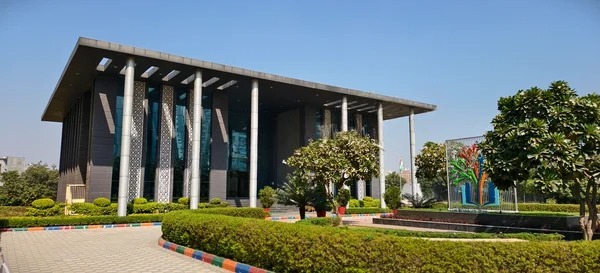
While many schools recognise the value of partnerships, the most impactful collaborations are those that directly enhance classroom experiences for both students and educators. At one of the best CBSE school in Greater Noida West, The Wisdom Tree, the school's network of associations has been built with exactly this standard in mind — not as a feature of the brochure, but as a structural commitment to richer learning.
A Curriculum Enriched by Global Intellectual Traditions
The Wisdom Tree's approach to curriculum begins from an honest recognition of what CBSE, for all its strengths, doesn't always cover in sufficient depth at the foundational level — particularly in science, mathematics, and language. Rather than accepting that gap, the school fills it deliberately: by drawing on the work of internationally recognised thinkers like Richard Feynman, George Gamow, Ian Stewart, Maxwell Nurnberg, and Edward De Bono to enrich the concepts students encounter from early years onwards. This isn't supplementary content bolted onto the syllabus. It's curriculum design informed by the people who best understand their fields — giving students a foundation that doesn't just prepare them for CBSE assessment but for genuinely advanced academic and professional life beyond school.
Teacher Development and Partnerships That Extend the Learner's World
The Wisdom Tree has built continuous teacher training into its institutional structure — through internationally recognised training centres — backed by a 360-degree ongoing assessment system that treats teacher development not as a one-time event but as a sustained commitment. Faculty are selected not just for subject expertise but for versatility, intellectual curiosity, and genuine care for students — and the school's partnerships are designed to keep those qualities current and growing.
For students, the school's vision of associations extends across sports, performing arts, and wellbeing — connecting young learners to world-class expertise in disciplines that CBSE alone cannot fully provide. The goal in each case is the same: to ensure that a student at The Wisdom Tree is encountering the best available thinking and practice in every dimension of their development, not just in the academic core. Educational partnerships of this kind don't just broaden the school's offering — they change what a student believes is possible by showing them what genuine excellence looks like up close.
Conclusion
Global collaboration in education isn't about prestige. It's about ensuring that what students experience in school is genuinely connected to the best of what the world has to offer — in teaching practice, intellectual tradition, professional expertise, and human development. Schools that build these connections thoughtfully and embed them into the actual fabric of daily learning give their students something no single institution can manufacture alone: real breadth. At The Wisdom Tree, Greater Noida West, that commitment to building outward — to learning from the world as much as from within — is what makes its educational associations matter.
If you are also looking for such schools in Greater Noida West and nearby areas
 as a preferred source on