








Ask most people what "learning" looks like, and they'll picture a classroom — a blackboard, a textbook, maybe an exam looming at the end of the term. Fair enough, those things matter. But some of the lessons that stick with us longest never happen at a desk. Gardening is one of them, and it teaches children a lot more than most people give it credit for.
Kids today are growing up indoors more than any generation before them — timetables, screens, structured everything. It's no surprise many feel disconnected from the natural world, even though it's the thing keeping them alive. A school garden is a small but genuine way to close that gap, getting kids out into the dirt, literally, to engage with something real.
There's more going on in a garden bed than planting a seed and hoping for the best. Along the way, kids pick up patience, responsibility, curiosity, and a real sense of what it means to look after something living. Today, through this article, we wanted to talk about an example of one of the best schools in Bangalore, Kesar The International School, and how it is providing this option through its Anubhava program.
Where the Textbook Falls Short
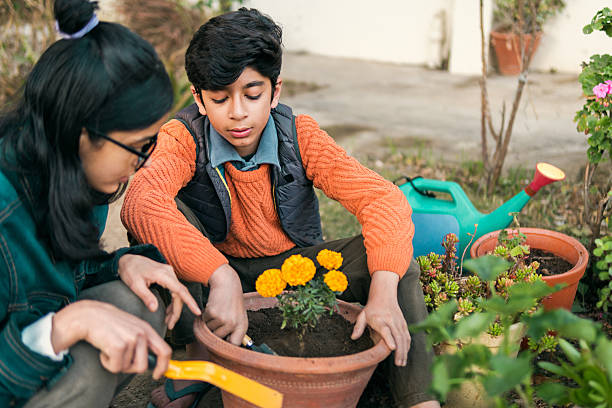
Science comes alive differently when you can actually see it happening. Photosynthesis or pollination read like abstract diagrams in a book, but watch a seed crack open and push a shoot through the soil, and suddenly it isn't abstract anymore.
Spend enough time in a garden and kids start noticing things they'd otherwise walk past — earthworms turning the soil, bees drifting between flowers, the odd beetle doing whatever beetles do. That noticing is where real curiosity starts, and it's the same instinct behind good science.
This lines up with where education has been heading for a while — less rote memorizing, more actually doing things and figuring stuff out. Research backs it up too: kids retain more and understand more deeply when they've experienced something rather than just read about it.
Responsibility, Learned the Slow Way
A homework assignment gets handed in, and it's done. A plant doesn't work that way. Skip a few days of watering, and there are consequences you can see wilting in front of you.
That's a powerful lesson in accountability, and it sinks in gradually. Kids learn that anything worth growing — a flower, a tomato plant, a bit of basil on a windowsill — needs consistent attention, not just enthusiasm on day one. Over time, that builds habits that go well beyond the garden: discipline, sticking with things, following through even when it's a little boring.
Patience, the Old-Fashioned Kind
Most kids today are used to getting what they want almost instantly — a video loads in seconds, an answer is one search away. Gardens don't play by those rules. A seed takes its time. A flower blooms when it's ready, not when you want it to. Fruit and vegetables need weeks, sometimes months, before there's anything to show for it.
That teaches something a lot of digital life doesn't: good things are often slow things, and that's okay. Kids who've sat through that waiting tend to carry a bit more patience into schoolwork, hobbies, and eventually their careers.
Also Read| Character Education an Important Topic
A Healthier Relationship With Food — and With Being Outside
Once a child has grown something themselves, food stops being something that just appears on a plate. Kids who've grown their own vegetables or herbs tend to take more interest in what they're eating, and often end up with better habits around food as a result.
There's a physical side too — digging, weeding, and hauling water all get kids moving, no small thing given how much of their day is spent sitting down. Time around greenery is also linked to better focus, lower stress, and generally improved mood.
Working Together, Without Really Trying To
Most school gardens aren't solo projects. Kids share the work — preparing beds, taking turns watering, figuring out who does what and when. That shared responsibility teaches cooperation in a way that's hard to fake in a classroom, and it comes with a payoff: celebrating together when something finally blooms or is ready to pick. It's teamwork, but nobody's calling it that — which might be exactly why it works.
Learning to Care About the Planet
Words like climate change, biodiversity, and water conservation can feel abstract to a ten-year-old reading them in a textbook. A garden makes them concrete. Kids start to understand, almost without being told, why healthy soil matters, what compost does, why bees are worth protecting, and how plants clean the air we breathe. It stops being a poster topic and becomes something they've watched happen with their own hands.
Also Read| Smart Kid and Trained Kid
How Kesar – The International School Brings This to Life
.jpeg)
At one of the best CBSE schools in Bangalore, Kesar The International School, learning doesn't stop at the classroom door. Through its Anubhava program — built around the idea that real understanding comes from doing rather than just reading — the school treats hands-on experience as a core part of education, not an extra.
Gardening fits naturally into that philosophy. Students get their hands in the soil, plant saplings, and take an active role in caring for what they grow. What matters to the school is that moment when a child sees the direct result of their own effort — the first leaf, the first bloom, the first thing they can point to and say they made happen.
This sits alongside the school's other experiential spaces — science and maths labs, a robotics facility, a library, sports, and life-skills programs — all working toward the same goal: connecting theory to something students can actually do.
Conclusion
Gardening will never replace textbooks or exams, and it isn't meant to. What it offers instead is something those things often can't: a slow, hands-on encounter with patience, responsibility, teamwork, and the natural world, learned from the simple act of caring for something alive.
Kesar The International School treats this as preparation for life, not just for exams. Weaving gardening into everyday learning gives children a natural way to build character and awareness that no textbook can fully teach on its own. In a world where kids often spend more hours looking at screens than at trees, experiences like this matter more than ever — a reminder that learning can happen anywhere, and sometimes it starts with something as small as a seed.
If you want to explore other schools in Bangalore, click on the link below
 as a preferred source on