






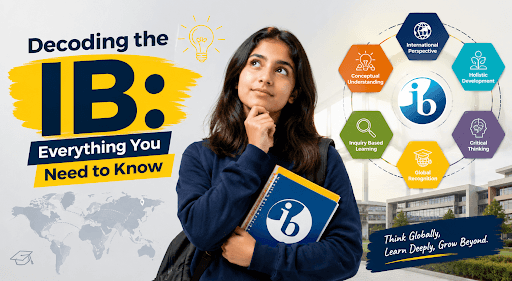

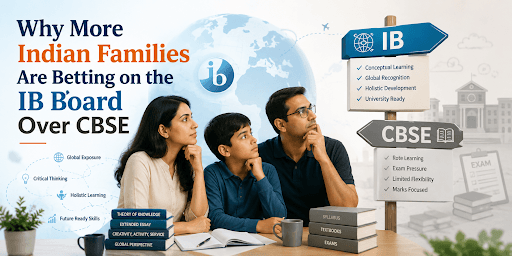
IB has been around since the 1960s, so it isn’t some new-age experiment. But if you grew up on CBSE, board exams, and the usual 10th-12th boards routine can feel like a different system altogether. Transdisciplinary themes, Theory of Knowledge, Extended Essay–none of it sounds familiar, right? Let’s remove this confusion!
Maybe you're a parent trying to figure out if IB actually makes sense for your kid. Or a student who's been told "you're doing IB" without anyone really explaining what that means. Either way, we're breaking it down properly.
And if you're specifically searching for the best IB school in Hyderabad, this will save you the trouble of opening fifteen tabs and reading vague brochures. We'll walk you through the curriculum itself — the programmes, the core components, and what makes IB different from what you're used to. We'll also bring in DRS International School as an example along the way, just to keep things real instead of purely theoretical.
Also Read: The Truth Behind 5 Common IB Board Myths
What IB Is? & Its Features
The International Baccalaureate isn’t a single course or a fixed syllabus like CBSE or ICSE. It’s a globally recognized system of education followed by schools in over 150 countries, built around one core idea: preparing students to think for themselves, not just to clear the exams.
It was founded in 1968 in Geneva, Switzerland, with a simple mission to develop young people who are inquiring, knowledgeable, and genuinely engaged with the world around them, not just their textbooks.
The Features of the IB Board:
1. It's inquiry-based, not memorization-based
Instead of "learn this, repeat this in the exam," IB pushes students to ask questions, explore concepts, and arrive at answers themselves. Facts matter, but understanding why matters more.
2. It's interdisciplinary
A history topic might connect to language, or a science concept might tie into a real-world ethical debate. The idea is that real life doesn't come in separate subject boxes, so learning shouldn't either.
3. It follows students from age 3 to 19
Unlike boards that only structure the last few years of school, IB is designed as a continuum, means starting from early childhood all the way to pre-university, with each stage building on the last.
4. Assessment isn't just about final exams
IB places a lot of weight on ongoing, internal assessment like projects, essays, presentations, alongside external exams. It's less "one exam decides everything" and more "your understanding is judged over time."
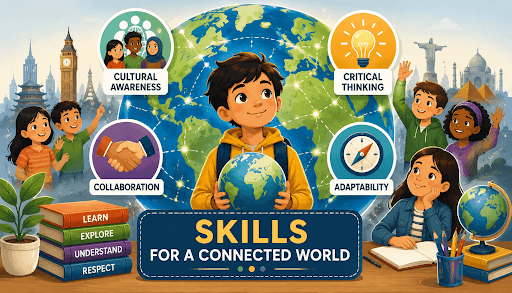
5. It has a strong focus on global-mindedness
Respect for different cultures, perspectives, and ways of thinking is baked into the curriculum, not treated as an add-on.
Four Stages of IB & How They Actually Work
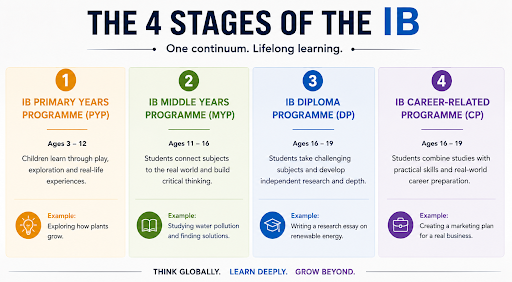
PYP: Primary Years Programme
Age: 3 - 12 years
Think of this as the "why" stage. Little kids ask a hundred questions a day, and PYP just runs with that instead of shutting it down. There's no sitting and memorizing here. Kids explore big questions like how the world works through stories, activities, and plain old play. Math, art, and science don't feel like separate subjects; they all blend into everyday exploration.
Even the report cards are different; there's less focus on marks and more on how the child is growing, whether they're curious, kind, and able to think on their own. In short, PYP just protects that natural curiosity kids already have instead of replacing it with rote learning too early.
MYP: Middle Years Programme
Age: 11 - 16
This is the middle stretch, where kids start connecting subjects instead of treating them like separate boxes. Take a language class; instead of just grammar drills, students might read a short story about a real historical event, then discuss it in their humanities class, then write a persuasive essay linking the two. Same topic, different lenses.
There are eight subject groups in total, but the real focus is connection, not memorization. The big highlight here is the Personal Project in the final year, which is a self-driven piece of work, like building an app or researching a social issue, judged on effort and thinking rather than a straight test score.
DP: Diploma Programme
Age: 16 - 19 years
This is the one everyone's actually heard of, the two years before university. Students pick six subjects, some at Higher Level and some Standard. Take Biology, for example; in DP, it's not just diagrams and definitions. A student might design their own lab experiment, analyze real data, and write it up almost like a mini research paper.
That same "figure it out yourself" energy runs through what IB calls the Core, three things every DP student has to do alongside their subjects. There's TOK (Theory of Knowledge), which isn't really a subject with facts to memorize. It's more of a thinking class, questioning how we actually know what we know. There's the Extended Essay, a proper independent research paper, around 4,000 words, on a topic the student picks themselves. It's almost like a first taste of university-level research.
And there's CAS (Creativity, Activity, Service), which gets students out of the classroom entirely. Picking up something creative, staying active, and genuinely giving time to community work, with no exam attached, just honest reflection on what they actually took from it. It's intense, sure, but it builds someone who can think and manage their own work.
CP: Career-related Programme
Age: 16 - 19
Think of this as DP's more practical sibling. Say a student is genuinely interested in business. Instead of picking six purely academic subjects, they'd take a couple of DP courses, like Economics or Business Management, and pair them with career-related study focused on real industry skills, such as digital marketing or entrepreneurship.
So instead of just learning marketing theory from a textbook, the student might actually work on a mock campaign for a real product, understand pricing, and analyze what actually works and what doesn't. Add a Reflective Project on top, where they think through a real-world issue tied to their chosen field, and you get a qualification that's still globally recognized, but built for someone who wants academic depth without going the fully traditional academic route.
Also Read: Should Every Student Learn a Global Language?
Take A Short Meme Break
If you are confused between CBSE, ICSE & IB, these memes will remove all confusion:
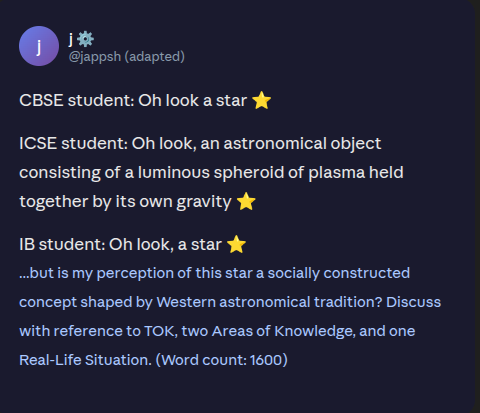
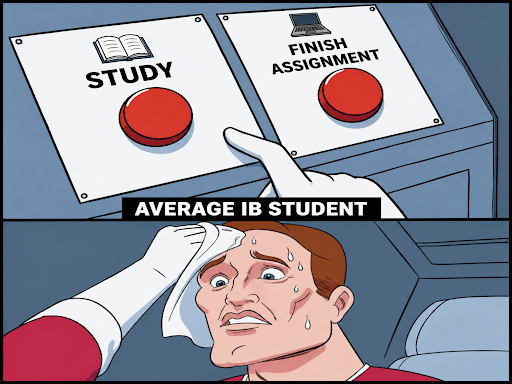
This is for all the IB Students who are torn between sleep, studies, and assignments:
DRS International School: A Real Example of IB in Action
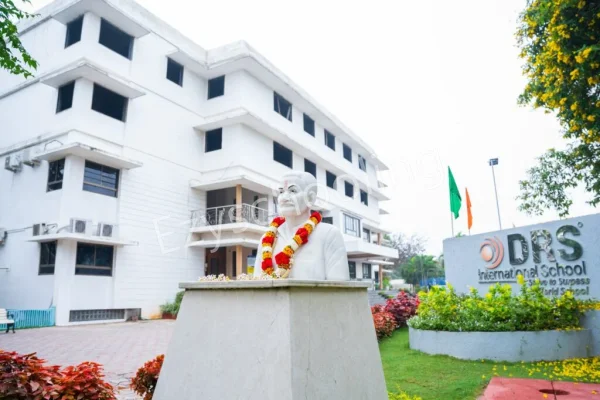
Reading about programmes and acronyms is one thing, but seeing how it actually plays out in a real school makes it easier to picture. That's where DRS International School in Hyderabad comes in.
Located in Dulapally, Kompally, DRS offers the full IB continuum, meaning a child can go through PYP, MYP, and DP at the same school, all the way from age 3 to the pre-university years. It's also one of the few schools in the city recognized as an IB Continuum World School, which basically means it's authorized to teach more than one IB programme under one roof, something not every school manages to pull off.
What's interesting is that DRS doesn't run IB in isolation either. It offers CBSE alongside IB, so families genuinely get to choose the path that fits their child, instead of being boxed into one system by default.
Beyond academics, there's a strong push toward the "whole child" idea that IB keeps talking about. Life skills programmes, community outreach, sports, personality development workshops, even a residential wing for students who need it. It's less about just clearing a syllabus and more about building the kind of well-rounded profile IB is designed around in the first place.
The school has also picked up recognition along the way, including a British Council International School Award, and has had notable personalities like Grandmaster Viswanathan Anand associated with it, which says something about the kind of visibility and standards it's aiming for.
If you're specifically searching for top schools in Hyderabad that offer a genuine IB pathway without compromising on CBSE as a backup option, DRS is a name that comes up for good reason. It's not just about ticking the "IB school" box; it's about actually building the ecosystem, teachers, facilities, and programme structure that the IB philosophy needs to work in the first place.
For more information about this and other schools in this area


 as a preferred source on