









A child may know the answer to a query but may be hesitant to raise his hand. Another may have a brilliant idea for a group project but may find it hard to voice it when someone questions him. The soft skills acquired during these minuscule classroom interactions follow a child throughout his life. Be it while presenting a project, voicing a concern at home, working in coordination with someone or even during a conference call at work, explaining an idea or a thought process logically is a skill that comes in handy at some point in everyone's life. This is why, while parents look for best schools in Hyderabad, they may also consider Meru International School, where the children are provided with a platform to exhibit their leadership skills and ability to work in a team, apart from regular studies.
Why Speaking Up Is More Than Public Speaking
It is important to note that everyday communication extends far beyond the speaking arena. From a young age, children explain to their parents why they should go to a specific destination, ask their teacher for help, and share with a friend why a group activity should be modified. These are all methods of communication, as the key is to make sure that the intended message is received by another individual.
According to research conducted by the OECD, there is a link between students who feel confident voicing opinions, taking action in groups, and raising their voices concerning topics that interest them, and slightly better performance on creative thinking tests. The OECD also reports that perspective-taking is closely linked to creative thinking.
This serves as a reminder to parents that in order for children to engage in idea-sharing, questioning and modifying, they need to be encouraged.
A useful progression can look like this:
|
Opportunity |
What does the child practices |
|
Show-and-tell |
Speaking clearly |
|
Group discussion |
Listening and responding |
|
Debate |
Building an argument |
|
Presentation |
Organising ideas |
|
Student council |
Representing others |
|
Negotiation activity |
Finding common ground |
A child who regularly moves through these experiences slowly learns that communication is not about having the loudest voice. It is about making your thinking visible.
Do Follow | MUN Teaches Students to Disagree Well
Learning to Defend an Idea Without Fighting
Imagine two children planning a class picnic. One wants a park, while another prefers a museum. A child who has only learned to "win" an argument may simply repeat, "My idea is better." A child who has practised reasoning might ask, "Why do you prefer the museum?" The answer may reveal that the other child is worried about the weather.
Suddenly, the disagreement has changed. The children are no longer fighting over two choices. They are solving a problem.
This connects with a basic idea from negotiation research: people often have positions and interests. Harvard's Programme on Negotiation explains that understanding those underlying interests can open the door to solutions that satisfy different priorities.
Children can practise this through simple situations:
- Two friends want different games during free time.
- A group cannot agree on how to divide a project.
- Siblings want to use the same device at the same time.
- A student thinks a school rule should be changed and wants to explain why.
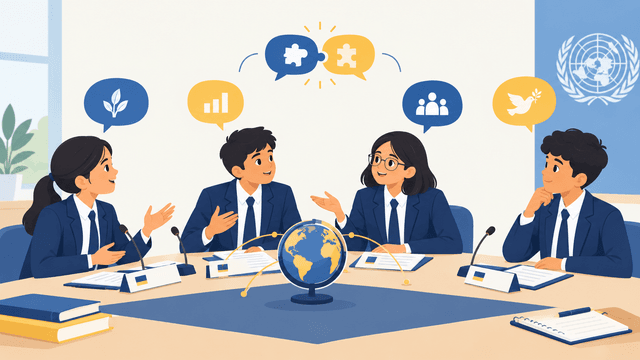
These are small situations, but they teach children to ask questions, listen carefully, explain their reasoning, and look for alternatives.
From Classroom Discussions to Future Workplaces
The phrase "conference room" is not necessarily something students think of often. Future professionals may need to be able to talk through a solution for a problem, explain a situation to a client, debate a point with a peer, or negotiate with a boss.
This is why schools should integrate communication into the curriculum on a regular basis instead of as an occasional competition.
Rather than have students write about what they would do to save water, teachers could ask students to explain what they would do to save water by asking them to:
- Research the problem.
- Take different viewpoints.
- Present a proposal.
- Question another group's proposal.
- Modify their idea after receiving feedback.
This approach combines knowledge with communication and creative thinking. The OECD describes creative thinking as the ability to generate ideas and then evaluate and improve them, rather than simply producing something new.
The result is a child who learns that changing an idea after hearing better evidence is not losing. It is learning.
Also Read | The Power of Transformative Learning
How Schools Can Create Real Opportunities for Student Voice

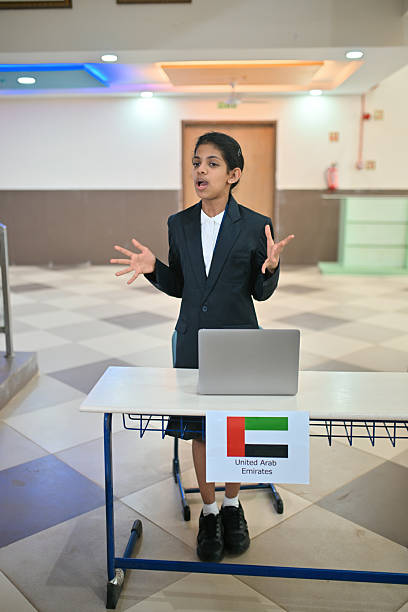
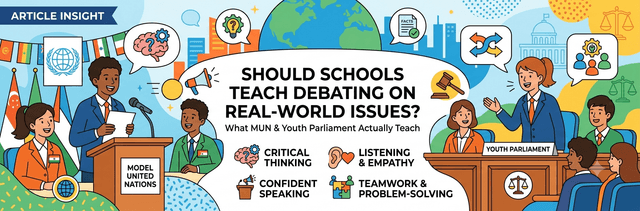
Debates can teach students to support opinions with reasons and evidence. Student councils can show them what it means to represent other people's concerns rather than simply their own. Model United Nations can introduce negotiation, diplomacy, and different perspectives.
Meru International School's Student Council includes Junior and Senior Councils, with multiple students involved in understanding concerns, suggesting solutions, and providing feedback on school policies.
Its JMUN program provides students with opportunities to engage in research-based discussions, debates, negotiations, and resolutions of real-world issues. The 2026 edition featured discussion-based research, policy debates, and resolution writing, while the 2025 edition attracted over 300 delegates.
The school's Student-Led Conference takes a different approach by encouraging students to share what they have learned and how they are progressing, as well as what they need to work on. This allows them to present evidence about their own learning and improve their speaking skills. For parents searching for the best schools in Tellapur, Meru International School can serve as an example of how students' voices can be heard beyond the classroom, in leadership, reflection, and decision-making.
Conclusion
The goal is not to turn every child into a future politician, lawyer or corporate speaker. It is to help children become comfortable with the ordinary parts of adult life: explaining what they think, listening when someone disagrees, asking better questions, changing their minds when evidence demands it, and finding solutions when people want different things.
A classroom that makes room for these experiences is doing more than teaching children how to speak. It is teaching them how to participate. And that is a skill they can carry from their first group project to their future conference room.
To know more about schools in Hyderabad, click on the link below
 as a preferred source on