







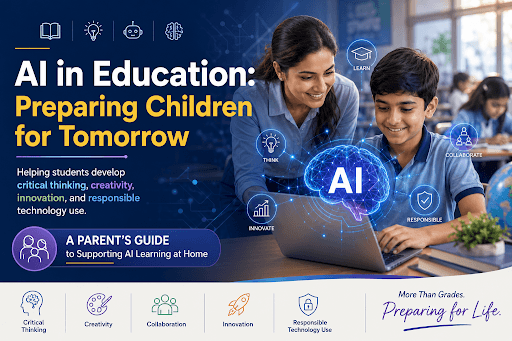

Artificial Intelligence is no longer a technology of the future. It is becoming a part of everyday life, from the way we search for information and learn new skills to how businesses, hospitals, and governments operate.
Recognising this shift, Podar Global School, one of the schools in Yelahanka, Bangalore, has integrated Artificial Intelligence into its curriculum, helping students build future-ready skills while strengthening creativity, critical thinking, and responsible technology use. This step reflects Podar's long-standing commitment to preparing children for the evolving world around them.
Interestingly, schools across India are moving in the same direction. Government bodies and education boards are actively working towards expanding AI education, with initiatives focused on introducing AI concepts to students from an early age and strengthening digital literacy nationwide. For many parents, however, the introduction of AI raises an important question:
"How can I support my child when I don't know much about AI myself?" The good news is that you do not need to be a technology expert. What children need most is guidance, curiosity, and healthy learning habits.
Also Read| Improve Retention Through 3D Learning at Podar Global School
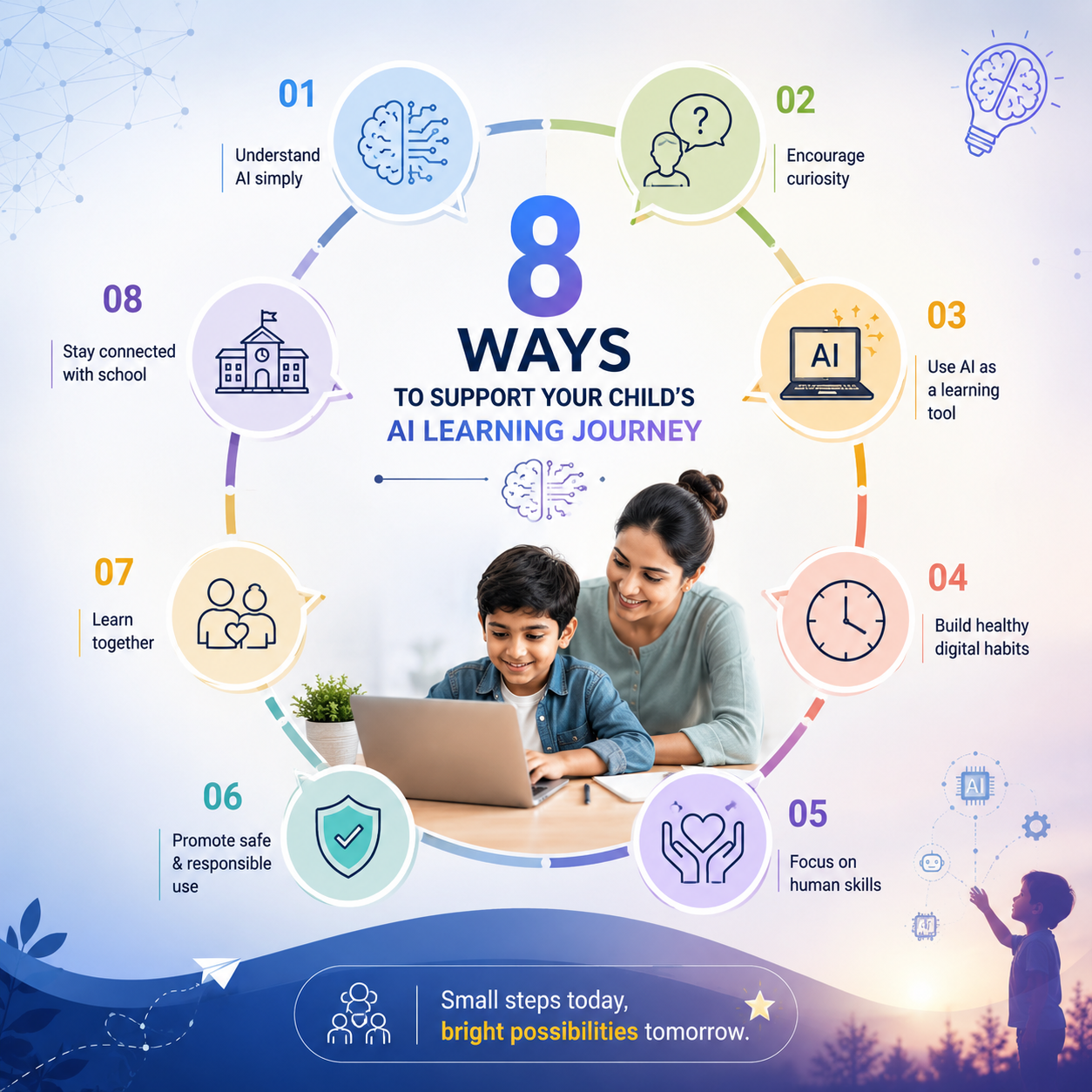
Here is a practical step-by-step guide on how you can help your child learn AI better.
Step 1: Understand That AI Is More Than Coding
Many parents assume AI means programming and complex computer science. At the school level, AI education often begins with understanding how technology makes decisions, recognises patterns, solves problems, and assists humans. Students learn to think logically, ask better questions, and use digital tools responsibly.
The goal is not to turn every child into a software engineer. The goal is to help them become informed, confident, and adaptable learners.
Step 2: Encourage Curiosity Instead of Providing Answers
When your child talks about an AI tool or project, avoid immediately giving solutions.
Instead, ask questions such as:
- How did the AI arrive at that answer?
- Do you think the answer is correct?
- What would happen if the information were wrong?
- Can you verify it from another source?
These conversations strengthen critical thinking, which remains one of the most important skills in an AI-powered world.
Step 3: Teach Children That AI Is a Tool, Not a Replacement for Thinking
One of the biggest misconceptions about AI is that it can do all the thinking for us. Children should learn that AI can assist learning, but it cannot replace creativity, judgment, empathy, or original ideas.
Encourage your child to use AI to brainstorm ideas, learn concepts, or explore topics—but not to avoid learning.
Step 4: Create Healthy Digital Habits at Home
As children gain access to more digital tools, balance becomes increasingly important.
Parents can help by:
- Setting clear screen-time boundaries
- Encouraging outdoor play and physical activity
- Maintaining regular reading habits
- Promoting face-to-face conversations and family interactions
Technology should enhance childhood, not replace it.
Step 5: Focus on Skills That AI Cannot Easily Replicate
While AI can process information quickly, uniquely human qualities remain invaluable.
Encourage activities that build:
- Creativity
- Communication
- Collaboration
- Leadership
- Emotional intelligence
- Problem-solving
These skills will continue to be essential regardless of how technology evolves.
Step 6: Discuss Online Safety and Responsible Use
AI-powered tools often rely on information shared by users.
Teach children simple digital safety rules:
- Never share personal information online
- Verify information before believing it
- Respect intellectual property
- Use technology ethically and responsibly
Learning responsible AI use is just as important as learning how AI works.
Step 7: Learn Alongside Your Child
Perhaps the most powerful thing a parent can do is embrace a learning mindset. You do not need to know every answer. When children see parents asking questions, exploring new ideas, and adapting to change, they learn that continuous learning is a lifelong skill.
Also Read| Where Gandhi's Values Meet Modern Innovation: Inside Podar Global School
Preparing Children for Tomorrow
Artificial Intelligence is transforming the way we live, learn, and work. Yet, at its core, education remains about something far more enduring: helping children become thoughtful, capable, confident, and responsible individuals who can navigate an ever-changing world.
One of the schools in Yelahanka, Bangalore, Podar Global School, has introduced AI into the curriculum, which is not simply about teaching students to use new technology. It is about preparing them for the future through a balanced approach that combines innovation with strong foundational values. By integrating AI learning with critical thinking, creativity, problem-solving, collaboration, and ethical decision-making, the school is ensuring that students develop the skills needed to thrive in the 21st century.

As part of the renowned Podar Education Network, the school has consistently focused on creating meaningful learning experiences that go beyond textbooks and examinations. The addition of AI education is a natural extension of this vision, equipping students with the confidence to understand emerging technologies while encouraging them to think independently and responsibly.
The future will not belong simply to those who know how to use AI. It will belong to those who can question it, evaluate it, innovate with it, and use it wisely. These are the qualities that will help young learners become future-ready leaders, innovators, and changemakers.
As schools embrace new possibilities and parents continue to support learning at home, a strong partnership between the two becomes more important than ever. Together, they can ensure that children are prepared not just for the next examination, but for a future filled with opportunities, challenges, and possibilities yet to be imagined.
If you want to know more about this school and other schools in this & nearby areas
 as a preferred source on