







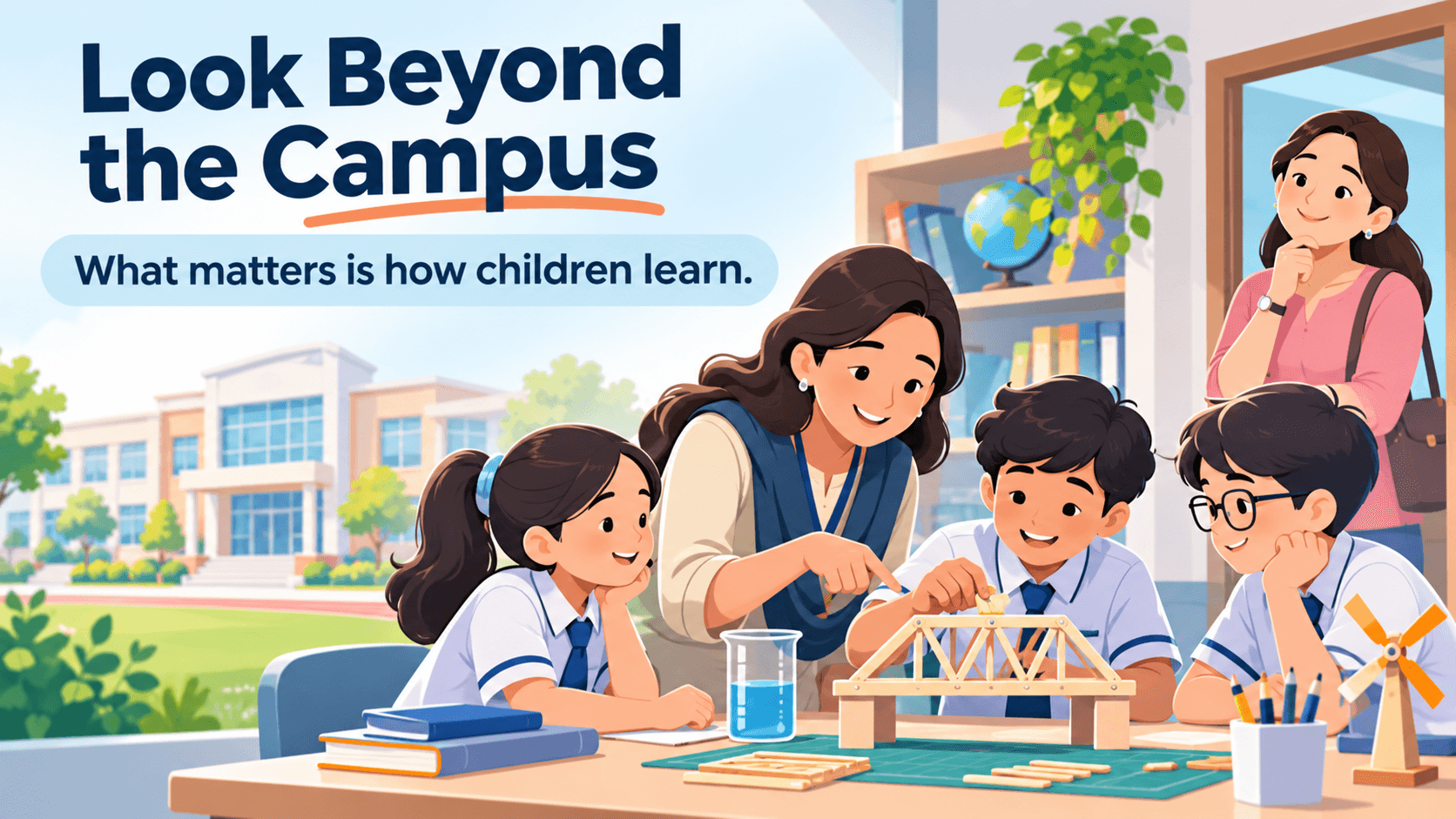

When parents visit a school, they usually notice what they can see: the campus, classrooms, laboratories, library, sports facilities, auditorium and technology. These facilities matter. Children need safe, stimulating spaces in which to learn, play and grow.
But an impressive campus does not automatically mean an equally strong learning experience. The more important question is: What happens to a child inside that infrastructure?
For parents exploring how to choose the right school for their child, this distinction matters. Pune offers schools with different educational philosophies, teaching methodologies and approaches to student development.
A robotics lab tells you that equipment is available; it does not tell you whether children design, experiment and solve problems. A sports ground provides space to play; it does not show whether students develop teamwork, discipline and resilience.
As education places greater emphasis on critical thinking, creativity and experiential learning, parents need to look beyond facilities and understand the everyday educational experience.
Infrastructure Matters, But It Is Only the Beginning
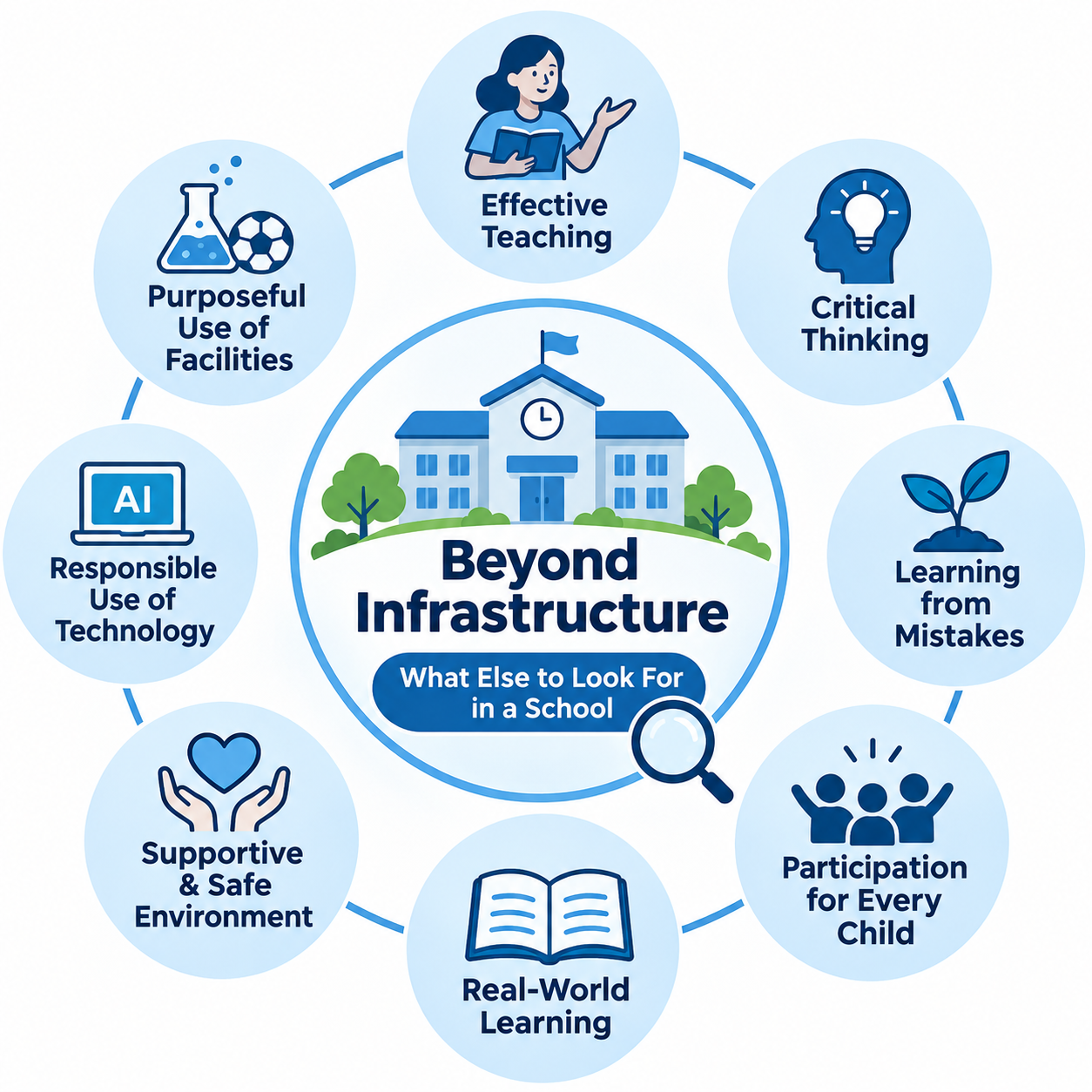
A well-equipped campus can support learning, but the value of a facility depends on how students use it. During a school visit, ask:
- How often do students use the laboratories, library and sports facilities?
- Do children conduct experiments or simply watch demonstrations?
- Are students creating projects, solving problems and presenting ideas?
- Do all children get opportunities to participate, or only a selected few?
Look for frequency, access and purpose. A facility used regularly as part of learning can be valuable; one that students rarely enter may contribute little to their education.
Infrastructure tells you what a school owns. Student experience tells you what a school believes.
Look at the Classroom, Not Just the Furniture
Smart boards, modern furniture and digital tools can support teaching, but they do not guarantee effective learning. Notice what students do during a lesson. Are they mainly listening and memorising, or are they questioning, discussing, experimenting and applying concepts?
Direct teaching is important for building strong foundations in mathematics, science and languages. But children also need opportunities to understand ideas rather than simply reproduce answers.
Through experiential learning, students investigate, collaborate, make mistakes and discover solutions. Look for classrooms that encourage curiosity and independent thinking.
Teachers Matter More Than Technology
Schools can purchase technology; building a culture of effective teaching takes sustained effort. Beyond teachers' qualifications and subject knowledge, parents should ask how educators are trained, supported and encouraged to improve.
Ask how teachers receive professional development, support different learning needs and encourage questions and independent thinking.
As artificial intelligence makes information easier to access, teachers play an important role in helping students evaluate information, understand context and apply knowledge responsibly. Technology can support teaching, but it cannot replace the relationship between a teacher and a child.
Does the School Encourage Critical Thinking?
A child who memorises a science definition has a different experience from one who conducts an experiment, observes the results, asks questions and discusses what happened.
Look for opportunities for students to analyse ideas, debate, solve open-ended problems, conduct investigations and explain their reasoning. The growing importance of computational thinking and artificial intelligence makes these capabilities even more relevant. CBSE's 2026–27 framework for Classes III to VIII reflects this changing educational landscape.
Parents should ask not simply whether a school teaches AI, but what students actually learn: Do they understand its limitations, verify information and use technology responsibly? The aim should be to help children question, evaluate and use information intelligently.
What Happens When a Child Makes a Mistake?
A school's response to mistakes reveals much about its learning culture. If errors are treated only as failures, children may become reluctant to ask questions or attempt challenging tasks.
When mistakes are treated as part of learning, students can understand what went wrong, try again and develop resilience. A supportive environment does not remove standards or challenges; it gives children the guidance and confidence to work through them.
Does Every Child Get an Opportunity to Participate?
A school may organise debates, competitions, sports events and cultural programmes, but how many students take part? Opportunities should not be limited to children who are already confident or academically strong.
Children may show leadership through communication, creativity, empathy, organisation or technical skills. Schools should create different ways for them to discover their strengths and take responsibility.
Leadership is more than a badge or title. Organising an event, coordinating a team, managing a project and making decisions can teach accountability, communication and collaboration.
Learning Should Extend Beyond Textbooks
Academic knowledge becomes more meaningful when children connect it to everyday life. A mathematics lesson can become a budgeting exercise; science can involve an investigation; an entrepreneurship activity can introduce problem-solving, costs and decision-making.
Financial literacy, communication, technology and entrepreneurship broaden the educational experience. Ask to see student work and find out what problems children tackled, what decisions they made and what they learned.
How Do Pune Schools Differ in Their Educational Approach?
Pune offers a diverse range of schools, each with its own educational emphasis. Published information can help parents begin their research:
- The Lexicon Schools highlights experiential and interdisciplinary learning, technology, coding, entrepreneurship, financial literacy and student participation.
- The Bishop's School shares examples of practical learning alongside its academic approach.
- St. Mary's School, Pune offers opportunities for projects, research and activities beyond conventional classroom instruction.
- The Orbis School highlights experiential learning, peer learning, leadership and collaboration.
- Podar International School focuses on innovation-oriented learning, including coding, robotics and artificial intelligence.
- Mahindra International School emphasises inquiry, student agency and real-world learning.
These examples are starting points, not rankings. Visit schools and speak with teachers to understand how each philosophy translates into everyday learning. The right choice depends on a child's needs and aspirations, not simply the number of facilities.
A Parent's School-Visit Scorecard
Use the same criteria when comparing schools. Give each area a score from 1 to 5.
Use the scorecard as a guide, not a substitute for judgement. During your visit, ask to observe a regular classroom, see recent student projects, understand how mistakes are handled, and find out how opportunities for leadership, sports, arts and technology are shared. Also ask how teachers are supported and what capabilities the school hopes students will develop by Class XII.
The Building Matters. But the Child Matters More.
Infrastructure, safety, academic results and facilities should all be considered when choosing a school. But parents should also understand how children learn, how teachers support them and whether students are encouraged to question, create, collaborate and lead.
A good school does more than prepare children for examinations. It helps them develop the knowledge, confidence and skills to navigate an evolving world.
Ultimately, the question is not how impressive a school looks when parents walk through its gates. It is what happens to the child after walking through those gates every morning.
The building matters. But the child matters more.
Frequently Asked Questions
1. What is the most important factor when choosing a school?
Consider teaching quality, classroom experience, academic foundations, student participation, critical thinking, emotional development and experiential learning opportunities.
2. Is school infrastructure important?
Yes. Safe, well-equipped facilities support learning. Parents should also understand how frequently and meaningfully students use them.
3. How can parents identify genuine experiential learning?
Ask to see student projects. Find out what problems students solved, what decisions they made and what they learned from the process.
4. Should parents look for AI education in schools?
Yes. Ask how schools introduce computational thinking, AI concepts and responsible technology use in an age-appropriate way.
5. Are sports and arts important alongside academics?
Yes. Sports, arts, music and communication activities can develop teamwork, creativity, discipline, confidence and resilience.
6. Should parents choose a school based on rankings?
Rankings can offer useful information, but they should not be the only deciding factor. Teaching, school culture and suitability for the child matter too.
The best school is one where a child does not simply gain knowledge, but develops the ability to think, create, communicate and grow independently.
For more information on this and similar schools, check out this list of the best schools in Pune.
 as a preferred source on