







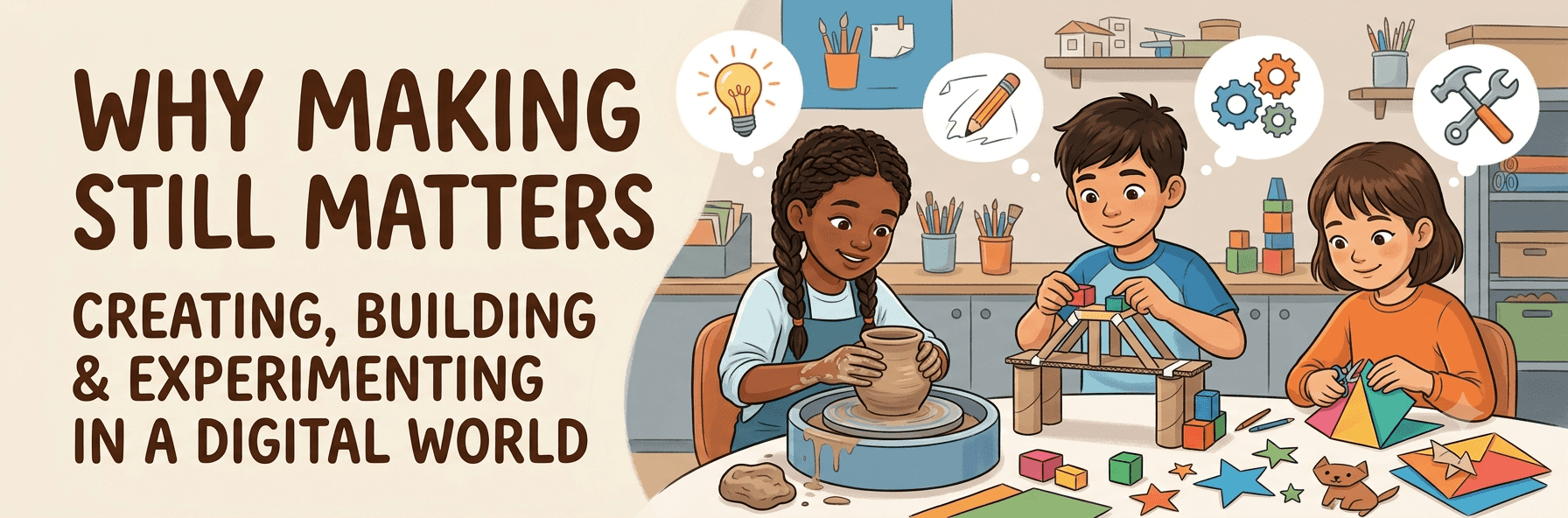

A child can watch someone build a clay pot, fold paper into something interesting, or create a beautiful craft in just a few minutes online. But give that same child a piece of clay, paper, or cardboard and ask them to make something themselves, and the experience can be very different.
They have to decide where to begin.
They may make mistakes. They may change their idea halfway through. They may end up with something completely different from what they imagined.
That is exactly why making still matters.
For children growing up surrounded by screens, digital tools can offer wonderful ways to learn and explore. But children also need opportunities to physically create, build, experiment, and work with materials. Delhi World Public School is one example of a school that includes practical and creative experiences alongside its broader learning programme.
Also Read| Empowering Young Voices through Language Learning
What Does “Making” Actually Mean for Children?
Making does not simply mean doing an art-and-craft activity.
It can mean building a model, shaping clay, preparing a simple dish, creating something from recyclable material, designing an object, growing a plant, or repairing something under adult guidance.
The important part is that the child is actively creating something rather than only watching or consuming information.
When children make something, they have to think about what they want to achieve and how they will get there. Even a simple activity can involve planning, choosing materials, following steps, and making adjustments.
The final product may not be perfect. That is part of the learning.
What Happens When Children Make Things?
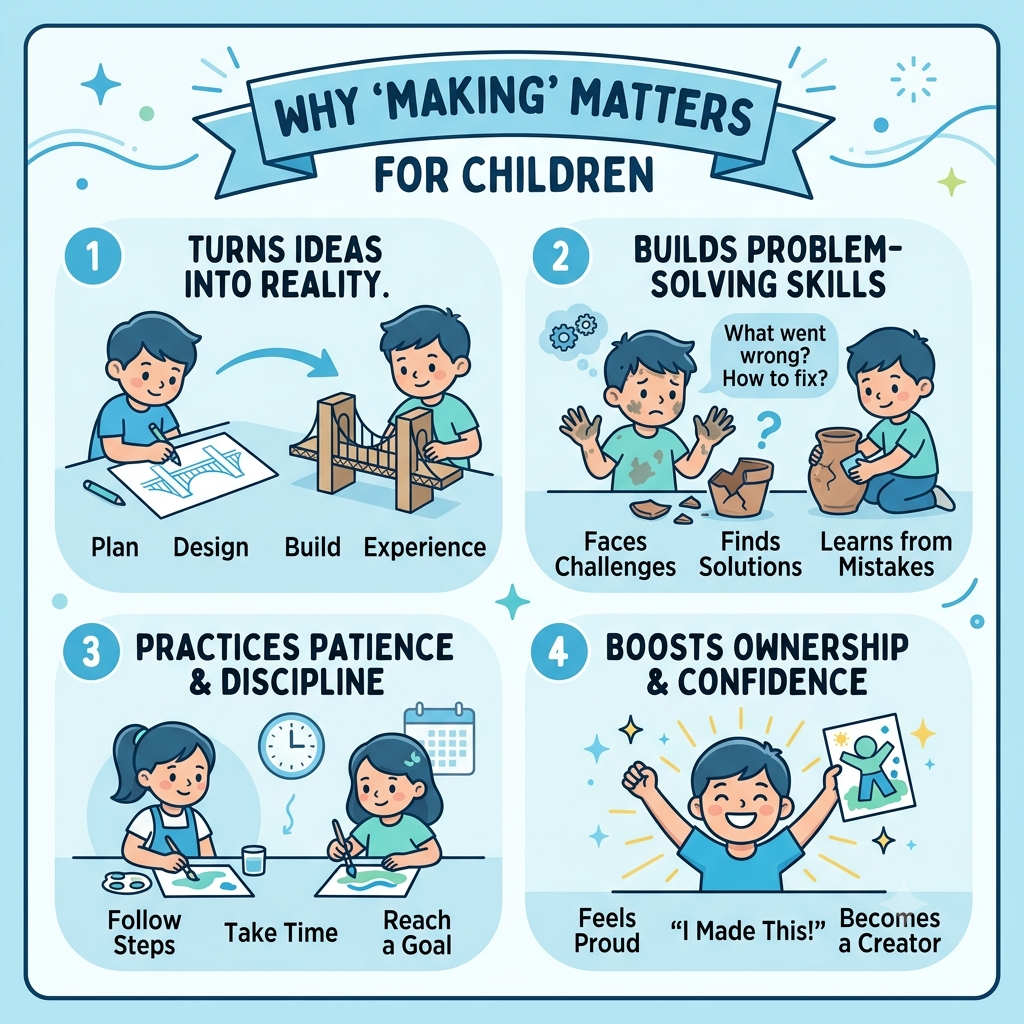
They Turn Ideas Into Something Real
Children often have plenty of ideas. Making gives them a chance to discover what happens when an idea has to become something physical.
Suppose a child wants to build a small bridge using cardboard. They need to think about its shape, strength, and balance. If it bends or falls, they have a reason to reconsider the design.
This is different from simply being told how a bridge works.
The child is experiencing the problem.
They Learn to Deal With Problems
One of the most useful things about making is that problems become visible.
A paper structure may not stand. A clay object may lose its shape. A craft may not look the way the child expected.
Instead of immediately asking an adult for the answer, children can be encouraged to ask:
“What went wrong?”
and then:
“What can I change?”
This simple process can help develop practical problem-solving habits.
They Practise Patience
Digital content often moves quickly. A child can switch between videos, games or activities within seconds.
Making usually works differently.
A child may need to wait for something to dry, repeat a process, correct a mistake, or spend time completing several steps.
This can give children valuable practice in staying with a task even when the result does not appear immediately.
They Experience Ownership
There is a special satisfaction in looking at something and being able to say:
“I made this.”
It does not have to be beautiful or complicated.
The sense of ownership comes from having made choices and put effort into the process. Over time, such experiences can encourage children to see themselves as capable creators rather than only users of things made by others.
Making Is Not About Getting Everything Right
Parents sometimes worry that a child's craft, model, or project should look polished. But an imperfect creation can actually provide useful learning.
A child whose model falls apart has an opportunity to understand why.
A child whose design does not work can change it.
A child who makes a mistake while preparing something can think about what should be done differently next time.
This makes failure part of the process rather than the opposite of learning.
It is also why adults should avoid taking over too quickly. If a parent fixes every crooked piece or completes every difficult step, the final product may look better, but the child may miss the chance to solve the problem independently.
How Parents Can Encourage More Making at Home
Making does not require expensive equipment or a dedicated room.
Start With Everyday Materials
Cardboard boxes, paper, string, and other safe reusable materials can become building resources.
Ask your child what they could create rather than giving them a fixed design to copy.
Let Children Help With Simple Cooking
Age-appropriate cooking can involve measuring, sequencing, observing changes, and making decisions. Even something as simple as preparing a no-fire snack can become an opportunity to learn.
Give Them Small Problems to Solve
Instead of immediately repairing a loose arrangement of books or finding a storage solution yourself, ask:
“How could we make this work better?”
Let the child suggest an idea and test it.
Make Room for Imperfect Results
The goal is not to create something worthy of display every time.
Sometimes the most valuable part is the thinking, experimenting and trying again.
What Should Parents Look for in a School?
When choosing a school, parents may look at classrooms, academic programmes and examination preparation. These remain important, but it is also worth asking how often children get opportunities to create something themselves.
Parents can look for learning environments where students:
- Work with different materials
- Build or design things
- Participate in practical activities
- Experiment with ideas
- Have opportunities to improve their work
- Connect activities with real-life situations
- Learn that creativity is about more than producing a perfect final product
The strongest making experiences are not necessarily the most elaborate ones. A simple activity can be meaningful when children have room to think and make choices.
Also Read| Fostering Growth Through Social-Emotional Care
How Delhi World Public School Makes Space for Making
At Delhi World Public School, practical work includes activities such as embroidery, paper craft, fireless cooking and recycling projects, while pottery adds a tactile element to creative learning. The school's Imaginarium also provides opportunities to explore areas such as painting, sculpture, pottery and crafts.

For parents considering a Top school in Greater Noida West, these kinds of experiences can be worth considering alongside academics because they give children opportunities to create, experiment, and develop practical skills. Families looking for the Best school in Greater Noida West can similarly ask whether a school's approach gives children enough opportunities to move from simply consuming information to actively making something of their own.
Children Need to Create, Not Just Consume
Technology has an important place in modern childhood. Children can use digital tools to discover ideas, learn new skills, and explore subjects in ways that were difficult to imagine earlier.
But a screen cannot replace every kind of experience.
Children also need to get their hands messy, make imperfect things, change their plans and discover what happens when an idea meets reality.
Sometimes, meaningful learning can begin with something very simple: a piece of paper, a lump of clay, a cardboard box, or a few safe household materials.
The important question is not “Did the child make something perfect?”
It is: “What did the child discover while making it?”
To know more about other schools in Greater Noida West, click on the link below.
 as a preferred source on