









There is a funny thing about children. Tell them to remember something, and they may forget it by the next morning. Let them actually do it, and somehow the memory sticks.
Ask a child what they learned in science last week, and you might get a blank face. But ask them about the experiment where the model fell apart three times before finally working, and suddenly they remember everything — what they did, what went wrong, and why they changed it.
Learning does not always happen when a child is sitting with a book open in front of them. Sometimes it happens while building, moving, touching, acting, measuring, or simply trying something out. This is the thinking behind kinesthetic learning.
We'll also look at a few schools in Bangalore, like Podar Global Schools, one of which is using such techniques to help children learn efficiently.
Also Read: Is AI a danger to growing kids? How are schools balancing it?
What Exactly Is Kinesthetic Learning?
Kinesthetic learning is a way of learning where physical activity and hands-on experience become part of the process. Instead of only listening to an explanation or reading about something, children get opportunities to interact with the idea.
Take examples of fractions. A teacher can write ½, ¼, and ¾ on the board and explain them. The child may understand the explanation. But give them a paper circle and ask them to divide it into four equal pieces. Now ¼ is no longer just a number written in a notebook. It is something they can see and handle.
The same thing happens outside mathematics. A child learning directions can walk around a space using a map. A student learning about forces can build and test a small structure. A language class can involve role-play instead of only filling in blanks.
The activity is not meant to replace teaching. It becomes another way of teaching.
The Brain and the Body Are Not Completely Separate
For a long time, classroom learning has often been imagined as something that happens mainly inside the head. Sit still, listen carefully, remember the information and reproduce it in the examination.
But research around embodied cognition offers a slightly different way of looking at learning. It explores how our physical bodies, actions and surroundings can influence the way we think and understand things.
Think about learning the word “above”.
You could memorise its dictionary meaning. Or you could hold a ball above your head, put it below the table and move it beside a chair.
The second experience gives the word a context.
Even something as ordinary as using hand gestures while explaining an idea can connect physical movement with thinking. The body is not doing all the learning, of course. But it can become part of the learning process.
Children Have Always Learned by Doing
Interestingly, the philosophy behind this is not particularly new. Educational philosopher John Dewey argued strongly for the importance of experience in education. His work challenged the idea that education should be separated from the experiences of everyday life.
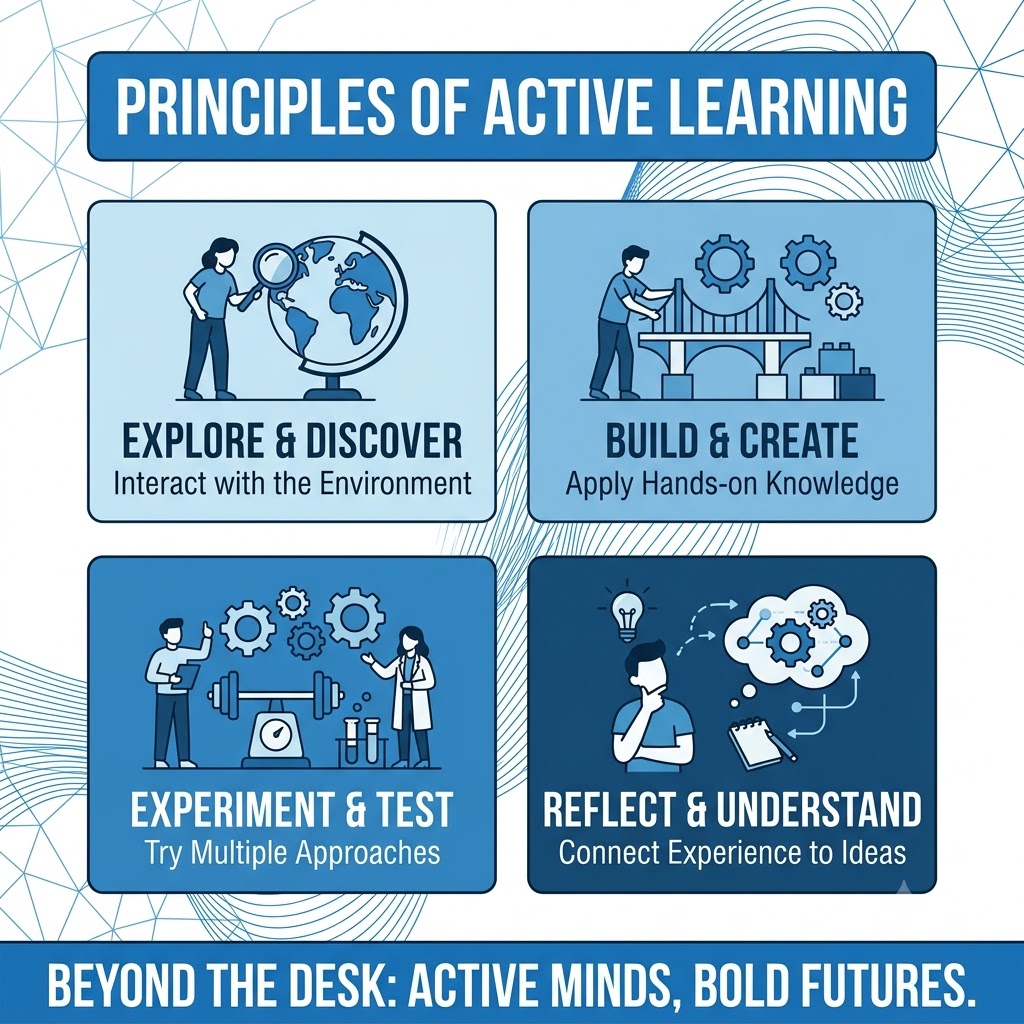
Later, David Kolb developed the idea of experiential learning, where experience, reflection, understanding and experimentation work together. In a classroom, that might look something like this:
- Try: A child builds something or performs an activity.
- Notice: They see what worked and what did not.
- Think: They try to understand why it happened.
- Try again: They change something and test the idea once more.
It sounds simple, but that little cycle can teach something that memorising an answer often cannot: how to figure things out.
What If the Answer Is Wrong?
This is probably one of the more useful parts of learning through activity. Imagine a group of students building a paper bridge. They put more weight on it and, collapse.
Nobody needs to circle an answer in red ink. The bridge itself has given them feedback. Maybe the base was too narrow. Perhaps the paper needed folding differently. Maybe the students simply put too much weight in one place.
They make changes and try again. This is where learning can become less frightening. A mistake is not just “wrong”; it is information about what to change next.
It also connects with psychologist Carol Dweck's work on growth mindset, which emphasises the role of effort, feedback and strategies in developing abilities. A hands-on activity naturally creates situations where children have to adjust their approach rather than simply accept that they got something wrong.
And No, It Doesn't Mean Every Class Needs Games
Kinesthetic learning can easily be misunderstood. It does not mean:
- children have to be moving throughout the entire lesson;
- books and writing suddenly become unnecessary;
- every topic has to be converted into a game;
- or sitting and listening are somehow “bad” ways of learning.
A good lesson can involve several things. Children might listen to an explanation, read something, discuss it with classmates, and then use an activity to apply what they have understood. The important question is not, “Are the children moving?”
It is, “Does the activity help them understand something better?”
That difference is important.
Sometimes the Simplest Activities Work Best
A school does not need an elaborate laboratory or expensive technology for kinesthetic learning to happen.
- A mathematics teacher can ask students to measure the classroom.
- A history teacher can let students recreate a marketplace from a particular period.
- A biology lesson can involve students creating a simple model of an ecosystem.
- A geography class can turn the floor into a rough map and ask students to physically locate different places.
Even writing can become active. Students can arrange sentence cards to understand how changing the order of words changes meaning.
These are small things, but they change the role of the child. Instead of only receiving information, the child has to do something with it.
Why This Approach Matters Today
Children are growing up in a world where finding information is easier than ever. A search can produce an answer in seconds. AI tools can explain a difficult concept almost instantly. So perhaps one of the more important things schools can offer is not simply more information, but opportunities to experiment with it.
A child who has built, tested, failed and rebuilt something has practised a skill that goes beyond remembering a chapter. They have had to make a decision, observe the result and change their approach.
That kind of learning can be useful whether the child eventually becomes an engineer, designer, teacher, researcher, entrepreneur or chooses an entirely different path.
Also Read: The Role of AI in Modern School Education
How Podar Global School, Yelahanka Is Bringing This Approach Into Learning
At Podar Global School, one of the top schools in Yelahanka, Bangalore, kinesthetic learning forms part of the school's broader approach to making learning more activity-oriented and engaging. The school highlights kinesthetic learning alongside brain-based learning and other teaching approaches designed to move children beyond purely passive classroom learning.

Its approach gives importance to learning through activity and experience, allowing children to engage with concepts rather than simply receive them. The larger contribution of such an approach is easy to understand.
When children are given opportunities to build, experiment, move, observe and try again, school becomes less about getting through a chapter and more about understanding how things work. And perhaps that is what learning should leave a child with — not just a notebook full of answers, but the confidence to ask, “What happens if I try it another way?”
For more information regarding this and other schools in the nearby area
 as a preferred source on