





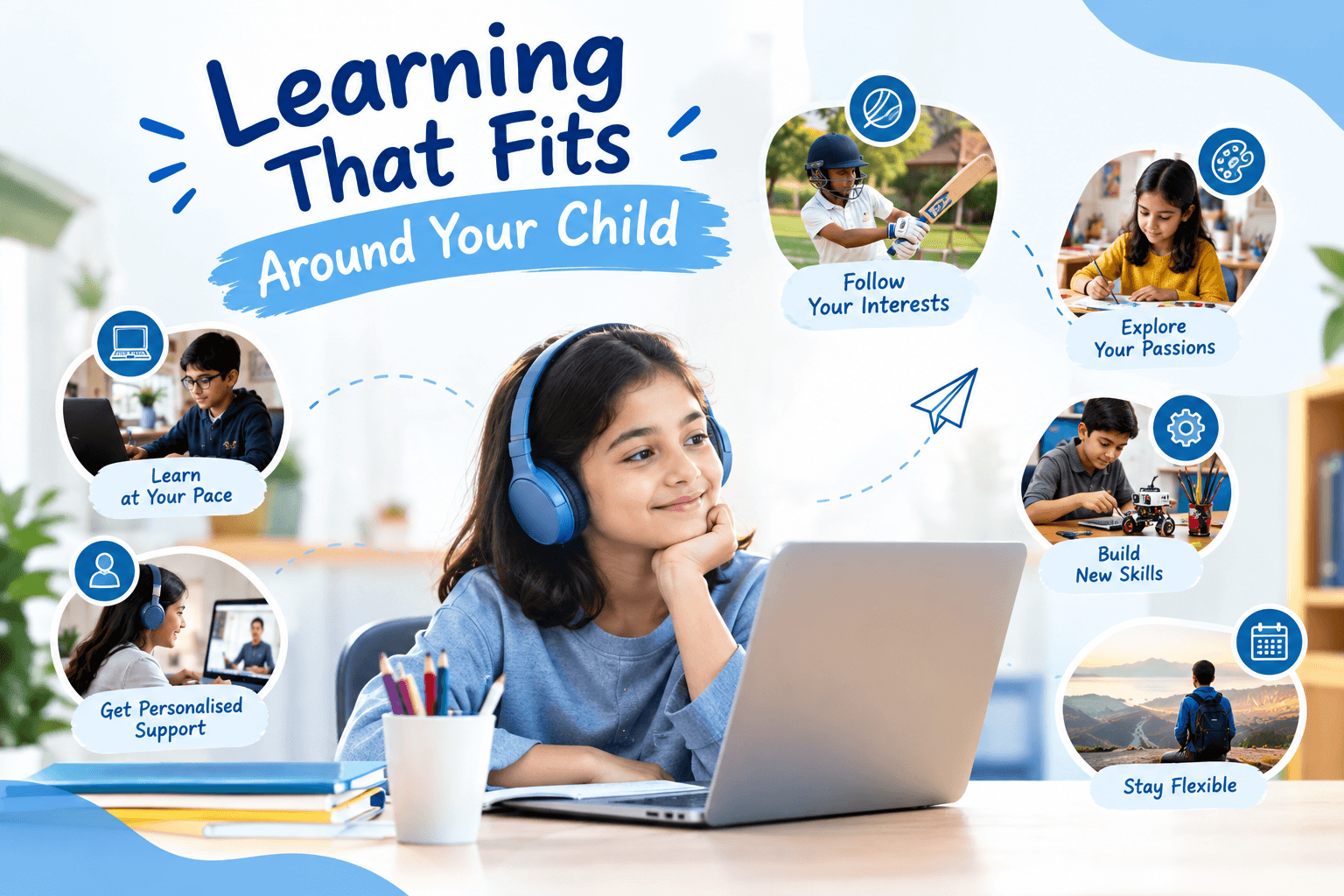

“School starts at 8, so you have to be ready by 7.” “Football practice is at 5, so finish your homework before that.” “Your music class is clashing with your tuition again.”
For many families, a child’s day becomes a matter of fitting one thing after another into the timetable. There is school, travel, homework, tuition, sports, hobbies and, somewhere in between, time to eat and sleep. The child is expected to adjust to all of it.
But what if we looked at it the other way around? Instead of asking how a child can fit everything into the school routine, what if we asked whether the school routine could leave some room for the child?
This question becomes especially important because children are not all living the same kind of life. A child who spends several hours every week training for swimming may need a different routine from a child who loves spending those hours drawing or building things. A family that travels often may have different needs from one that has stayed in the same city for years. Even two children sitting in the same class may learn a chapter at very different speeds.
The purpose of education, then, cannot simply be to put every child through the same timetable and hope they all arrive at the same destination. That’s why online schools offering online education came into being. And today we will take the example of one of the Online schools in India, The World Ecademy, which is offering online education and easing the problems of many people.
Check Out | Online Schools vs. Traditional Schools | What Has Changed in 2026
A Child Is Not a Clock That Runs on the Same Schedule Every Day
Think about how children learn to ride a bicycle. One child may get on the cycle and balance within a few attempts. Another may wobble for days before feeling comfortable. If we told the second child, “You have had your ten attempts. Everyone else has moved on,” we would not be helping them learn. We would simply be following the clock.
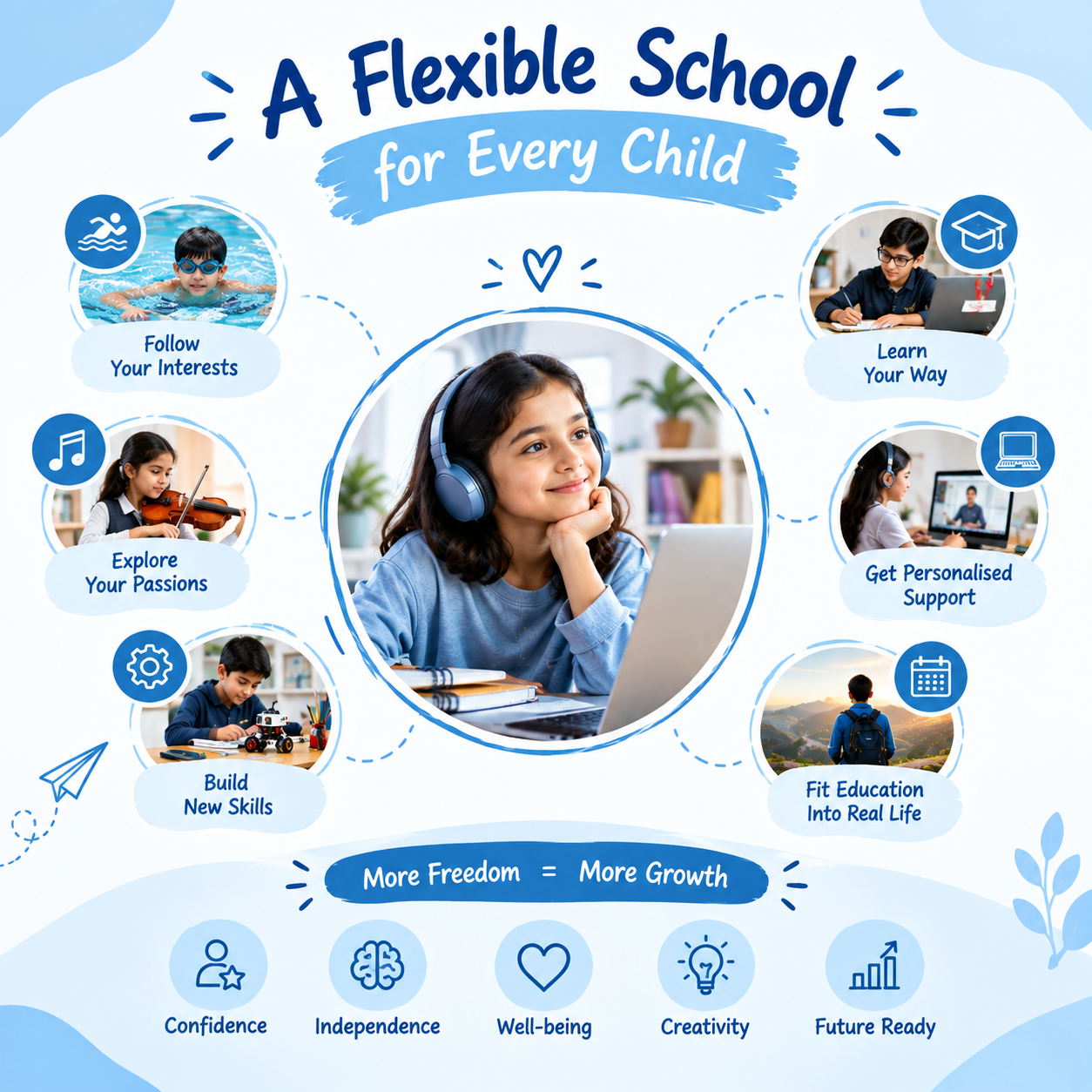
Classroom learning can sometimes work in a similar way.
A teacher may explain fractions today, give students a few questions, and move to the next chapter tomorrow. One child understands the idea immediately. Another knows how to solve the questions but does not really understand why the method works. A third child is still trying to make sense of what a fraction actually represents.
Giving all three children the same worksheet does not necessarily mean giving them the same learning experience.
This is one reason the idea of personalised learning has become important in education. Psychologist Lev Vygotsky's work on the Zone of Proximal Development offers an interesting way of looking at it. Children can often do more when they receive the right amount of help than when they are simply left to figure everything out themselves. Sometimes they need a hint. Sometimes they need another example. Sometimes they need someone to slow down and explain the idea differently.
And sometimes, the opposite is true. A child who has already understood something does not need to spend another week waiting for everyone else to catch up.
There is an old gardening analogy that fits surprisingly well here. A sunflower and a rose do not need exactly the same amount of sunlight, water or space to grow. You would not put every plant on the same watering schedule simply because they are all plants. Children are not plants, of course, but the larger idea is useful: growth needs the right conditions, not identical treatment.
What Happens When Children Have More Room in Their Day?
Now consider a student who loves cricket and has practice four evenings a week. Or a child who is learning classical dance seriously. Or someone who spends weekends participating in chess competitions. These interests are not necessarily distractions from education. They can become important parts of a child's development.
The difficulty is often time.
If a student spends a couple of hours travelling to school and back every day, attends classes for most of the day and then returns home to homework, there may not be much energy left for anything else. The child may still have interests, but gradually starts hearing, “You can do that later.”
Later can become next year. Next year can become “after Class 12.” Flexible schooling can change that equation.
The time saved from a daily commute can become time for practice, reading, rest or simply pursuing something the child enjoys. A student interested in technology might use that time to build a small coding project. Someone interested in chess might play a few more games and analyse where they went wrong. A young athlete might be able to manage training without constantly worrying about missing schoolwork.
This does not mean children should have completely unstructured days. In fact, the opposite is often true. Flexible learning works best when there is a clear routine, regular interaction with teachers, and someone keeping track of the child's progress. The difference is that the routine can have some breathing space.
There is also a practical side to this. Families move. Parents travel for work. Some children have commitments outside school that do not fit neatly into a conventional timetable. For them, flexibility is not necessarily about finding an easier way to study. It can simply be about finding a way to make education work alongside real life.
Also Read | The End of One-Size-Fits-All Education
Schooling Can Be Flexible Without Becoming Less Serious
There is sometimes a misconception that if schooling becomes more flexible, academics must become less demanding. That does not have to be the case.
A student can still have teachers, assignments, assessments and examinations. They can still be expected to prepare, participate and take responsibility for their work. What changes is the way those pieces are arranged around the learner.
This is where The World Ecademy takes a different approach to online schooling. The school offers live, interactive classes in smaller groups, with personalised academic support rather than leaving students to learn entirely on their own. Its programmes also give students different curriculum pathways, including Indian options such as NIOS and BOSSE and international pathways, depending on their educational requirements and future plans.
The school also recognises that education does not stop with academic subjects. Its skill-development programmes include areas such as coding, robotics and STEM, chess, communication and financial literacy. For a child, learning how to write a programme, think through a chess position or explain an idea clearly can be just as valuable in the long run as remembering a chapter for an examination.

The interesting part is that these opportunities can sit alongside formal schooling instead of always having to compete with it.
This brings us back to the child with the packed timetable. Perhaps the question should not always be, “How can we make the child manage everything?” Perhaps it should also be, “Can we create an educational system that gives the child enough room to manage it well?”
That is the idea behind The World Ecademy's model. Through online live classes, smaller batches, personalised guidance, flexible schooling options and additional skill programmes, the school tries to give students a more adaptable way of completing their education. It also offers different academic pathways so that students and families can consider an option that suits their circumstances rather than assuming that one route will work for everyone.
Conclusion
Children do not all learn at the same speed, have the same interests or wake up excited about the same things. One may want to spend an afternoon solving a maths problem, while another would rather build a robot. One may need extra time with a difficult topic, while another may be ready to move ahead.
That does not mean children need an education without rules or expectations. They need guidance, good teachers, and a strong academic foundation. But they also need some room to be themselves. Maybe the better question for modern schooling is not, “How well can a child fit into our system?” Maybe it is, “How well can our system make room for the child?”
For more information on this and similar other schools, check out this list of the best online schools in India.
 as a preferred source on