







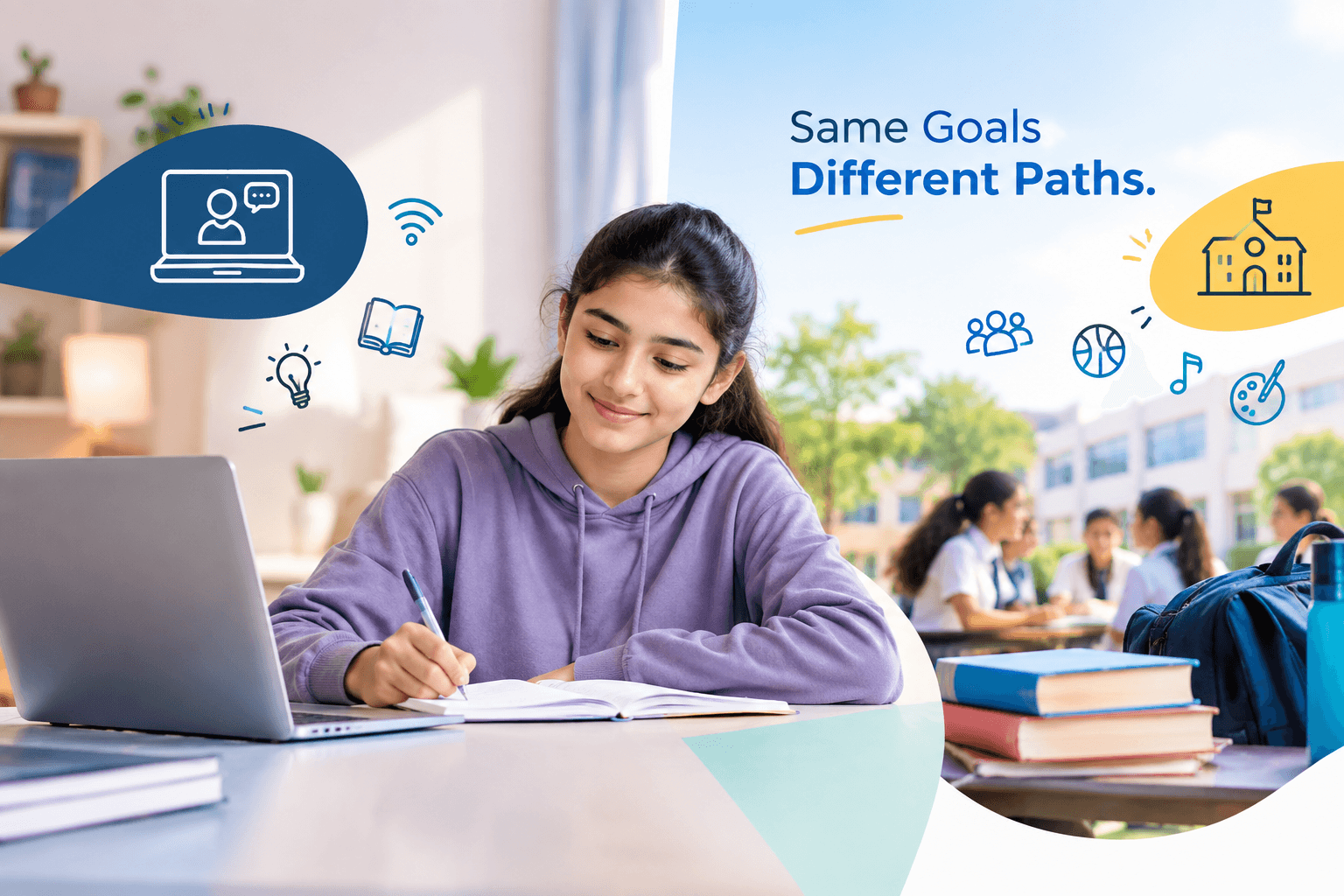

Online Schools Better Than Regular Ones? Who will decide? Do you have those child actors who act in movies, dramas, and series? Those kids are not extraordinary. They also study and act. But the way they study is totally different from how a kid going to regular school does. This is not easy, but it's manageable.
One question that must be on your mind is: How do these kids, these child actors, manage to study with their 10-12 hours of shifts on sets? They are not alone; the kids involved in sports and going for national and international championships also face the same thing. They are supposed to keep their profession a priority while managing studies as well.
That is why we have different boards, and we also have different modes of education; today, we will explore one of them: online education. There are many online schools in India, and we will understand how it actually works by taking the example of one of the Online Schools, The Class of One.
Also Read: Is Online School a feasible option in a country like India?
When the Regular School Routine Doesn't Quite Fit
For many children, a regular school is exactly what they need. They wake up, get ready, take the school bus, attend classes, meet their friends, come home, and finish their homework. There is comfort in that routine.
But not every child's day looks like this. Imagine a 14-year-old swimmer whose practice begins at 5:30 in the morning. After school, there is another training session. By the time the child reaches home, homework is waiting.
Now imagine tournament season, when the same student has to travel for several days. The problem is not that the child does not want to study. There are simply too many things competing for the same 24 hours.
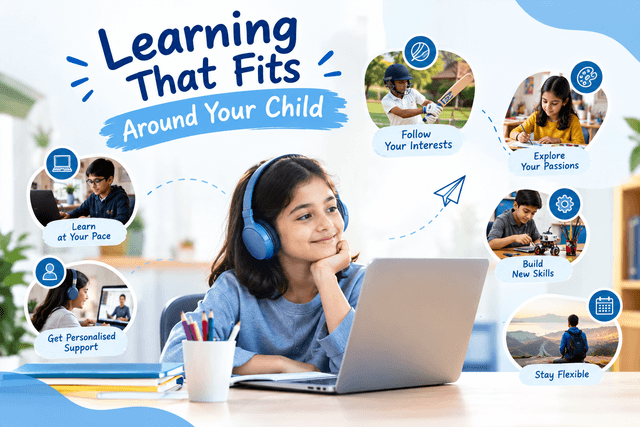
An online school can provide another way of organising that day. Instead of education being tied completely to a physical location, learning can become more flexible around the child's schedule. The Class of One is built around this idea of flexibility, making it an option worth considering for students balancing academics with sports, performing arts, travel and other commitments.
Flexibility Does Not Mean "Study Whenever You Feel Like It"
This is one of the easiest misconceptions about online schooling. Learning from home does not mean sitting in bed with a laptop open while watching a maths class. A good online learning routine still needs structure.
Take a student preparing for an examination. They may attend their online classes in the morning, practise questions in the afternoon and attend football practice in the evening. The schedule may look different from that of a regular-school student, but there is still a routine.
In fact, flexibility can teach something important: how to manage your own time. Think about a simple Sunday task. If you have three assignments due on Monday, you cannot keep saying, "I'll do it later." At some point, you have to decide which one to finish first, how much time each will take, and when to take a break.
That habit of planning does not disappear after school. College students, athletes, artists, and working professionals all have to manage their own time eventually.
What About Friends, Activities and Everything Else?
This is probably the question parents ask first: "But won't my child miss out on school life?"
Fair question. School is not only about solving equations and remembering historical dates. A child also learns when they argue over which idea to use for a group project, cheer for a teammate, perform on stage, or nervously raise their hand during a debate.
A child who is usually quiet in class may suddenly become the loudest person during a drama rehearsal. Another student who struggles with written answers may become completely absorbed while building a model.
These experiences matter because children discover things about themselves through doing. That is also close to John Dewey's idea of experiential learning: education becomes meaningful when children can connect what they learn with actual experiences.
Online schooling, therefore, should not be judged only by the screen. Parents should ask what happens beyond the lessons. Are there co-curricular activities? Opportunities for interaction? Creative pursuits? Physical activities? Ways for students to communicate and collaborate?
The Class of One incorporates activities such as music, dance, art and craft, drama and physical fitness alongside academics, showing how online education can extend beyond simply attending virtual classes.
A Different Child May Need a Different School
Consider two children. The first loves going to school every morning. She enjoys sitting with her friends, participating in assemblies, and playing basketball during game periods. A regular school may be the perfect fit for her.
The second child spends three evenings a week at dance practice and travels frequently for performances. Sitting in a traditional classroom every day may be harder to manage. For her, a flexible online model could make more sense.
Neither child is getting a "better" education. They simply need different things from their school. This is why the online-versus-regular-school debate can sometimes become unnecessary. Education is not a competition where one format has to win.
Also Read: How Online Schools Are Shaping the Future of Education in India
So, Are Online Schools Better Than Regular Schools?
There is no universal answer. For some children, the routine, friendships, and physical environment of a regular school are important parts of learning. For others, flexibility may be equally important, particularly when academics have to fit around sports, performing arts, travel, or other commitments.
The Class of One is one example of an online schooling model designed around this flexibility, combining academics with personalised learning and opportunities for activities beyond the core curriculum.
Ultimately, the question parents need to ask is not, "Which school is better?" It is, "Which school fits my child's life, learning style and goals?" Because sometimes education needs to fit the child — not the other way around.
For more information regarding these schools
 as a preferred source on