






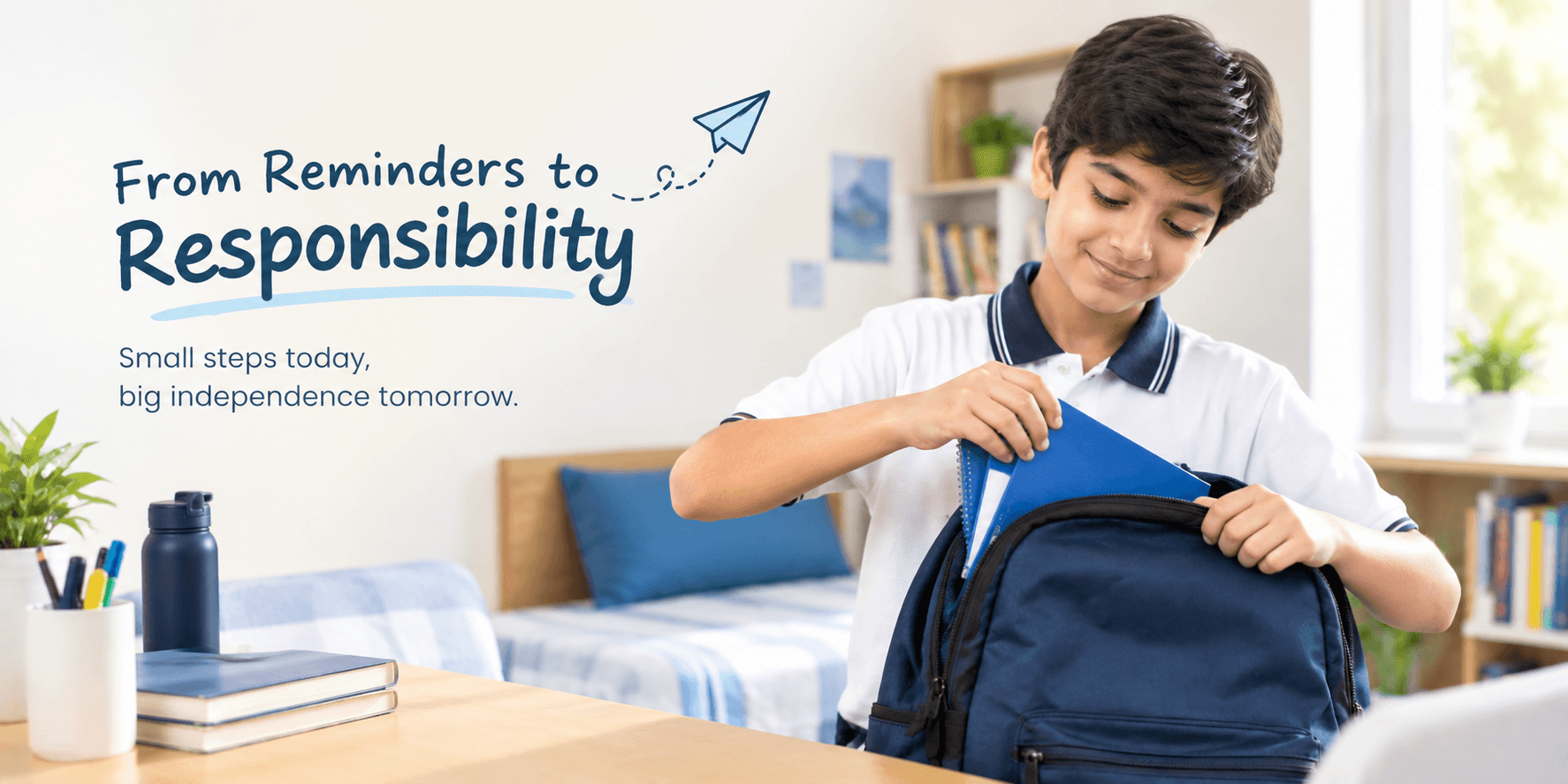

“Did you pack your bag?” “Did you finish your homework?” “Where is your water bottle?” Parents often repeat these questions every day without even noticing it. After all, helping children stay organised feels like part of parenting. But there comes a point when a child needs to start managing these small responsibilities without constant reminders. This is one reason parents exploring the Top Boarding Schools in India, including Birla Public School Kishangarh, may find the idea of independence especially important. The real question is not whether children can complete a task, but whether they can remember, plan and complete it on their own.
Also Read| Decoding the Growing Popularity of Indian Boarding Schools
Why Small Responsibilities Matter More Than They Seem
A child who remembers to pack a notebook, organise a uniform or refill a water bottle is practising much more than a household chore. These simple actions involve executive function, a group of mental skills that help people plan, focus, remember instructions, control impulses and manage several tasks.
Harvard's Center on the Developing Child compares these skills to an “air traffic control system” for the brain. Children are not simply born with fully developed executive-function skills; they develop them through practice, support and repeated experiences.
Consider two children who have a test on Monday. One waits for a parent to announce when to study, find the books and remind them about the test. The other checks the timetable, makes a small study plan and keeps the required books ready. Both may eventually score well, but the second child is practising a skill that becomes increasingly important as responsibilities grow.
Parents can begin with everyday situations such as:
- Allowing children to prepare their school bags according to the next day's timetable.
- Asking children to keep track of their own belongings instead of immediately replacing lost items.
- Giving them a small weekly responsibility at home, such as organising a shelf or helping plan a meal.
- Letting them experience reasonable consequences when they forget something, provided there is no safety risk.
The aim is not to leave children completely on their own. It is to gradually move from “I will do it for you” to “I will help you learn how to do it.”
The Right Amount of Help: A Lesson in Scaffolding
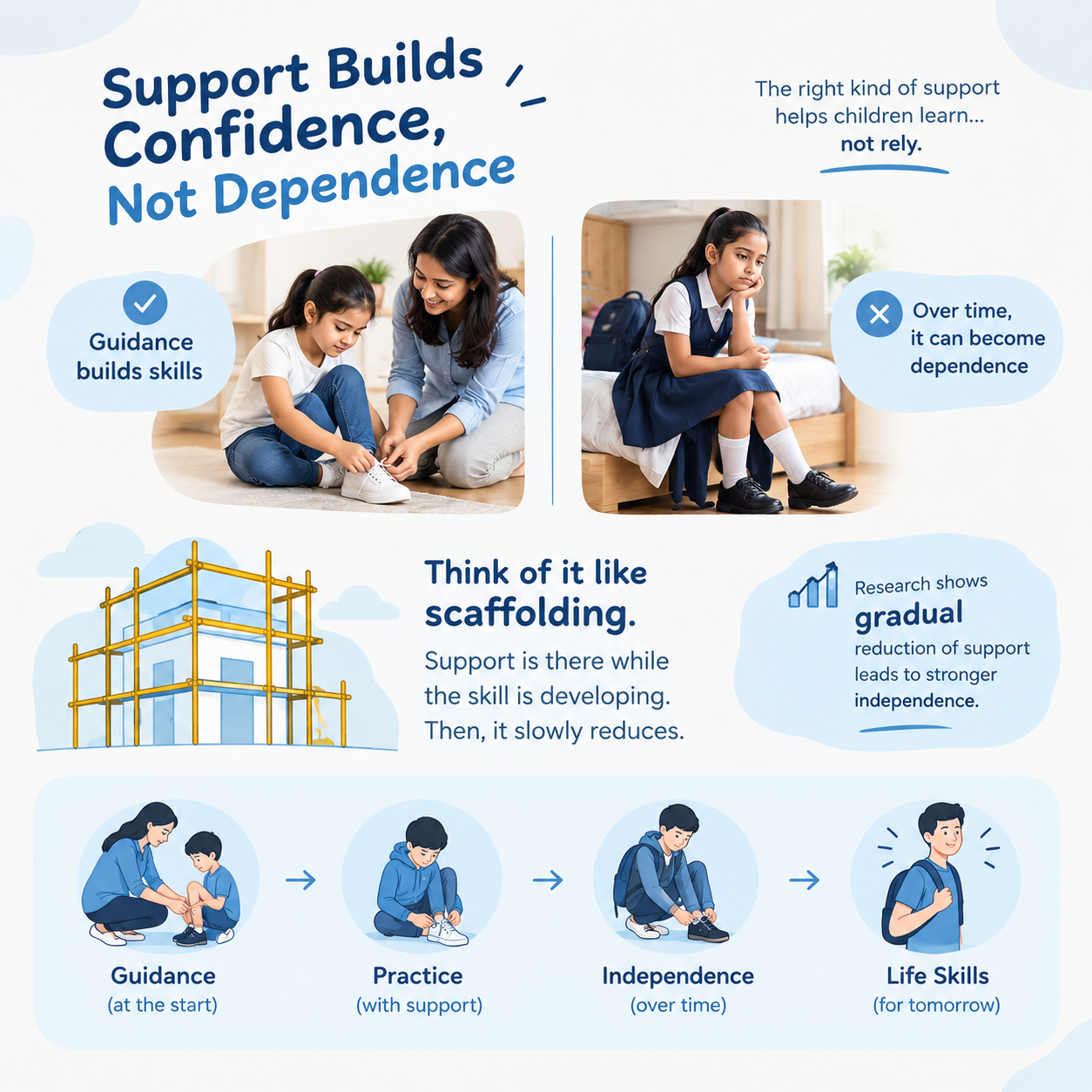
There is an important difference between support and dependence. A child who cannot tie their shoelaces may need guidance. But if an older child still expects someone else to tie them every morning, the help may have continued for too long.
This connects with the educational idea of scaffolding. Like scaffolding around a building, support is meant to help a learner while the skill is developing. As confidence grows, the support can slowly be reduced. Harvard's research on children's development describes this kind of age-appropriate support as a way of helping children practise important skills with gradually less assistance.
For example, instead of saying, “Your project is due tomorrow; start working now,” a parent might ask, “When is your project due, and what do you need to finish before then?” The second question makes the child think about time, planning, and responsibility.
Independence Does Not Mean “Do Everything Alone”
There is sometimes a misunderstanding that independent children should never ask for help. In reality, healthy independence also means knowing when and how to seek help.
A student who tries to solve a difficult maths problem for twenty minutes and then asks a teacher for a hint is showing a useful form of independence. The same applies when a child cannot resolve a disagreement with a friend and approaches an adult rather than reacting impulsively.
This matters particularly during adolescence, when children face more complex decisions. Harvard's work on adolescent development notes that teenagers are still developing executive-function skills while simultaneously dealing with increasing academic, social and personal responsibilities. Goal-setting, planning and monitoring progress can therefore be actively practised during these years.
Parents can encourage this by asking questions such as:
- “What do you think you should try first?”
- “What could you do differently next time?”
- “Who could help you with this?”
- “What part of the problem can you handle yourself?”
These questions do not remove parental support. They change its purpose from solving the problem to building the child's ability to solve problems.
Also Read| What Parents Actually Look for Before Sending Their Child to a Boarding School
A Boarding Environment Can Turn Independence Into a Daily Habit
For parents considering boarding education, independence is not something that has to be taught only through occasional activities. Residential life naturally creates many opportunities for children to practise routines, organisation, time management, cooperation and responsibility in everyday situations.
Birla Public School Kishangarh is a co-educational residential school established under Birla Education Trust, Pilani. Its official material describes its boarding environment as one that encourages community, companionship and personal growth, while its mission focuses on future-ready education, holistic development and character-building.

The school operates from a large campus and provides separate boarding facilities for boys and girls, along with opportunities in academics, sports, arts, and other activities. For families comparing the Top Boarding Schools in India and Birla Public School Kishangarh, this connection between learning and everyday residential experiences is particularly relevant because independence can be practised as part of a student's routine rather than treated as a separate lesson. The school's emphasis on sports and co-curricular activities also gives students opportunities to practise teamwork, discipline and responsibility beyond the classroom.
The goal is not to make childhood harder
Parents do not need to suddenly hand over every responsibility. Independence develops gradually, and children will still need guidance, reassurance and occasional rescue. The important shift is to notice which tasks a child is now capable of managing and give them enough space to try.
Even something as simple as allowing a child to prepare their own bag can become practice for a much bigger skill: taking ownership of what needs to happen next.
When parents slowly step back, children get the opportunity to step forward. And that may be one of the most valuable preparations for life that education can offer.
Looking for Top Boarding Schools in India? Check out here
 as a preferred source on