







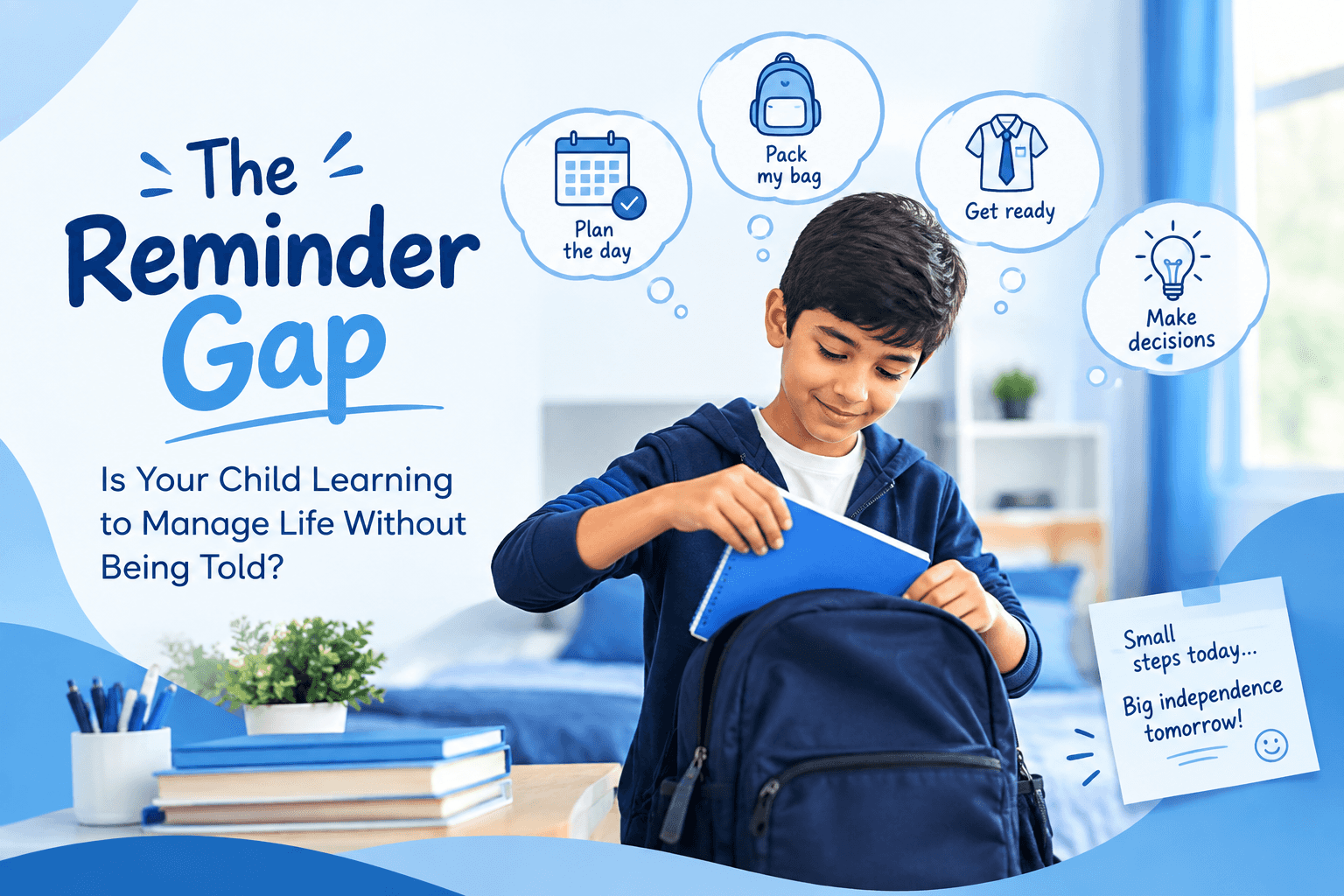

When parents explore the Top Boarding Schools In India, they often compare academics, sports, safety, campus facilities and teaching methods. But there is another question that deserves equal attention: What happens when nobody reminds the child what to do next? For parents considering a boarding environment, this can be an important question. At home, a child may hear, “Pack your bag,” “Finish your homework,” or “Keep your shoes in the right place.” Over time, these reminders can become so regular that the child starts depending on them. The real test of independence is not whether a child can complete a task, but whether they can notice that the task needs to be done in the first place.
Also Read| Scholarships are a Long-Term Investment in a Student’s Future
Why the “Reminder Gap” Matters More Than Parents Think
Imagine a 12-year-old who knows exactly how to pack a schoolbag but waits for a parent to check every book. The problem is not a lack of ability. The missing skill is self-management.
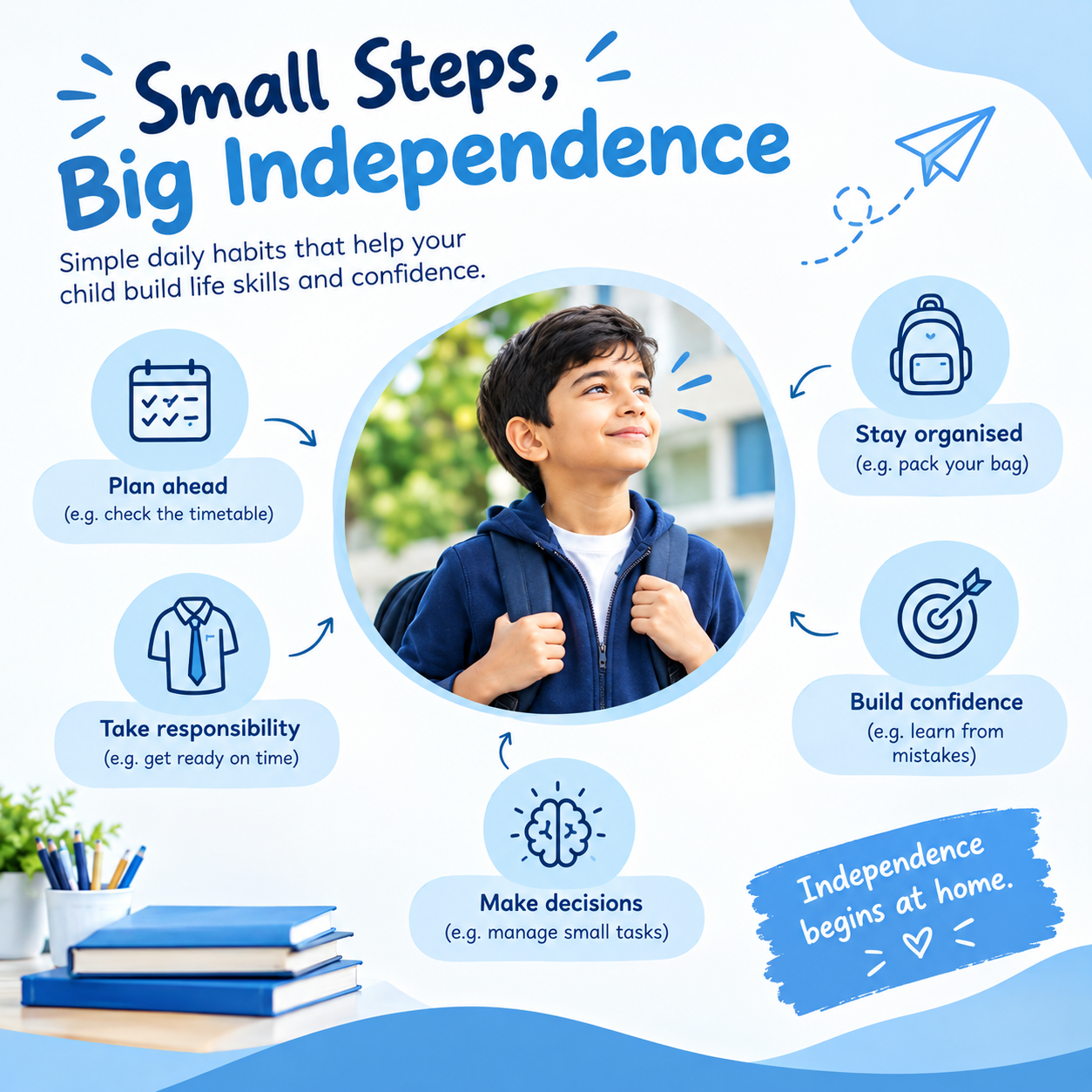
Psychologists often connect this area with executive functions, which help people plan, remember instructions, control impulses and organise actions. These skills continue developing through childhood and adolescence. This is why a child may understand a responsibility but still need practice before managing it consistently.
A simple difference can be seen here:
|
With constant reminders |
With growing self-management |
|
“Did you pack your notebook?” |
The child checks the timetable independently. |
|
“Go and take a shower.” |
The child follows a morning routine. |
|
“Your uniform is still outside.” |
The child notices and puts it away. |
|
“Start studying now.” |
The child begins at the agreed study time. |
This does not mean parents should suddenly stop helping. Independence develops gradually. A younger child may need direct reminders, while an older child can be given responsibility for the entire process.
For example, instead of saying, “Brush your teeth, wear your uniform and pack your bag,” a parent might first create a simple morning checklist. After several weeks, the checklist can become the child's responsibility.
The aim is to slowly move from adult-controlled action to child-controlled action.
What Actually Builds Independence in Everyday Life?
Independence is rarely created through one big responsibility. It grows through many small decisions.
A child who regularly decides where to keep their books, checks tomorrow's schedule or manages a small personal task is getting repeated practice in planning and decision-making.
A useful approach is to divide responsibilities into three stages:
- Do it together: The parent and child complete the task side by side.
- Let the child lead: The parent stays nearby but allows the child to decide the steps.
- Let the child own it: The child handles the task and deals with reasonable consequences.
For example, if a child repeatedly forgets a water bottle, immediately taking responsibility for it may solve the problem for the day. Instead, a parent could help the child create a “leaving home” checklist and later allow the child to manage it independently.
This connects with Self-Determination Theory, developed by psychologists Richard Ryan and Edward Deci. The theory highlights three important psychological needs: autonomy, competence and relatedness. Research in education suggests that supporting these needs can encourage autonomous motivation and better self-regulation.
In simple words, children need to experience:
|
Need |
What it can look like at home |
|
Autonomy |
“I can make this choice.” |
|
Competence |
“I am getting better at this.” |
|
Relatedness |
“My parents trust and support me.” |
This is why simply giving children more commands is not the same as teaching independence.
How Can Parents Reduce Reminders Without Creating Chaos?
The answer is not to become less involved overnight. Instead, parents can change how they help.
Try replacing repeated instructions with questions that make the child think.
Instead of: “Did you finish everything for tomorrow?”
Try: “What do you need to be ready for tomorrow?”
Instead of: “Take your sports shoes.”
Try: “What do you need for practice?”
The second approach makes the child search for the answer rather than waiting for one.
Parents can also introduce a weekly responsibility audit. Pick three tasks the child currently depends on adults for and discuss:
- What can the child already do?
- Where do they still need help?
- What can they take ownership of this week?
- What happens if they forget?
The last question is especially important. Natural, reasonable consequences can teach lessons that repeated lectures often cannot. If a child forgets their library book, for instance, experiencing the inconvenience may make the next reminder unnecessary.
However, responsibility should always match age and maturity. Independence does not mean leaving children to solve problems that are unsafe, overwhelming or beyond their developmental level.
Also Read| Life at a Boarding School: A Journey of Learning, Independence, and Growth
Why This Matters in a Boarding Environment
Boarding can make the “reminder gap” more visible because children have more parts of daily life to manage away from their parents. They may need to organise personal belongings, follow study schedules, maintain routines, participate in activities and live cooperatively with peers.
At Swarnprastha Public School, the residential programme places students in boarding houses supported by House Parents and mentors. The school says its residential setting is designed to provide independence within a safe environment, while House Parents guide students with personal hygiene, room organisation and daily routines. Boarders also have scheduled preparation time for academics and supervised sports and activities.

For parents comparing the Top Boarding Schools In India and Swarnprastha Public School, this aspect can be useful to consider: independence works best when children are given responsibility with a support system around them, rather than being expected to manage everything alone. The school's residential structure combines shared living, adult guidance and opportunities for students to handle parts of their daily routine themselves.
The Goal Is Not a Child Who Never Needs Help
A truly independent child is not one who refuses help. It is one who knows when to try alone and when to ask for support.
Parents can begin preparing for this long before a child leaves home. Let them organise a drawer, plan part of a weekend, prepare their school materials, manage a small responsibility or solve an ordinary problem before stepping in.
The question to keep asking is simple: “Am I doing this because my child cannot do it, or because it is faster for me to do it?”
That small distinction can change parenting in powerful ways. Independence is not created when parents disappear from the picture. It develops when parents gradually move from being the child's constant reminder system to becoming the person who helps the child build their own system.
To know more about other boarding schools in India, click on the link below

 as a preferred source on