








When parents visit schools before admission season, they usually ask about the curriculum, the labs, the sports facilities, and the fee structure. Very few ask a simple but important question: how many students does one teacher actually handle in a classroom? This number, known as the student-teacher ratio, rarely makes it to the top of a parent's checklist, yet it quietly shapes how much attention a child gets every single day. For families exploring the Top Schools in Bangalore, understanding this ratio can be just as useful as comparing boards or fees. Kesar The International School (KTIS), Bangalore, is a useful example to look at here, since it is one of the schools in the city that discloses this number clearly to parents.
Also read| From Ganga to Robotics Labs: The Five Pillars Transforming Learning
What Student-Teacher Ratio Actually Means
Student-teacher ratio (STR) simply tells you how many students, on average, are assigned to each teacher in a school. A ratio of 20:1 means there are 20 students for every one teacher across the school. It is different from the number of children physically sitting in one classroom, since a school's overall STR is calculated using its total student strength and total number of teachers, not just one section.
This distinction matters because a low overall ratio usually points to a school that has invested adequately in staffing relative to its student base, one of the practical signs of a school's day-to-day capacity to support each child, alongside teaching quality and classroom practices.
Why It Matters More Than It Seems
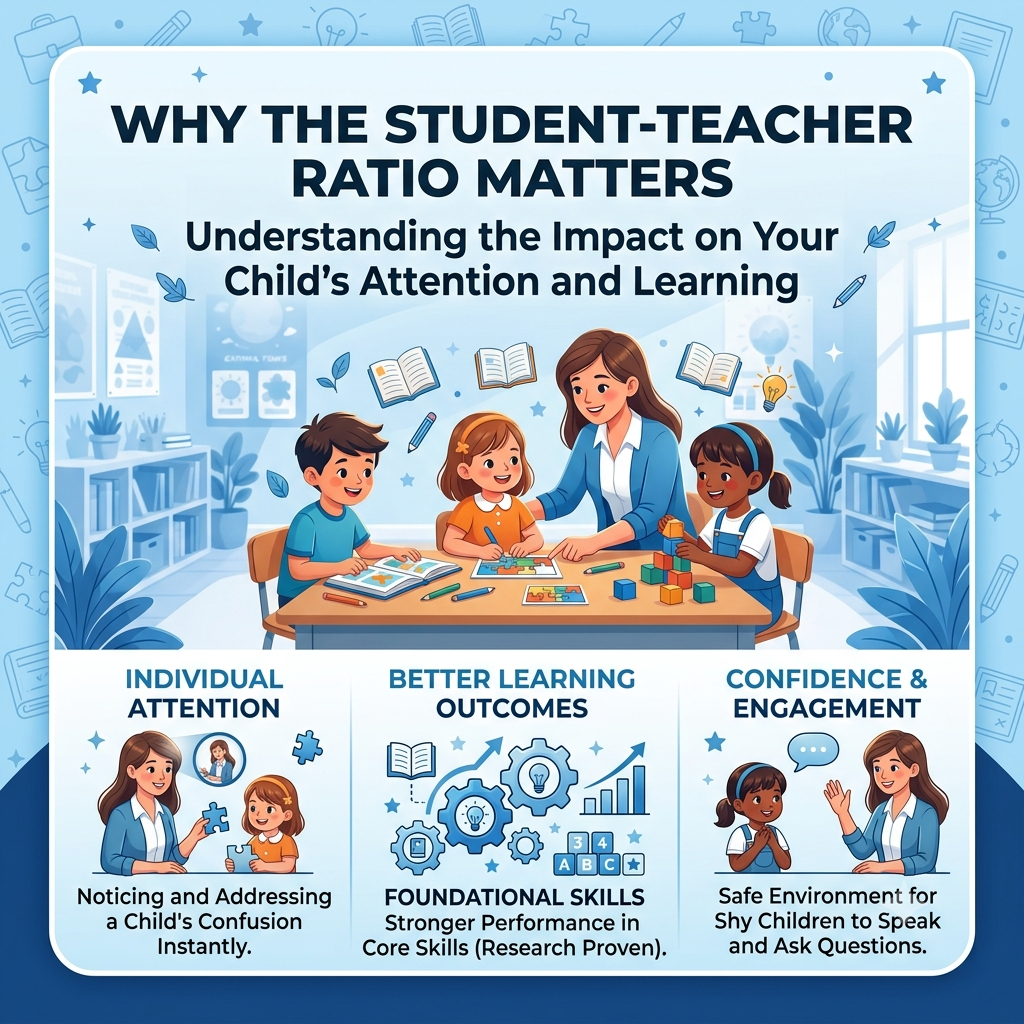
A lower student-teacher ratio generally means a teacher has more room to notice which child is struggling with a concept, which child hasn't spoken up in days, or which child needs a slightly different explanation to understand a topic. In a classroom where one teacher is managing a very large group, even a well-meaning teacher has limited time to check in with every student individually.
Think of a child who is shy about asking questions. In a smaller, well-staffed classroom, a teacher is more likely to notice the hesitation and gently draw the child out. In a much larger group, that same child may simply stay quiet, and the gap in understanding can build up unnoticed over weeks. This is not a criticism of teachers; it is simply a reflection of how much individual bandwidth one person has.
What Research and Policy Say
India’s Right to Education (RTE) Act, 2009, lays down statutory pupil-teacher-ratio norms for elementary schools. The commonly stated norm is 30:1 at the primary level and 35:1 at the upper-primary level. These norms are intended to ensure that schools have sufficient teachers and that pupils can receive meaningful classroom attention. The Act also requires the specified ratio to be maintained at the level of each school, rather than only as an average across a district or state.
Independent research by the Azim Premji Foundation examined 766 lower-primary schools in North-East Karnataka. It found a strong association between lower pupil-teacher ratios and better school performance: schools with a PTR below 30:1 were more likely to demonstrate strong learning outcomes, while schools with a PTR above 40:1 had less than a 2% chance of doing so in the study.
These findings should not be interpreted as proof that pupil-teacher ratio alone determines educational quality. A lower ratio does not automatically guarantee effective teaching, and a somewhat higher ratio does not by itself prove that a school is performing poorly. Teacher preparation, attendance, classroom practice, school leadership and the wider learning environment also matter. Nevertheless, a lower ratio can make individual attention more feasible, particularly for younger children developing foundational skills.
Also Read| Why More Parents Are Thinking About Character Education Today
How Parents Can Use This When Choosing a School
When you're comparing schools, here's how to actually use this number instead of just noting it down:
- Ask the school directly for its current student-teacher ratio, not just an approximate figure.
- Ask whether this is calculated for the whole school or per grade, since ratios can vary between primary and senior classes.
- Visit an actual classroom, if possible, to see how many children are present and how the teacher manages the group.
- Ask how the school supports a child who needs extra help, through remedial sessions, smaller group work, or one-on-one time.
- Weigh this number alongside other factors like teacher qualifications, retention (whether teachers stay long-term), and the overall learning environment.
Where KTIS Fits Into This Conversation
For parents researching the Best Schools in Bangalore, it helps to look at concrete numbers rather than general claims. Kesar The International School (KTIS) lists its student-teacher ratio as 12:1 on its official school profile, a figure well below the RTE-mandated minimum standard for Indian schools.

A ratio at this level suggests more room for teachers to engage with individual students across the school's stages, from its foundational years through to secondary school. As with any school, parents considering KTIS or any other institution should still ask how this ratio translates into everyday classroom practice during a school visit.
Conclusion
Student-teacher ratio may not be the most talked-about number when parents compare schools, but it has a real, everyday impact on how seen and supported a child feels in the classroom. The next time you're shortlisting schools, don't just ask about smart classrooms and sports facilities; ask about this number too, and ask how the school puts it into practice.
For more information on KTIS and similar schools, check out this list of the best schools in Bangalore.
 as a preferred source on