







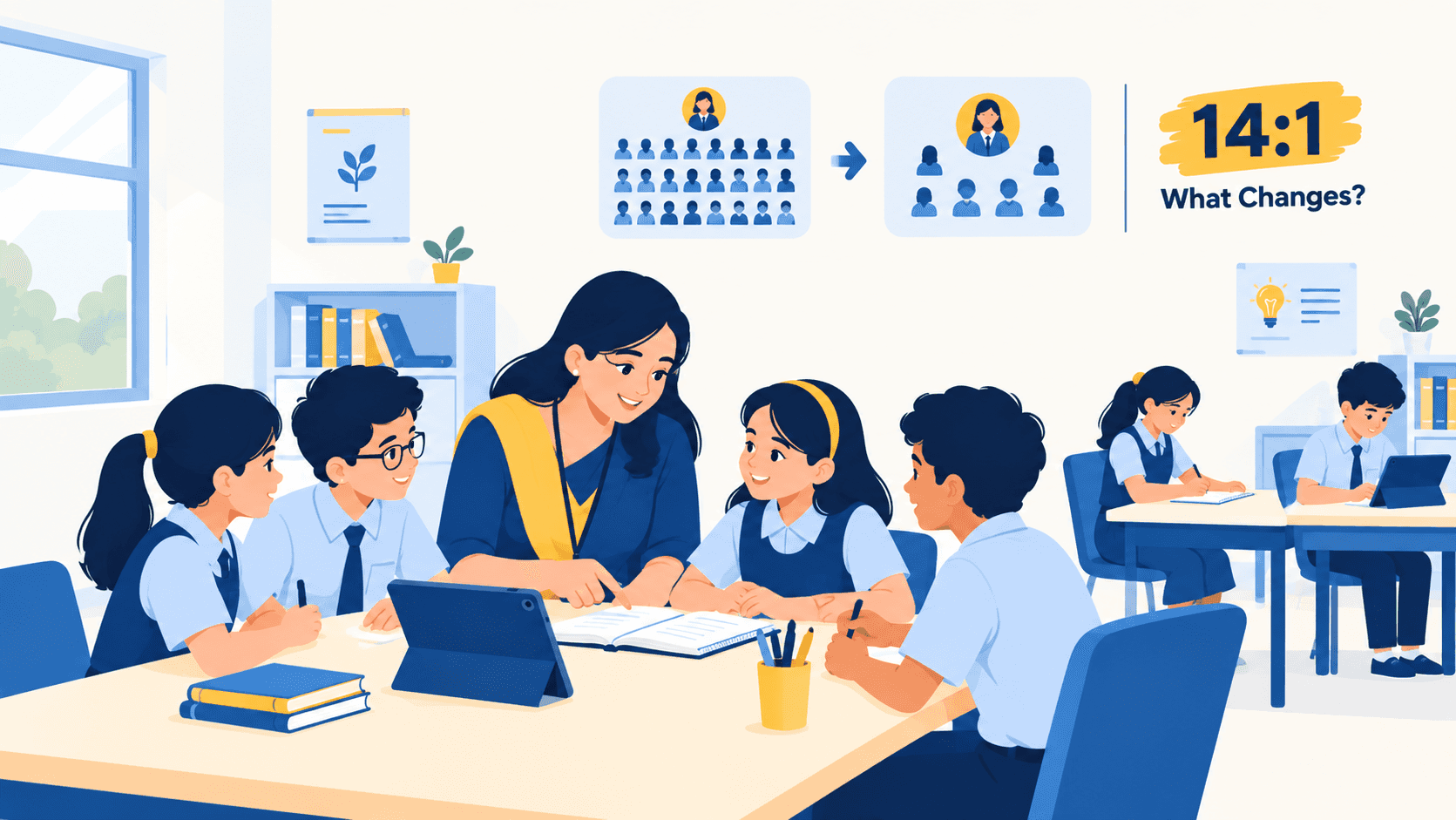

When parents look at the top schools in Bangalore, numbers such as fees, board results, and campus size often get most of the attention. But there is another number worth understanding: the student-teacher ratio. For example, GoldenBee Global School highlights a 14:1 student-teacher ratio, a figure that sounds impressive, but what does it actually change inside a classroom?
The answer is more interesting than simply saying, “Smaller classes are better.” Research suggests that class size alone has a relatively small effect on learning. What matters is what teachers can actually do with fewer students: give better feedback, notice misunderstandings sooner, ask more questions, and work with smaller groups when needed.
A 14:1 Ratio Does Not Mean a Class Has 14 Children
This is the first distinction parents should understand. A student-teacher ratio and class strength are not the same thing.
|
Number |
What it tells you |
|
14:1 student-teacher ratio |
The overall number of students compared with teachers |
|
28 students per class |
Roughly how many children may be sitting together in one classroom |
|
Teacher allocation |
How many educators or support staff are actually available to that group |
Imagine a school has 280 students and 20 teachers. That creates a 14:1 ratio. It does not mean every classroom contains 14 children with one teacher.
This is why parents should avoid treating a ratio as a magic number. A school can have a favorable overall ratio while still having fairly large classes if teachers are also working in specialist, support, or activity roles.
The more useful question is what happens during an ordinary lesson.
Suppose 28 children are learning fractions. One child understands the concept immediately, another keeps confusing numerator and denominator, and a third understands the calculation but cannot explain why it works. In a very busy classroom, the teacher may have to keep moving simply to keep the lesson going. With stronger staffing support, there is more room to stop, ask questions, and adjust.
That difference is where a ratio can become meaningful.
Also Read | Are Drones a Powerful Learning Tool
Why Smaller Numbers Do Not Automatically Create Better Learning
It is tempting to believe that fewer children automatically mean better academic results. The evidence is more cautious.
The Education Endowment Foundation finds that reducing class size has a small average impact, about one additional month of progress, and notes that simply removing a few students does not necessarily change learning. The benefit becomes more meaningful when teachers use the smaller group to change how they teach, provide more feedback, or reduce disruption.
This explains an important point: the number matters because of what it allows a teacher to do.
Consider two classrooms with 25 students each. In Classroom A, the teacher mainly lectures, students complete worksheets, and feedback comes several days later. In Classroom B, the teacher moves between groups, checks understanding, asks individual questions, and changes the task when several children make the same mistake.
The class size is identical. The classroom experience is not.
This is also why smaller groups can be particularly useful for children who are struggling. Research on small-group tuition suggests stronger average benefits in primary education, with low-attaining pupils particularly benefiting from targeted support.
For a younger child who is still learning to read, for example, a teacher noticing that the child is struggling with letter sounds rather than vocabulary can change the next activity completely.
That is personalised teaching in practice. It is much more useful than simply putting the word "personalised" in a brochure.
Also Read | Financial Literacy Should Start in Schools
The School-Visit Test: Can the Teacher Tell You What Your Child Needs?

Parents can actually test whether a school's ratio translates into meaningful attention.
During a school visit, instead of only asking, “What is your student-teacher ratio?" Try asking:
“How do teachers identify what each child is struggling with?”
Then listen to the answer.
A useful follow-up is whether teachers can identify individual learning gaps through classroom observation, assessments, conversations, and regular feedback. You can even ask how the school supports a child who understands a topic more slowly than classmates.
Think about a cricket coach working with 14 players compared with one handling 40. The smaller group does not guarantee better coaching, but it makes it easier to notice that one player is struggling with footwork while another needs help with timing. The same basic idea applies to classrooms.
You can look for signs such as:
- Teachers using different activities for children working at different levels.
- Regular feedback instead of waiting for term-end examinations.
- Small-group support when several children face the same difficulty.
- Teachers who can explain a child's learning pattern rather than only quoting marks.
- A system for following up when a child repeatedly struggles with a concept.
These details tell parents much more than a ratio printed on a website.
What 14:1 Can Look Like in a Real School?

This is where the number becomes more concrete. GoldenBee Global School states a 14:1 student-teacher ratio as part of its approach to personalised attention. Its school information also identifies a Personalised Learning Centre, designed to support individual learning needs.
For the Begur/Bannerghatta campus, school-directory information lists an average class strength of 28 students, which is an important companion figure to the 14:1 ratio.
Together, these numbers create a more useful picture than either number alone. A class of around 28 is still a proper-sized classroom, not a one-to-one tutoring setup. But a broader 14:1 staffing ratio suggests that the school is allocating educators in a way that can support more individual attention across the learning environment.
The school's Personalized Learning Centre also makes the idea more practical. Its stated approach includes support for different learning needs and differentiated teaching, rather than assuming that every child will understand a lesson at exactly the same pace.
For parents exploring the best schools in Bannerghatta, the more useful takeaway is therefore not simply that GoldenBee Global School has a particular ratio. It is that the school has publicly stated the ratio and connected it with a broader personalized-learning approach at its campuses, including Begur Road.
The Number Is Only the Starting Point
A student-teacher ratio is not a guarantee of excellent teaching. It is better understood as a capacity number. It tells parents something about how much attention may be possible, but not whether that attention is actually being used well.
The real difference appears when a teacher has enough time to notice the child who rarely raises a hand, catch the misconception before it becomes a habit, give useful feedback, and offer extra support without holding back everyone else.
So when comparing schools, look beyond the headline number. Ask how teachers use it.
Because the real question is not simply, “How many children are there per teacher?”
It is “How much does the teacher know about each child?”
That is the number parents cannot always see on a brochure, but it may be the one that matters most.
To know more about other schools in Bangalore, click on the link below
 as a preferred source on