







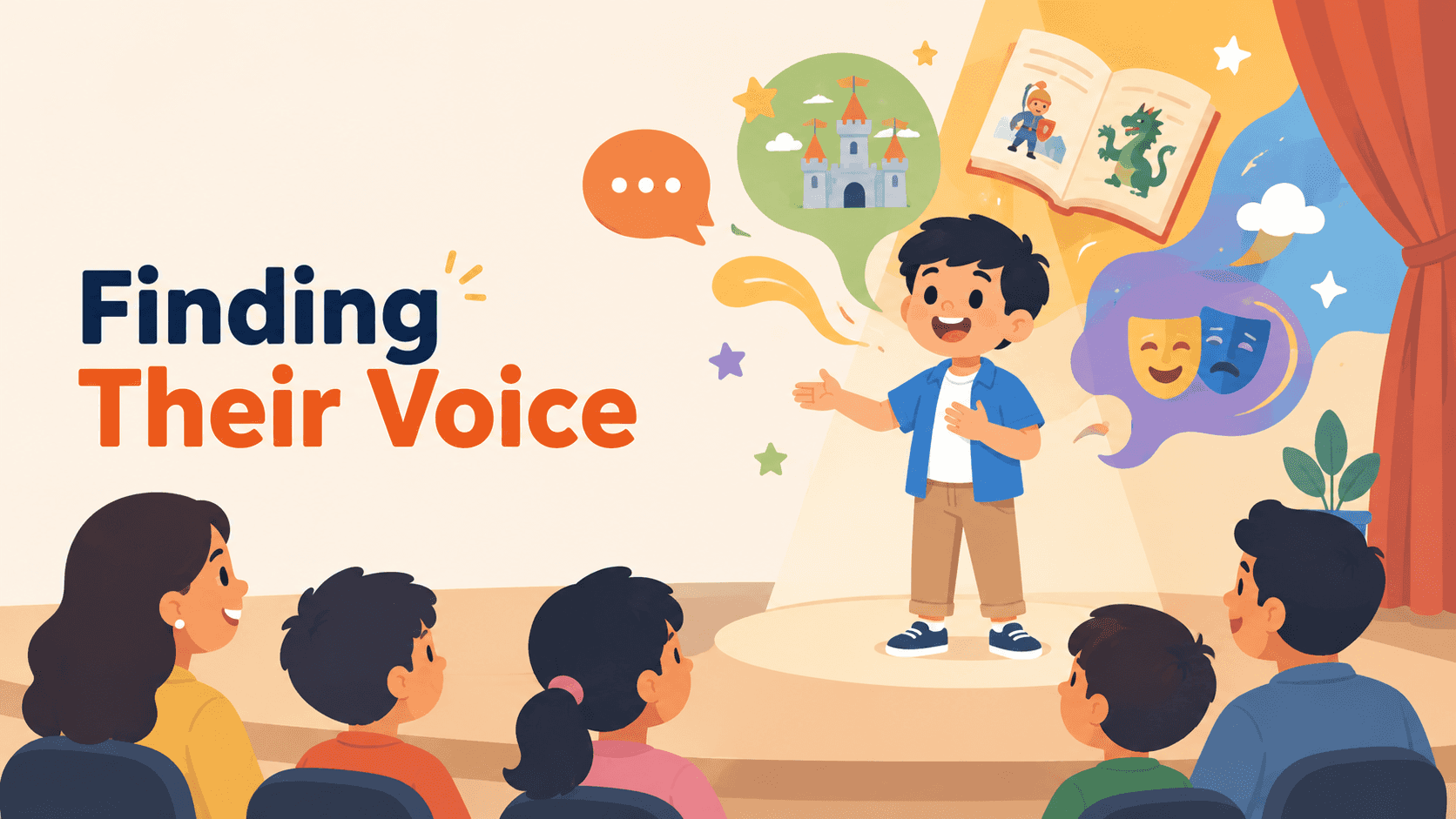

A child raises their hand in class and answers a question. That is participation. But what happens when a child has an idea that is unfinished, unusual, or difficult to explain?
Can they still share it?
This question may sound small, but it says a lot about the kind of learning environment children experience. As they grow older, many children become increasingly careful about what they say. They begin to look for the “right” answer before speaking. They may worry about being wrong, sounding silly, forgetting their words, or being judged by others.
That is where storytelling, drama, role play, and other forms of creative expression can play a much bigger role than simply making learning enjoyable.
At a recent Storytelling & Drama Workshop with Shraddha Gupta, one of the best schools in Gurgaon, The Beacon School brought children and parents together around stories, imagination, expression, and performance. Experiences like these offer an interesting reminder: sometimes children do not need to be told what to think or say. They need spaces where they can first explore an idea and discover how they want to express it.
Children Often Have Ideas Before They Have the Words
Adults sometimes mistake silence for a lack of understanding. But children can be thinking deeply even when they are not ready to explain themselves.
A child may have a vivid opinion about a story but struggle to put it into a complete sentence. Another may understand a character's feelings better by acting them out than by writing an answer. Some children may need to hear an idea several times, discuss it with others, or imagine themselves inside a situation before they can confidently respond.
Storytelling creates room for this process.
Unlike a question with only one expected answer, a story invites interpretation. Why did a character make that decision? What could happen next? What would you do differently? How would the story change if it were told by another character?
Suddenly, the child is not simply trying to remember information. They are making choices. And making choices is an important part of learning. Drama can be particularly valuable because it gives children permission to use more than words. They can use movement, voice, facial expression, timing, and interaction to communicate an idea.
A child playing the role of a nervous traveller, a clever detective, or even an imaginary creature has to make decisions. How would this character speak? What are they feeling? How should they react to someone else?
The Real Skill Is Not Always Confidence
We often describe creative activities as “confidence-building.” That is true, but it can also be an incomplete explanation.
Confidence is usually the visible outcome. The deeper process is often about learning how to continue even when things are uncertain.
A child may forget a line and have to improvise. A group may disagree about how a scene should unfold. A performance may not go exactly as rehearsed.
These moments teach something important: communication does not require perfection.
Children begin to understand that they can pause, rethink, adapt, and try again. They do not always need to have the perfect sentence ready before opening their mouth.
This is especially relevant in a world where children will eventually need to discuss unfamiliar problems, collaborate with different people, and respond to situations for which there may not be a ready-made answer.
The ability to think while communicating is different from simply memorising and repeating.
Listening Is Also Part of Expression
Storytelling is not only about the person speaking.
A good story requires an audience. Drama requires children to notice cues, respond to others, wait for their turn, and understand what is happening around them.
In this sense, creative expression and listening are closely connected.
When children participate in a group performance, they quickly realise that they cannot focus only on themselves. If they miss what another person says or does, they may miss their cue entirely. They learn to pay attention not because someone has told them to “listen carefully,” but because the activity itself depends on it. This kind of listening is active. It involves observing, interpreting, and responding.
And perhaps that is one reason why collaborative creative activities can be so meaningful. They help children understand that communication is not simply about being heard. It is also about making space to hear others.
Why Parents Being Part of the Experience Matters
There is another interesting element when storytelling experiences bring children and parents into the same space.
Parents usually see their children through everyday routines: getting ready for school, completing homework, talking about the day, or participating in family conversations.
A creative workshop can reveal a different side of a child.
The quiet child may suddenly take on a dramatic role. The energetic child may become deeply focused while listening to a story. A child who usually gives short answers may create an elaborate imaginary world when given the opportunity.
These moments can help adults see that children are not always the same in every environment.
It also sends children an important message: their ideas are worth paying attention to.
When adults participate rather than simply observe, creativity becomes something shared instead of something children are expected to perform for approval.
Schools Need More Spaces for Unfinished Ideas
Children spend a great deal of time learning how to arrive at answers. They solve problems, complete assignments, and prepare for assessments.
But there should also be room for ideas that are still taking shape.
A story can begin with, “What if?”
A drama activity can begin with, “Imagine that you are…”
Neither requires the child to know exactly where they are going.
This is valuable because many real-world problems do not arrive with clear instructions. The ability to explore possibilities, listen to different viewpoints, and communicate an emerging idea can become just as important as knowing established information.
Creative spaces can therefore act as a kind of rehearsal room for thinking.
Children experiment. Some ideas work. Others do not. They change direction, borrow inspiration from others, and try again.
There is learning in the process, even when there is no single correct final answer.
Creating Moments That Stay With Children

The most memorable learning experiences are not always the ones attached to a textbook chapter or examination. Sometimes, they are the moments when a child discovers, perhaps unexpectedly, “I can do this.”
It may happen while telling a story in front of others. It may happen when improvising a role, making a group laugh, or finding the courage to speak a line that they had been nervous to say.
At one of the best CBSE schools in Gurgaon, The Beacon School, the Storytelling & Drama Workshop reflected the value of creating such moments. By bringing together storytelling, performance, imagination, and interaction between children and parents, the experience moved beyond entertainment and created opportunities for children to explore how they listen, think, communicate, and connect.
The school’s belief in helping every child Be. Grow. Become. also fits naturally with the purpose of these experiences. Growth does not always happen through visible milestones. Sometimes it begins quietly, when a child realizes that their voice can hold an idea, their imagination can take them somewhere new, and they do not need to wait until they are completely sure before expressing themselves.
That may be one of the most valuable things schools can offer children: not just more opportunities to find the right answer, but more opportunities to discover what they think when they are given the freedom to speak, imagine, and be heard.
To know more about other schools in Gurgaon, click on the link below





 as a preferred source on