







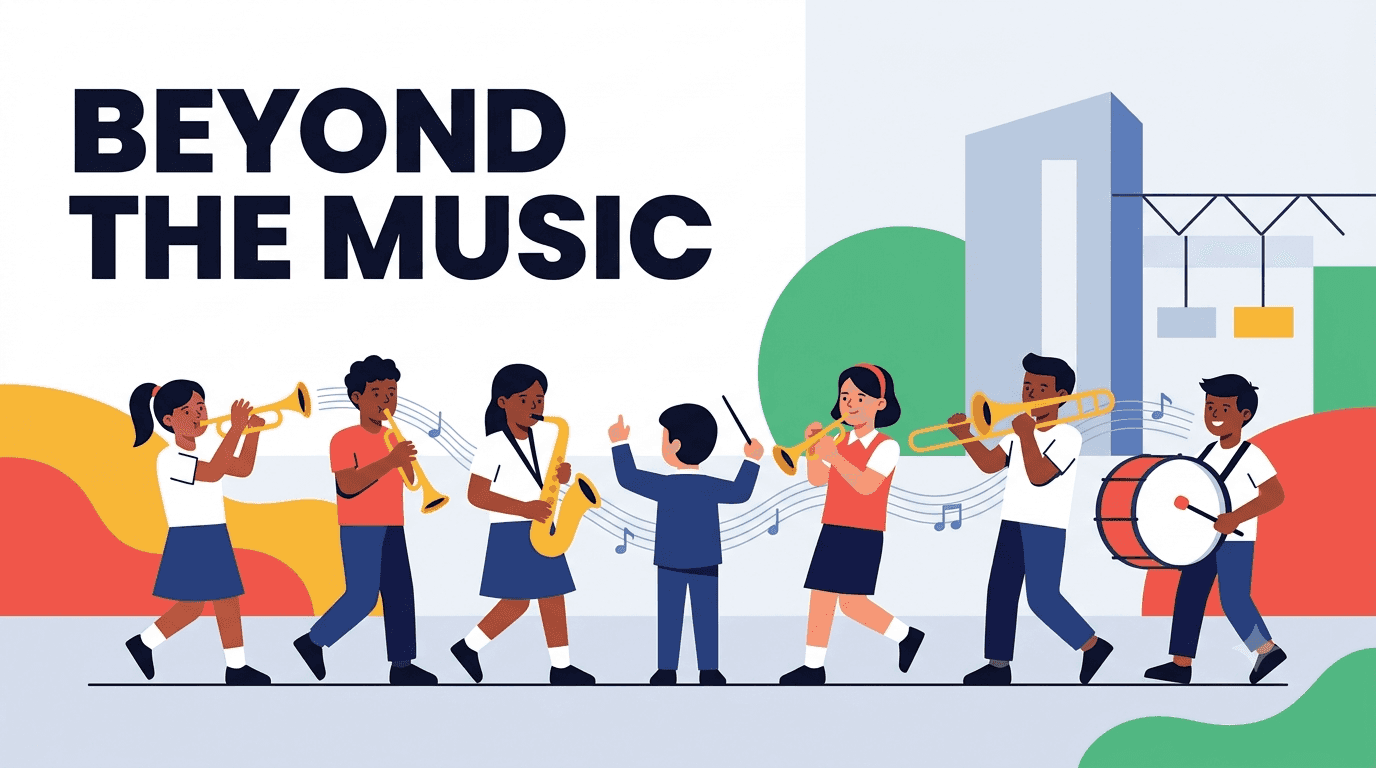

There is something unusual about watching a large school band perform.
One student may be holding a trumpet. Another may be focused on the precise movement of drumsticks. Someone else is waiting for the exact moment to bring in a cymbal crash. From a distance, they appear to be doing different things. But the performance only works when every individual understands one important rule: your part matters, but it must also fit with everyone else's.
This is what makes a school band more than a co-curricular activity. It is a lesson in listening, discipline, timing, teamwork, and responsibility—delivered without a classroom, textbook, or examination.
One of the best boarding schools in India, The Scindia School demonstrates the scale at which this experience can take shape. Its Brass Band brings together more than 200 students from Classes VI to XII, creating a musical unit where students learn and perform across a wide range of instruments and tunes. But beyond the sound and spectacle lies a larger question worth exploring: what does being part of a school band actually teach a child?
Music Is Only One Part of the Learning
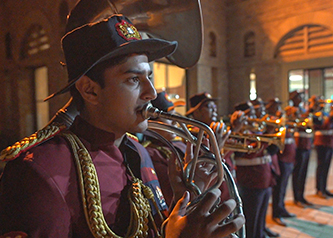
When people think about a school band, the first thing that comes to mind is usually musical ability. Students learn notes, rhythms, instruments, and compositions. They practice until they can perform a piece with confidence.
But individual musical ability alone does not create a good band.
A student may play their instrument perfectly and still disrupt the performance if they come in too early. A drummer may know the rhythm but lose the group if they ignore the conductor. A brass section may be technically strong, but the sound can become overwhelming if students do not learn when to hold back.
This is where the deeper learning begins.
Students gradually understand that performing well is not always about being the loudest or most visible person. Sometimes, their biggest contribution is waiting. Sometimes, it is following. Sometimes, it is supporting another section. And sometimes, it is taking responsibility when everyone else depends on them.
That is a valuable lesson in a world where young people are often encouraged to stand out but are not always taught how to work as part of something larger than themselves.
The Discipline of Being on Time
If a student misses practice, forgets a sequence or does not learn their part, the impact is not limited to them. Other students have to adjust. The group loses time. The performance may suffer. This creates a natural form of accountability.
Unlike a test, where an individual's preparation mainly affects their own result, a band makes responsibility visible. Everyone can hear when a section is missing. Everyone notices when the timing is off. And everyone benefits when consistent practice finally comes together.
Students begin to realize that discipline is not always about following rules because an adult has asked them to. Sometimes, discipline exists because other people are depending on you. That distinction matters.
A child who learns to show up prepared for a rehearsal is also beginning to understand what it means to be reliable. These habits can later appear in group projects, sports teams, workplaces, and communities.
Also Read | Why Boarding School Is Ideal for Sports Enthusiasts
Listening Can Be More Important Than Playing
One of the most underrated skills developed through ensemble music is listening.
A student cannot simply focus on their own instrument. They have to listen to the tempo. They need to hear the students around them. They must understand whether their section should be stronger, softer, faster, or slower.
This makes band training an interesting contrast to many individual activities. The goal is not simply to master your own task. The goal is to remain aware of what everyone else is doing while continuing to do your own part correctly.
That requires concentration but also awareness.
For young students, this can become an early lesson in collaboration. Good teamwork is not just about dividing work among people. It is about paying attention to whether the different pieces are actually working together.
A Place Where Seniority Can Become Leadership
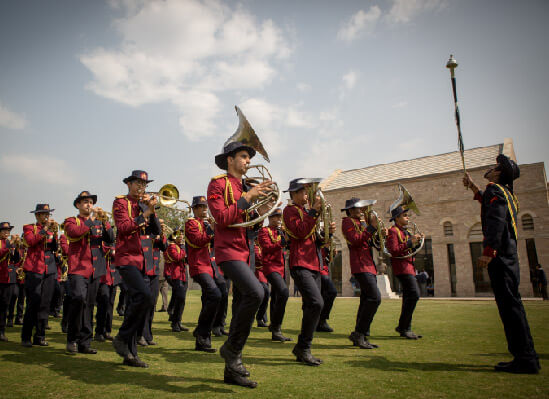
School bands often bring together students from different age groups. A younger student may be learning the basics while an older student has years of performance experience.
This creates opportunities for a different kind of leadership.
Senior students do not always need a formal title to guide others. They may demonstrate how to hold an instrument correctly, help a junior understand a difficult section or simply set the standard through their own preparation.
For younger students, this can make learning less intimidating. Instead of seeing an experienced performer as someone distant or unreachable, they can watch how progress happens over time.
The Confidence of Being Part of Something Big
Standing alone on a stage can be intimidating. Performing as part of a large group creates a different kind of confidence.
A student is still responsible for their role, but they are not carrying the entire performance alone. Over time, this can help students who may initially hesitate to participate in public settings.
There is also a powerful emotional moment that comes when weeks of separate practice finally become one performance.
The trumpet player hears the drums fall into place. The percussion section follows the rhythm. The entire group moves together. What was once a collection of individual students becomes a coordinated performance.
That transformation can be memorable because students are able to see—and hear—the result of collective effort. It teaches them that some achievements are impossible to create alone.
Also Read | How Great Schools Preserve Their Legacy
The Scindia School Brass Band: More Than a Performance Tradition

This broader idea becomes particularly visible in the Brass Band tradition at one of the best CBSE boarding schools in India, The Scindia School. With more than 200 students from Classes VI to XII, the band brings together a significant number of young musicians performing on instruments including the saxophone, clarinet, trumpet, euphonium, side drum, bass drum, cymbals, and trombone.
The repertoire is equally diverse, with more than 50 tunes ranging from stirring compositions such as Kadam Kadam Badhaye Ja to more contemporary songs like Wavin' Flag. That range reflects an important aspect of school music: students are not simply learning to reproduce notes. They are learning how different sounds, instruments, and styles can come together in a shared performance.
The band's journey also gives students something larger to work towards. Having earned national recognition and participated in the Republic Day Parade since 2005, the tradition represents the kind of long-term commitment that can turn a school activity into an important part of an institution's identity.
For a student entering such a group in Class VI, the experience is likely to be very different from that of a senior student preparing for their final school performance. Yet both are connected by the same rhythm and the same responsibility to the group.
And perhaps that is the real value of a school band.
Long after students forget a particular rehearsal or performance, they may remember what it felt like to depend on others—and to know that others depended on them too. They learn when to lead, when to listen, when to step forward and when to wait for the right moment.
A school band may begin with instruments and music.
But at its best, it teaches students something far more lasting: how individual effort can become extraordinary when hundreds of people learn to move to the same beat.
To know more about other Boarding Schools in India, click on the link below
 as a preferred source on