







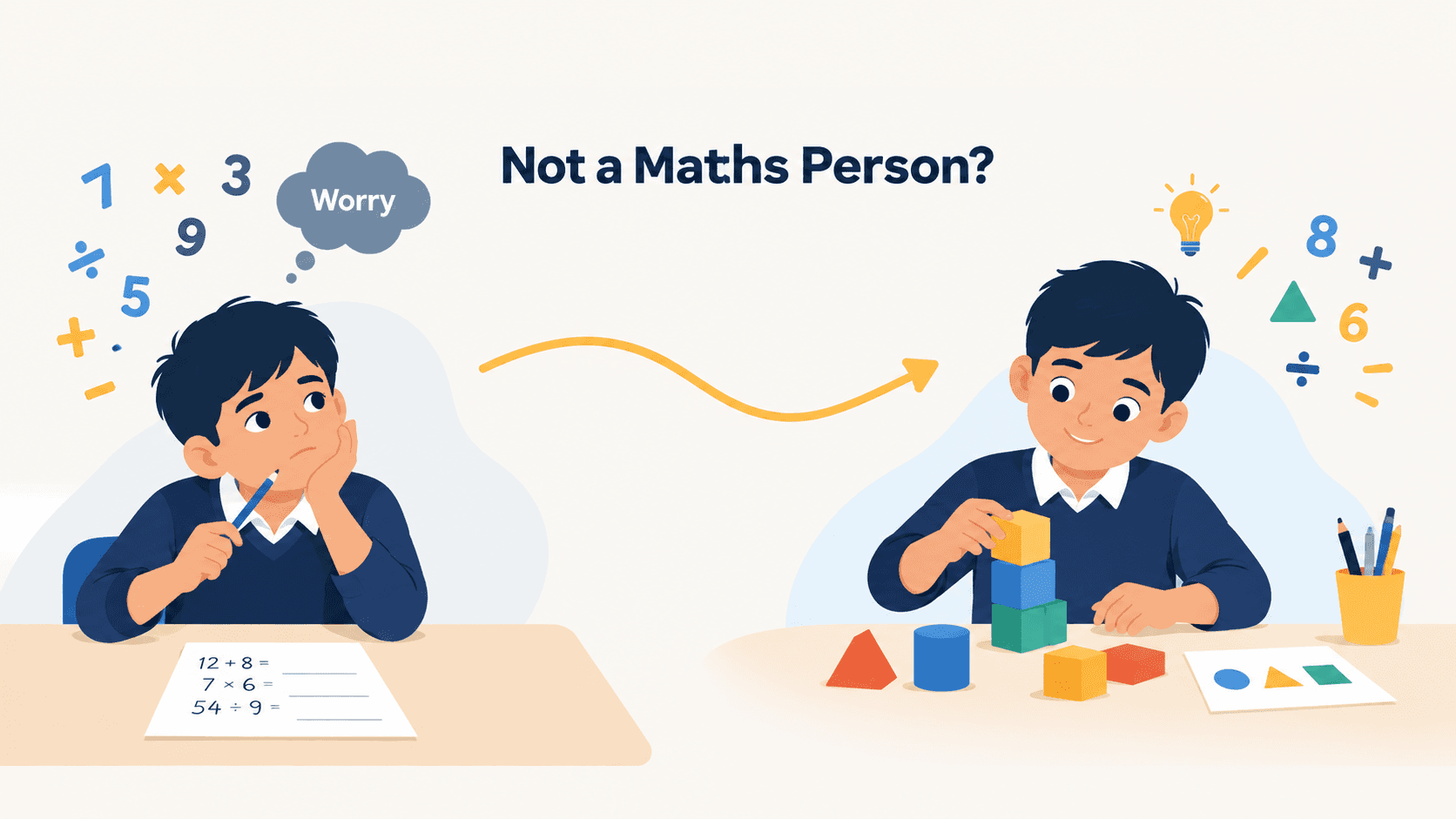

There is a surprisingly powerful sentence children sometimes say in Class 4 or 5: “I’m just not a maths person.”
It sounds harmless. It may even sound like an observation about ability. But repeated often enough, it can become an identity.
A child who once struggled with fractions may begin avoiding them. A student who needed more time to solve a problem may start assuming that everyone else is naturally better. Homework becomes something to fear rather than something to understand.
For one of the best schools in Bangalore, Canara Gurukula Public School, where practical learning and the development of independent, critical thinkers are part of the stated educational approach, the bigger question is not simply how quickly a child can solve a sum. It is how the child learns to respond when the answer does not come immediately.
Math Anxiety Is Not the Same as Being “Bad at Math."
Math anxiety is often misunderstood as simply disliking numbers. It is closer to what happens when worry begins taking up mental space that a child needs for solving the problem. Imagine a student looking at a multiplication problem. Instead of thinking only about the numbers, another thought appears:
“What if I get this wrong?”
Then comes:
“Everyone else is faster than me.”
The child's attention is now divided. Some of their working memory is being used to manage worry rather than work through the problem. They may make an avoidable mistake.
That mistake then seems to prove the original belief: “See? I really am bad at math."
The next math lesson begins with even more anxiety. This creates a cycle:
Worry → less mental space → mistakes → loss of confidence → more worry.
The important part is that the cycle can be interrupted. A wrong answer is not proof of a fixed ability. Sometimes it is simply evidence that the child needs a different route into the idea.
Also Read | Yoga Poses for Students
Three Things That Can Make the Cycle Worse
1. The speed-and-drill culture
Speed is useful for some mathematical skills, but treating speed as the definition of mathematical ability can create unnecessary pressure. A child who needs another minute may start believing that taking longer means thinking poorly. It does not. Some children need time to visualize a problem, test an approach, or connect it to something they already know. Fast calculation and deep understanding are related skills, but they are not identical.
2. Only the final answer matters
Consider two students who both write 24. One arrived at it through a clear method. The other guessed and happened to be correct. If only the answer is noticed, an important part of mathematical learning disappears: how the child thought. Asking, “How did you get there?” can reveal much more than asking, “What is the answer?” A child's explanation can also help teachers identify exactly where their thinking changed direction.
3. Adults can unintentionally pass on math fear
Children listen closely to the stories adults tell about themselves. When a parent says, “I was terrible at math too,” it may be intended as reassurance. But a child can hear something different:
“Being bad at math runs in our family.”
A better message is that mathematics contains things that can be difficult, and difficult does not mean impossible.
Start With Something Children Can Touch
One of the most useful shifts in mathematics teaching is moving from the concrete to the abstract. Before asking a child to manipulate symbols on a page, give them something they can see, move, group, compare, or measure.
- Counters can make multiplication visible.
- Paper strips can make fractions tangible.
- Blocks can help children understand area and volume.
A measuring activity can turn units from something memorised into something experienced. Only after the idea becomes meaningful should the symbols take over. This matters because mathematical notation is efficient, but it is also compressed. A symbol such as “½” carries an idea that a young learner may not yet fully understand. The physical experience gives the symbol somewhere to attach.
Also Read | Memories of School Life
Let Children Show Their Route
There is rarely only one interesting part of a math problem. The answer is the destination. The method is the journey. Children should have opportunities to explain their route, even when their route is different from the teacher's preferred method. A student might draw a picture. Another might break a number apart. Someone else might use repeated addition before discovering multiplication. These explanations turn mathematics into something students can discuss rather than something they simply receive. They also make mistakes useful. If a teacher can see where a child's reasoning changed direction, the next explanation can be much more targeted.
Practice Without Making Every Attempt Feel Like a Test
Low-stakes practice gives children room to make mistakes without attaching a large emotional consequence to every one. This can mean short problems, puzzles, estimation games, mental-maths conversations or everyday challenges where the emphasis is on trying a strategy. It also helps to separate fluency from understanding. A child may need repeated practice to become comfortable with multiplication facts. But memorising facts should not become a substitute for understanding multiplication itself. The goal is not simply to make children faster. It is to help them become more flexible.
Parents Can Put Mathematics Back Into Ordinary Life
- Math does not have to begin when the textbook opens.
- Cooking offers fractions, measurement, and proportion.
- Shopping offers estimation, comparison, and change.
- Cricket offers averages, runs, overs, scoring rates, and simple data.
- Planning a journey introduces time, distance, and calculation.
Even deciding how many pieces of fruit are needed for a group can become a small mathematical problem. These moments have one major advantage: there is usually a reason for finding the answer. Parents can also remove one particularly unhelpful pressure at home: timing everything. If a child is learning, the question does not always need to be, “How quickly did you finish?”
Try asking:
- “What did you try?”
- “Why did you choose that method?”
- “Can you find another way?”
And when a child gets something wrong, praise the process rather than pretending the error does not matter.
“Good thinking—let's see where it changed” is much more useful than either “You're so smart” or “You always make silly mistakes.”
What Happens When Math Leaves the Page?

The strongest response to math anxiety is not simply more worksheets. Sometimes children need to experience mathematics as something that does things. That is where the learning environment matters.
At one of the best CBSE schools in Bangalore, Canara Gurukula Public Schools, the Maths Lab forms part of a wider practical-learning setup that also includes Robotics and a Composite Science Lab. The school's stated approach emphasizes practical learning while aiming to develop independent learners and critical thinkers.
This creates opportunities for mathematics to move beyond recitation.
In a math lab, an abstract idea can be represented physically. In robotics, mathematical thinking can become part of building, coding, measuring, and problem-solving. In a science laboratory, numbers can be connected to observations and experiments rather than existing only as questions on a worksheet.
The school's January Science Exhibition also provides a natural showcase for this kind of applied learning; the school website notes that the exhibition is intended to expose students' talent. That distinction is important.
A child does not necessarily lose the belief “I am not a math person” because someone tells them to be confident. They may begin to lose it when they repeatedly experience themselves using mathematics successfully.
When numbers help them build something, investigate something, explain something, or solve something, maths stops looking like a subject that is judging them. It becomes a tool they can use.
And perhaps that is the better goal—not producing children who never struggle with mathematics, but children who can struggle with it without deciding that the struggle defines them.
To know more about other schools in this area, click on the link below
 as a preferred source on