







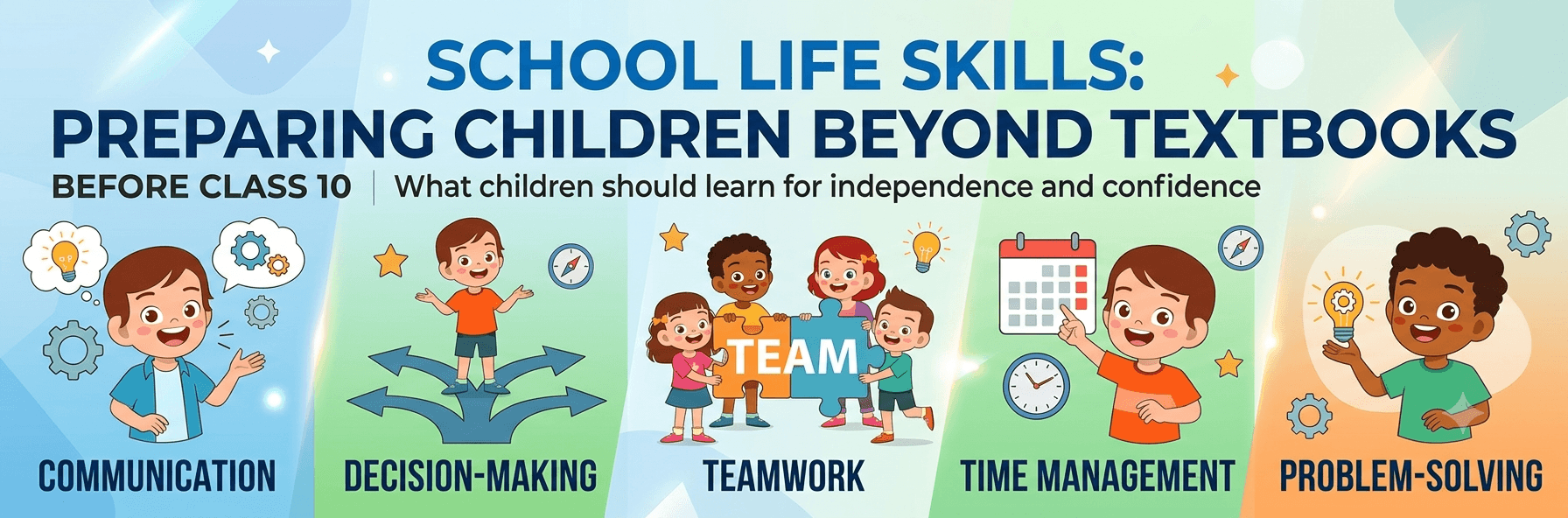

A child may score well in a test and still hesitate to speak in front of others, struggle to manage time, or depend on parents for every small decision. This is why education before Class 10 needs to build more than subject knowledge. For parents exploring a Top school in Greater Noida, it is worth asking not only what children study, but also what they learn to do independently.
Life skills help children handle everyday situations with greater confidence. They include communication, decision-making, problem-solving, teamwork, self-awareness, responsibility and managing time. These abilities do not replace academics. Instead, they help children use their academic knowledge in practical situations.
Also Read| From Curiosity to Capability: How Holistic Learning Shapes the Future
What Are Life Skills in School?
Life skills are the abilities children need to manage themselves and interact effectively with the people and situations around them.
For example, knowing the answer to a question is academic knowledge. Explaining that answer clearly to classmates involves communication. Working with a group to solve a problem involves collaboration. Planning when to complete homework involves time management.
In modern education, skills such as critical thinking, creativity, communication, collaboration, flexibility, leadership, initiative and self-awareness are increasingly recognised as important parts of student development.
In other words, life skills are not simply "extra" skills. They are part of helping children become capable learners and responsible individuals.
Why Do Life Skills Matter Before Class 10?
The years before Class 10 are an important period for developing independence. Children gradually have more subjects, assignments, group activities and social situations to manage.
They also begin making more choices for themselves. Instead of parents organising every part of the day, children can slowly learn to plan, prioritise and take responsibility.
This does not mean expecting a 12- or 13-year-old to behave like an adult. It means giving children small, age-appropriate opportunities to practise independence before the demands of senior school become greater.
1. Communication
A child should be able to explain an idea, ask a question, listen to another person's point of view and express disagreement respectfully.
Parents can encourage this by asking children to explain how they reached an answer rather than simply asking whether the answer is correct.
2. Time Management
Managing time becomes increasingly important as schoolwork, hobbies, friends and family responsibilities compete for attention.
Children can start with simple habits:
- Writing down important tasks
- Breaking large assignments into smaller steps
- Setting realistic deadlines
- Preparing school materials in advance
- Keeping some time for rest and recreation
The goal is not a perfectly organised timetable. It is to help children understand that their time is a responsibility.
3. Decision-Making
Children need opportunities to make small decisions and understand their consequences.
Parents can offer choices wherever appropriate. For example, a child might decide whether to complete a particular task before or after a short break, provided the agreed responsibility is completed.
When adults make every decision, children get fewer opportunities to practise judgement.
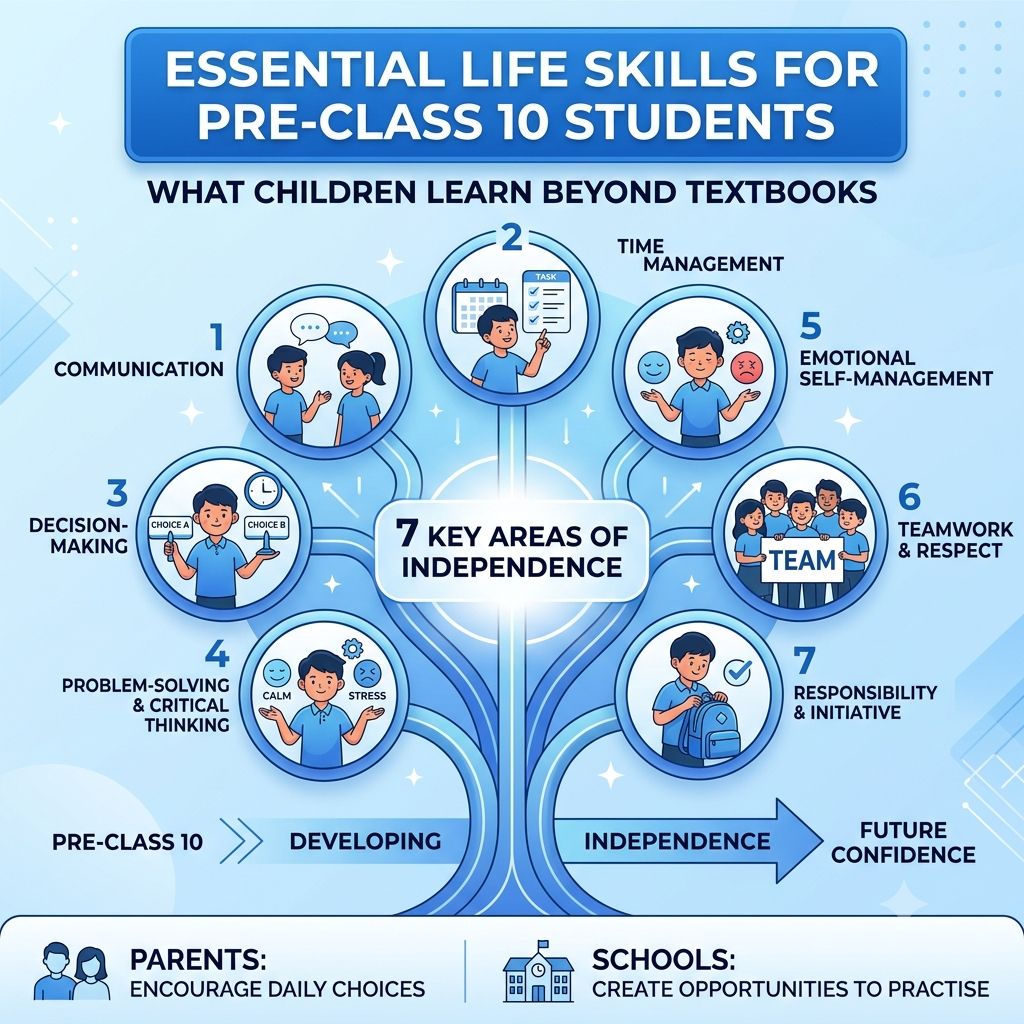
4. Problem-Solving and Critical Thinking
Life rarely presents problems with textbook-style instructions. Children need to learn how to identify a problem, consider possible solutions and decide which option makes sense.
Parents can encourage this by asking, "What do you think we could try?" before immediately providing a solution.
5. Emotional Self-Management
Children will experience disappointment, frustration, disagreements and failure. Learning to recognise these feelings and respond thoughtfully is an important part of growing up.
This does not mean asking children to hide difficult emotions. Instead, they can learn to pause, communicate what they are feeling, seek help when needed and try again after a setback.
6. Teamwork and Respect
Group projects, sports, classroom discussions and everyday friendships all require cooperation.
Children need to learn that teamwork is not simply about getting along. It involves listening, sharing responsibilities, accepting different ideas and contributing fairly.
These experiences can also teach an important lesson: being a good team member does not always mean getting one's own way.
7. Responsibility and Initiative
A child who remembers their own books, checks a timetable, completes an agreed task or admits a mistake is practising responsibility.
Parents can build this gradually. Instead of reminding children about every small task, they can give them ownership of age-appropriate responsibilities and allow them to experience the results of their choices.
How Can Parents Teach Life Skills Without Adding More Homework?
Life skills do not need to become another worksheet or coaching class.
They can be developed through ordinary family routines.
Parents can:
- Let children organise parts of their own school routine.
- Involve them in simple household decisions.
- Ask them to explain their reasoning.
- Give them small responsibilities at home.
- Allow reasonable mistakes instead of immediately correcting everything.
- Encourage children to solve manageable problems independently.
- Praise responsibility, persistence and improvement, not only marks.
For example, instead of packing a child's school bag every evening, a parent can ask the child to check the next day's timetable and prepare it independently. A small routine like this can gradually build responsibility and planning.
What Should Parents Look for in a School?
When comparing schools, parents often look at academics, fees, transport and facilities. These are important, but there is another useful question: Does the school give children opportunities to practise life skills?
Parents can look for opportunities where students can:
- Work collaboratively
- Express ideas and participate in discussions
- Take responsibility for tasks
- Participate in co-curricular activities
- Solve problems rather than simply memorise answers
- Develop leadership and communication
- Reflect on their experiences and learn from mistakes
Also Read| The Power of Experiential Learning
How GD Goenka Public School Connects Learning With Life Skills
At GD Goenka Public School, Sector Tau, Greater Noida, life-skills programmes are explicitly included in the school's stated approach beyond academics. Its educational approach includes art, music, sports and life-skills programmes as part of preparing students for future challenges.

The school also highlights debates, cultural events, Olympiads and community initiatives as experiences that can foster leadership and teamwork. For parents evaluating a Top school in Greater Noida or a Best school in Greater Noida, this provides a useful example of why the wider learning environment matters alongside classroom academics.
Life Skills and Academics Should Work Together
The choice should not be between good marks and good life skills. Children need both.
Strong academic foundations help students understand the world, while communication, critical thinking, responsibility and collaboration help them apply that knowledge.
The years before Class 10 are therefore an opportunity to build these abilities gradually. Children do not need to master everything at once. They need repeated chances to make choices, take responsibility, work with others, communicate clearly and learn from mistakes.
For parents, perhaps the most useful question when evaluating education is not only, "What will my child learn?"
It is also: "What will my child learn to do independently?"
That question can reveal a great deal about whether a school's approach is preparing children not just for the next examination, but for the next stage of life.
To know more about other schools in Greater Noida, click on the link below
 as a preferred source on