







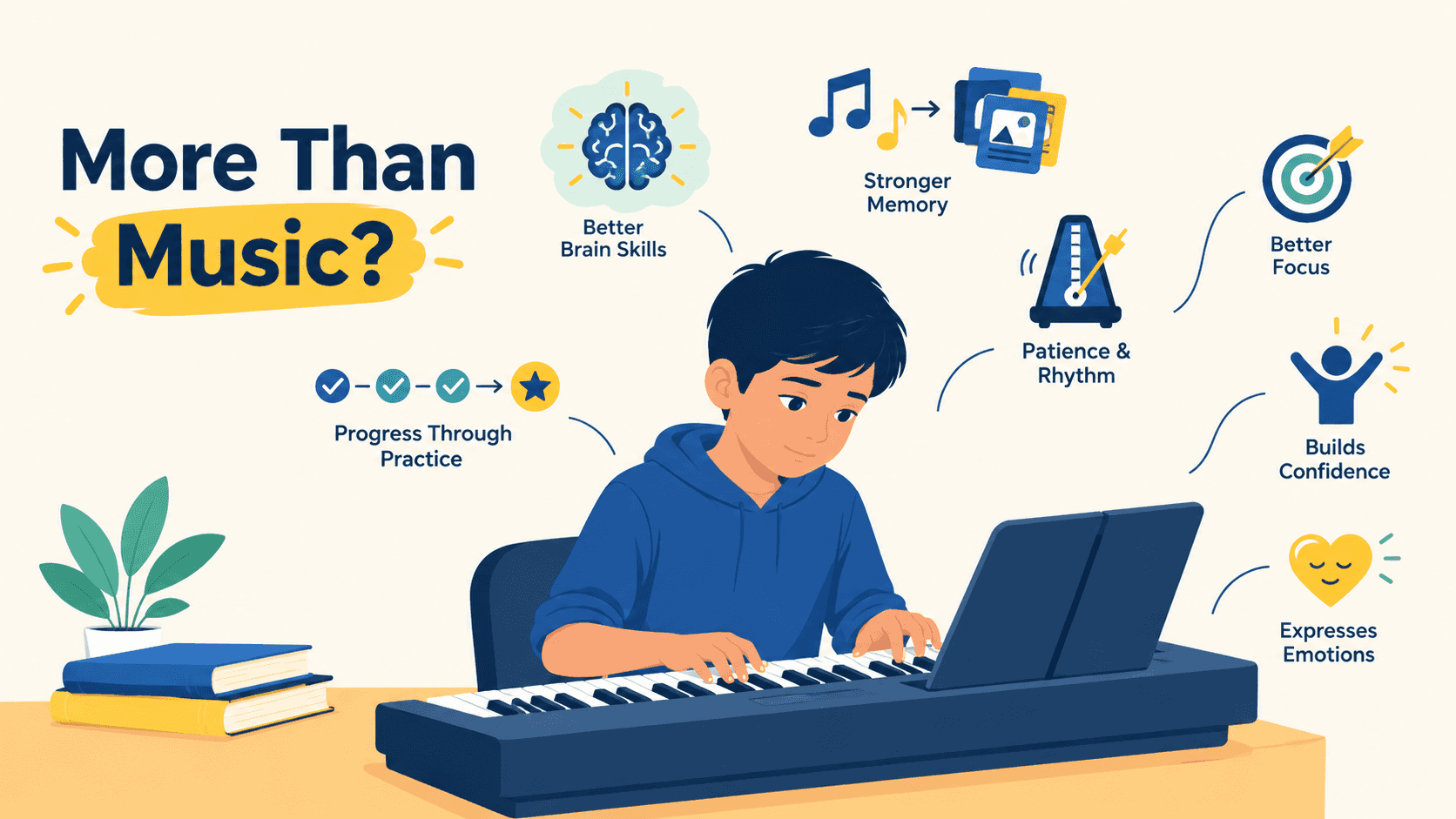

For many parents, choosing an activity for a child can feel like another decision on an already long list. Should it be sports, art, coding, dance or music? When exploring top boarding schools in India, parents may also notice how often music appears in a child's broader learning experience. Redbridge International Academy, for example, includes music among its co-curricular opportunities. But music does not have to be about producing the next great singer or pianist. Learning an instrument can help children practise skills that quietly matter in everyday life.
With International Music Day observed on October 1, it is a useful time to look beyond performances and certificates. The more interesting question is, what happens to a child while they are learning to play?
Music Teaches the Brain to Work in Layers
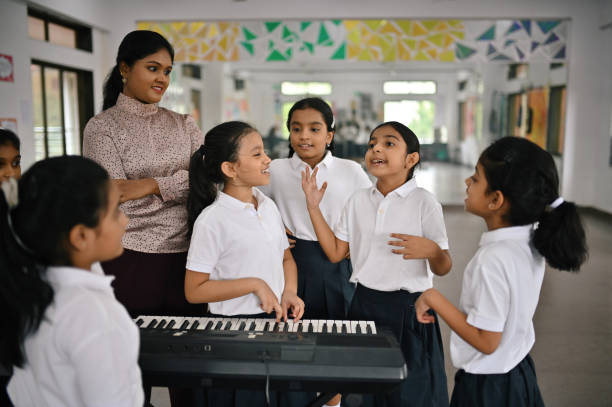
Learning an instrument is surprisingly complex. A child has to listen, remember, coordinate movement, follow rhythm and notice mistakes, often at the same time. Playing a simple tune on the keyboard, for instance, may require the child to remember which keys come next while keeping a steady beat and watching their fingers.
This connects with executive functions, the mental skills that help us plan, focus, remember instructions and control our actions. A 2024 meta-analysis of 22 longitudinal studies involving 1,734 children found evidence that music training can improve inhibitory control, although the researchers also noted that the effects varied across studies.
Earlier systematic research has also found possible benefits for inhibitory control, working memory and cognitive flexibility, though results have not been identical across every study.
A useful way to think about this is simple: music gives children a reason to practise paying attention. When a child waits for the right beat instead of rushing ahead, they are practising control. When they remember a sequence of notes, they are using working memory. When they change their approach after making an error, they are practising flexibility.
The Real Lesson May Be What Happens After a Mistake
The first few months of learning an instrument are rarely glamorous. A child may play the same four bars repeatedly, press the wrong key or struggle to change chords smoothly. That frustration is actually part of the learning process.
Instead of expecting quick mastery, parents can help children notice smaller signs of progress:
- A difficult rhythm becomes easier after several attempts.
- The child remembers a section without looking at the notes.
- They can identify their own mistake.
- They practise without being reminded every single time.
- They begin listening carefully instead of simply trying to finish the song.
This is where music can build patience. The goal is not to make practice feel like punishment. It is to help children experience the connection between repetition and improvement.
Research supports some of these cognitive links, but parents should avoid treating music as a guaranteed shortcut to better academic performance. A 2025 longitudinal study, for example, found improvements in fine-motor skills and auditory memory among children receiving music training but did not find broad causal improvements across all cognitive and socio-emotional measures.
That distinction matters. Music can be valuable without improving every other subject.
Also Read | International Curriculum works differently when students live on the campus
When Should a Child Start, and How Can Parents Keep Them Interested?
There is no single perfect age for every instrument or every child. Younger children can begin with playful singing, rhythm activities and simple musical exploration. As coordination and attention develop, they can move towards structured instrument lessons.
The better question is often not, “What is the earliest age to start?” but, “Is my child ready to enjoy regular practice?”
|
Sign of readiness |
What parents can look for |
|
Curiosity |
The child shows interest in sounds or instruments |
|
Attention |
They can stay with a short activity for a reasonable period |
|
Coordination |
They are willing to practise simple movements |
|
Motivation |
They want to learn at least some songs they enjoy |
|
Patience |
They can tolerate making mistakes without giving up immediately |
A 2022 randomised controlled study involving 84 children aged 4–6 found that a 10-week multimodal music programme was associated with improved working memory compared with control groups. Research on preschool music training has similarly explored improvements in executive functions, including inhibition and working memory.
For parents, however, consistency matters more than trying to create a mini-professional musician at home. Short, regular practice can be easier to sustain than long sessions that leave a child exhausted. Let children choose some of the music they want to learn, celebrate effort rather than perfection, and allow room for changing interests.
A child who leaves the piano after two years has not necessarily "failed". They may have learned how to listen, practise, perform, handle mistakes and decide what they enjoy.
Also Read | Why Alumni Become Testimonials
How Schools Can Make Music Part of Everyday Learning
 (1).jpg)
A strong music programme can make the experience broader than a weekly lesson. Children benefit when they have opportunities to sing, play different instruments, perform with others, and learn from people who treat music as a real practice rather than just another classroom subject.
This approach is evident at Redbridge International Academy, where the Music Chamber runs in collaboration with Furtados School of Music. Students can receive vocal coaching and learn instruments, including piano, guitar, drums, tabla and flute, with mentors who are practising musicians as well as teachers. This variety gives children the chance to discover whether they connect more naturally with rhythm, melody, singing, or an instrument. For families considering the best boarding school in Bangalore, these opportunities can help you assess a school's support for creative and well-rounded development.
Conclusion
Learning an instrument does not have to end with a child becoming a musician. Its greater value may lie in the habits built along the way: listening carefully, repeating difficult tasks, controlling impulses, remembering patterns, working with others and staying patient when progress is slow.
As International Music Day arrives on October 1, music can be viewed not simply as a performance skill but as another way for children to learn how learning itself works. The instrument may change, the songs may change, and a child's interests may change too. What remains is the experience of turning effort into something they can hear, feel and share.
To know more about other boarding schools in this area, click on the link below
 as a preferred source on