









Think about a plant sitting in a small pot near your window. You cannot keep it alive by watering it alone. It needs sunlight, air, water, nutrients from the soil, and enough space for its roots to grow. Give it plenty of water but no sunlight, and it will struggle. Give it sunlight but forget to water it, and the leaves will eventually droop. A healthy plant needs several things at the same time. Children are much the same.
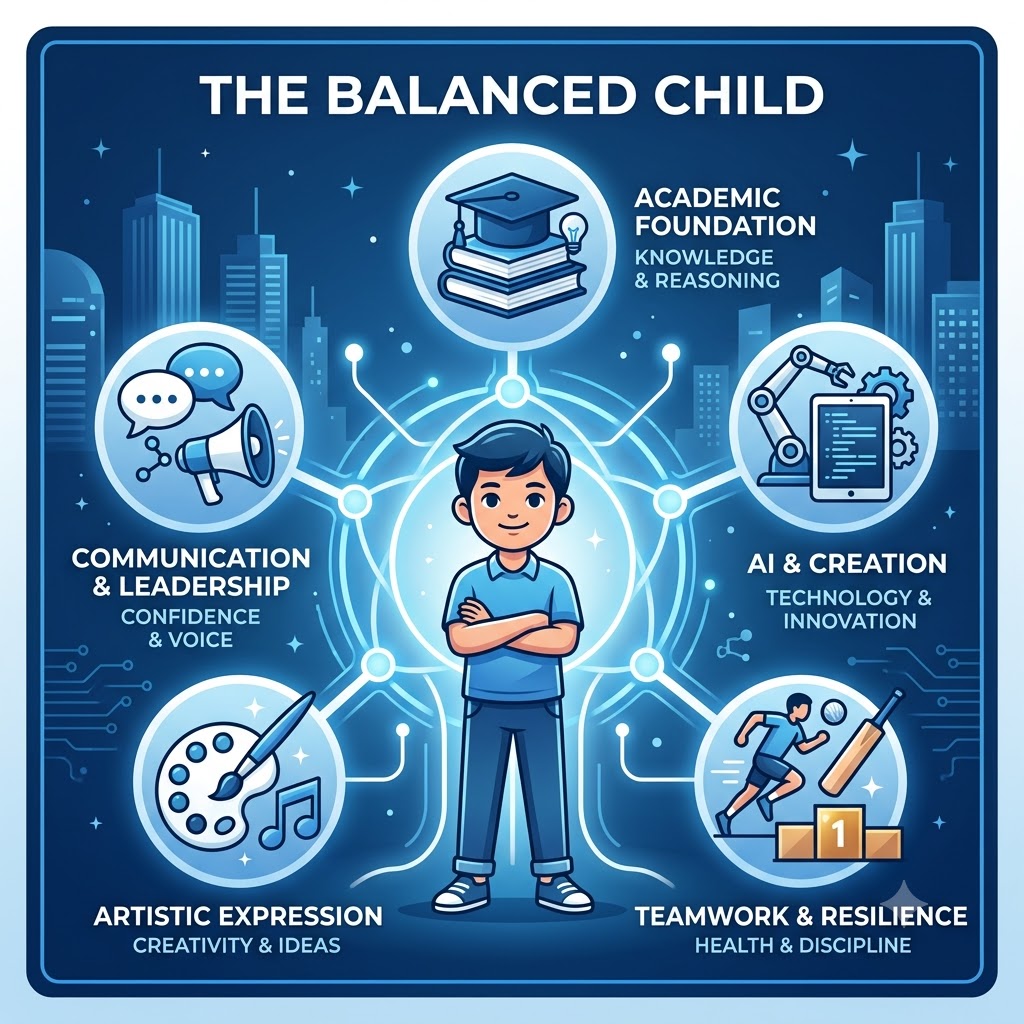
A child needs academics, of course. Mathematics, science, languages and other subjects give them the foundation they need to move ahead. But somewhere along the way, another set of things starts becoming equally important: confidence, communication, creativity, technology, sports, teamwork and the ability to actually use what they have learnt.
Think of two students who have just finished school. One has spent years chasing marks, memorising answers and making sure every test score is higher than the previous one. The other has also studied seriously, but has spent time building a small robot, playing basketball, participating in debates, working on projects and learning how to present an idea in front of a group.
Both may have good marks. But when they walk into an interview, a college application, a competition or even their first internship, the second student may have something extra to show: “This is what I can do.” That difference is becoming harder to ignore.
Today, we will understand how one of the schools in Devanahalli, Bangalore, MVM School, is offering holistic development to the students.
Also Read: From Karate to Coding: How MVM School Devanahalli is Redefining All-Round Education
Marks Can Get You Noticed. Skills Can Help You Stand Out.
Imagine three students applying for the same opportunity.
Student A has excellent marks but has never worked on a project outside the syllabus.
Student B has good marks and has spent the last two years building small coding projects and participating in technology competitions.
Student C has good marks, plays a competitive sport, has been part of school events, and is comfortable presenting ideas to a group.
It would be wrong to say that Student A has no chance. Marks still matter, particularly when academic eligibility and entrance requirements are involved. But if the opportunity also asks, “What have you built? What have you done? How well can you work with others? Can you communicate your ideas?”, students B and C have more experiences to draw upon.
This is one reason parents are increasingly looking beyond the report card when thinking about their child's education. The question is no longer only “How much did my child score?” It is also “What can my child do with what they know?”
Academics Are Still the Foundation
None of this means children should stop caring about marks.
A strong academic foundation matters. A student cannot expect to understand advanced science without learning the basics first. A child interested in engineering needs mathematics. Someone interested in medicine needs a strong grounding in science. University admissions and competitive examinations can also have demanding academic requirements.
But academics are a little like the soil in our plant example. They provide the foundation, but they are not the entire plant.
Consider a child who is very good at physics. He understands the concepts and scores well in examinations. Then, during a school project, he has to build a simple working model. His first attempt fails, and the circuit does not work. He changes the connections, tries again, asks for help, and finally gets it running. Something different has happened here. That child has moved from knowing physics to using it and that small transition can be enormously valuable.
AI and Robotics: From Using Technology to Creating With It
Children today are growing up surrounded by technology. They use smartphones, search engines, apps, and increasingly AI-powered tools. But there is a difference between being comfortable with technology and understanding how to create with it.
Suppose a student spends an hour watching videos about robots. He knows how they look and what they can do. Now imagine another child spending that same hour trying to make a small robot move. It doesn't work the first time. Perhaps the sensor isn't responding. Maybe the instructions are wrong. The child changes something and tries again.
The second child has just experienced something important: technology as a problem to solve, rather than something to consume.
That is where exposure to AI, robotics, coding, 3D printing and STEM activities can be useful at school. Not every child who works with a robot will become a robotics engineer. That isn't the point. They may instead develop patience, logical thinking, curiosity and the habit of asking, “Why didn't this work, and what can I change?” Those habits can travel with them into completely different careers.
Sport Teaches What a Mark Sheet Cannot
Now consider a child who plays cricket. He may spend an entire week preparing for a match and then get out on the first ball. There is no revaluation. No extra five marks. No chance to request that the teacher reconsider the result. He simply has to walk back. The next day, he goes back to practice.
That is one of the reasons sport deserves a more serious place in education. A child learns to deal with losing, work with teammates, listen to a coach, make decisions quickly and keep practising when improvement is slow.
For example, a child may not be particularly confident when answering questions in class. But she becomes a completely different person on the basketball court. She calls for the ball, communicates with teammates and takes responsibility when the match becomes difficult.
That confidence may eventually appear in other parts of her life too. And there is another benefit. Employers and universities do not only look for people who can work alone and get every answer right. They need people who can communicate, collaborate, handle setbacks and keep going when something does not work. Sport gives children a safe place to practise exactly those things.
Creativity Gives Children Somewhere to Put Their Ideas
Not every child wants to express an idea through an examination answer. Some children draw. Some write stories. Some act. Some make things with their hands. Some can spend an entire afternoon designing something that nobody asked them to make.
Imagine Nisha, who is average at memorising textbook answers but spends her free time designing posters on a computer. Over time, she learns about layout, colour, typography and how to communicate an idea visually. Years later, when she applies for a design course or even takes up a job where presentations and visual communication matter, that school interest may suddenly become useful.
This is why arts and creative activities should not be treated as something children do only when their “real work” is finished. Sometimes, the thing a child does for fun at 12 becomes the skill that sets them apart at 22.
A Good School Should Give Children Several Places to Grow
This brings us back to our plant. If you only water one part of the plant, the rest does not magically disappear. It simply remains underdeveloped. The same can happen with children.
A school that focuses only on marks may produce academically capable students who have had fewer opportunities to discover other strengths. On the other hand, activities without academic discipline are not enough either. Children need both. Parents can therefore look for a school where different parts of a child's development have a genuine place:
- Academics, to build subject knowledge and prepare students for higher education.
- Technology and STEM, to help children understand and create with emerging technologies.
- Sports, to develop fitness, teamwork, discipline and resilience.
- Arts and creative activities, to give children different ways of expressing ideas.
- Projects and experiential learning, so children learn to apply knowledge rather than only remember it.
- Communication and collaboration, because knowing something is useful, but being able to explain and work with others is equally important.
The important word is genuine. A school brochure can list twenty activities. What matters is whether children actually get time, guidance and encouragement to participate in them.
Also Read: Learn Farming & Life Skills at MVM School
How MVM School Brings These Opportunities Together
At MVM School, one of the schools in Devanahalli, Bangalore, this wider approach is reflected in the opportunities available beyond regular academics. The school follows the CBSE curriculum while providing exposure to technology, experiential learning, sports and creative activities.
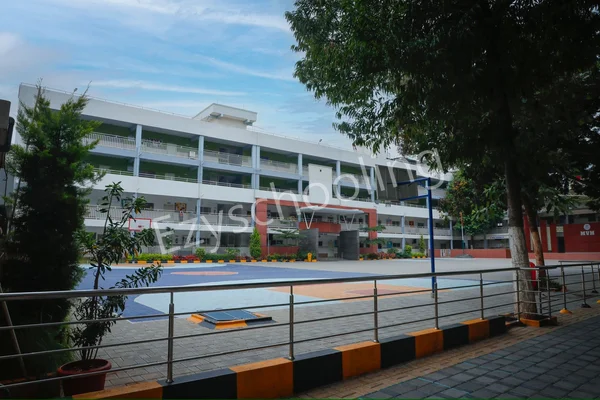
Its Cogno Space Lab gives students from Grades 1 to 10 opportunities to explore areas including robotics, artificial intelligence, drones, 3D printing and engineering mechanisms. The school also has dedicated science laboratories, allowing students to move beyond simply reading about scientific concepts.
On the sports side, students have access to activities including cricket, football, basketball, volleyball, table tennis and chess, along with yoga and karate. The school also highlights opportunities in areas such as art, craft and drama.
Put these together, and the idea becomes fairly simple. A child may spend one part of the day learning from a textbook, another trying to understand why a robot is not working, another playing a sport and another exploring a creative activity. None of these replaces academics. They add to it.
To know more about MVM School, Devanahalli, Bangalore, and other schools in nearby areas, visit our page
 as a preferred source on