








Children learn about money long before they earn it. They notice when a parent compares prices at a shop, waits for a sale, saves for a family trip, or says, “We can buy this next month.” These small moments can shape how children think about spending and saving later in life. This is why financial literacy is becoming an important part of childhood learning. Even families exploring the top schools in Gurgaon, including K.R. Mangalam World School, Gurugram, are seeing greater attention given to practical life skills alongside academics.
Financial literacy does not mean teaching a seven-year-old about taxes, loans, or complicated investments. It begins with simple ideas: money is limited, choices have consequences, and saving today can help us reach a goal tomorrow. Research from the Consumer Financial Protection Bureau shows that children begin developing money habits and values during middle childhood, and these can continue developing through adolescence.
Why Money Habits Can Start So Young
Think about a child who receives ₹500 during a festival. One child spends it all on small treats. Another keeps some aside for a toy they really want. Neither response is automatically right or wrong, but the second child is practising an important skill: delaying a small reward to reach a bigger goal.
This connects with the psychological idea of delayed gratification. Children gradually learn that waiting can sometimes bring a better result. Saving money provides a real-life way to practise this skill.
The home is especially important because children watch adults closely. Research reviewed by the CFPB describes this process as financial socialisation, where children learn through both direct conversations and by observing how adults behave around money.
Parents can therefore teach without turning every purchase into a lesson. Saying, “I am comparing these two packets because one costs less for the same amount,” can be more useful than giving a long lecture about budgeting.
Also Read | Student Stress Management Guide
Simple Ways to Teach Saving, Spending and Needs

Financial lessons work best when they are connected to things children already understand. A weekly allowance, a trip to the supermarket, or planning a birthday party can become a small learning exercise.
Parents can try activities such as:
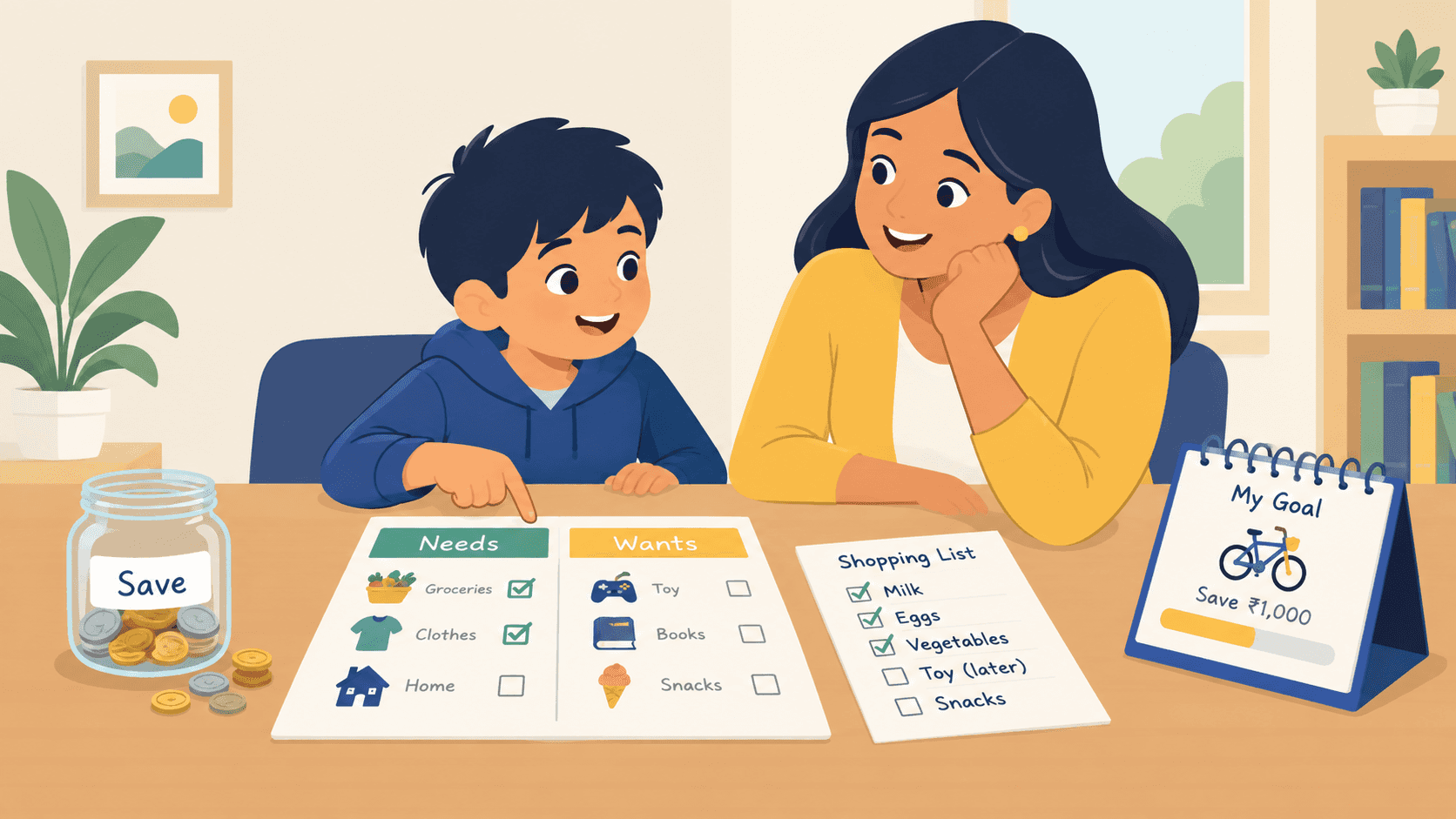
- Create three money jars: Label them "Save", "Spend", and "Share". A child can decide how to divide a small amount of pocket money between them.
- Set a visible goal: If a child wants a ₹1,000 board game, help them work out how much they need to save each week.
- Compare prices: At the supermarket, ask which packet offers better value instead of simply choosing the cheapest item.
- Make a simple family budget: When planning a picnic, give the child a fixed amount and let them decide how much can go towards snacks, games, or other activities.
- Talk about digital payments: Children may not see physical cash when a parent taps a phone or card. Explain that the payment still represents real money.
The CFPB similarly recommends helping school-age children practise earning, saving, planning, shopping, borrowing and protecting their financial information.
A simple needs-versus-wants activity can also be useful:
|
Situation |
Need or Want? |
What Can a Child Learn? |
|
Buying lunch |
Need |
Some spending is necessary |
|
Buying another toy |
Want |
We can choose to wait |
|
Replacing a torn school bag |
Need |
Needs may come before wants |
|
Buying a new game because friends have it |
Want |
Peer pressure can affect spending |
The important part is not making children feel guilty for wanting things. The goal is to help them understand that every spending decision involves a choice.
Avoid Making Money a Secret or a Reward for Everything
Two common approaches can make financial learning harder. The first is keeping children completely away from money conversations. The second is giving them whatever they want without allowing them to experience limits.
If parents never discuss why certain purchases are planned or delayed, children may see money as something that simply appears when they ask for it. On the other hand, if every task is rewarded with money, children may begin to see helping at home only as a paid activity.
There is a middle path. Children can be given age-appropriate responsibility while parents remain available to guide them.
For example, instead of saying, “We cannot buy that,” parents can say, “That is something we can plan for. Let's see how much it costs and what we would need to save.” This changes the conversation from immediate disappointment to planning.
Parents also do not need to pretend that they know everything. If a child asks what interest means, it is perfectly fine to look it up together. The CFPB recommends that parents use everyday situations and even “think out loud” about financial decisions so children can understand the reasoning behind them.
Also Read | Role of Nutritious Meals in Student's Life
How K.R. Mangalam World School Brings Financial Literacy Into Learning

For families looking at the best schools in Sector 41, Gurgaon, K.R. Mangalam World School, Gurugram, offers an example of how financial literacy can move beyond an occasional activity. The school's current Primary Wing curriculum for Classes II–V includes Financial Literacy alongside areas such as STEAM, AI, Coding, Robotics, Arts, Physical Education and Life Skills. Its curriculum also uses project-based activities, research-driven tasks, and real-world applications.
The school is also currently recognised as a Money Smart School for the 2024–25 and 2025–26 sessions, according to its website. Its collaboration information states that students gain financial knowledge and money-management skills through structured school-based programmes. This approach fits naturally with the idea that children can learn money skills through practical situations rather than waiting until adulthood to encounter them.
Building a Money-Smart Mindset, One Small Choice at a Time
Financial literacy does not need to begin with a complicated lesson. It can start when a child decides whether to spend ₹100 today or save it for something bigger. It can happen while comparing two products at the supermarket or planning how much to spend at a birthday party.
These small choices teach children something larger than how to handle money. They teach planning, patience, responsibility and decision-making. When parents allow children to see, discuss and practise these choices—and when schools reinforce them through structured learning—money becomes less mysterious and more manageable.
The goal is not to raise children who think about money all the time. It is to help them grow into adults who can think before making financial decisions.
To know more about other schools in Gurgaon, click on the link below
 as a preferred source on