








A child’s education today is no longer limited to textbooks, notebooks, and classroom discussions. Technology has become a natural part of how students learn, communicate, research, create, and solve problems. This is why schools are increasingly giving digital learning a meaningful place in everyday education. Top boarding schools in India, like Delhi Public School, Yamuna Nagar, provide students with computer labs, internet access, audio-visual learning facilities, and opportunities to work with technology as part of their academic experience.
But digital education is about much more than simply knowing how to operate a computer. The bigger goal is to help students become comfortable, responsible, and confident users of technology.
What Does Digital Literacy Really Mean?
Digital literacy refers to the ability to use digital tools effectively and responsibly. For a student, this can include basic computer skills, finding reliable information online, creating presentations, working with software, communicating digitally, and understanding how technology can be used to solve problems.
It also involves knowing when to question information.
The internet gives students access to an enormous amount of information, but not everything they find online is accurate. Learning how to compare sources, identify trustworthy information, and think critically about what they see is therefore an important part of modern education.
In this sense, digital literacy is closely connected with critical thinking.
A computer can turn an abstract idea into something students can see and explore.
For example, instead of only reading about the solar system, students can use digital simulations to understand planetary movement. A geography lesson can involve maps and visual data. A science topic can be supported by animations, demonstrations, or virtual experiments.
Also Read | An Ecosystem for Young Minds
Why Should Students Learn Technology Early?
Children are growing up in a world where technology is already present in everyday life. They encounter digital devices at home, in schools, in public spaces, and eventually in higher education and workplaces.
Introducing technology in school gives students the opportunity to learn these skills gradually rather than treating them as something they need to figure out later.
Early exposure can begin with simple activities. Younger students might learn basic computer operations, typing, drawing, or educational software. As they grow older, they can move towards research, presentations, coding, data handling, digital design, and other applications.
The important point is that technology should grow alongside the child's learning needs.
Digital Skills Can Support Creativity
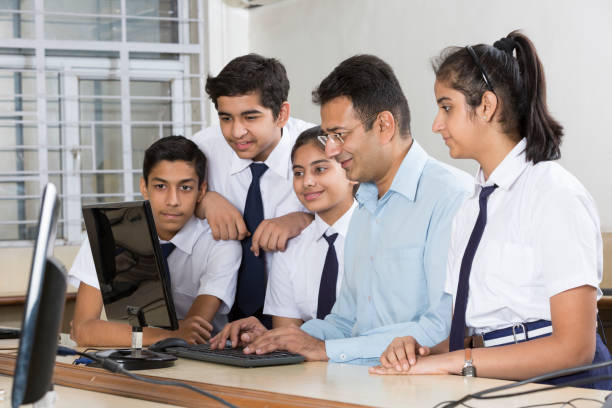
Technology is not only about consuming information. It can also help students create.
Students can use digital tools to make presentations, design posters, edit videos, create illustrations, develop websites, or experiment with basic programming. These activities allow them to communicate ideas in different ways.
A student who struggles to express an idea through a traditional written assignment may find that creating a presentation or visual project gives them another way to demonstrate their understanding.
This is particularly valuable because modern education increasingly recognizes that students can demonstrate learning in many different forms.
Digital literacy also has an important responsibility component. Students need to understand that technology comes with certain responsibilities. They should learn about protecting personal information, using strong passwords, communicating respectfully online, checking information before sharing it, and understanding that their digital actions can have consequences.
Also Read | Life and Learning Outside the Classes
Computer Labs Still Have an Important Role
With laptops, tablets, and smartphones becoming increasingly common, it may seem that dedicated computer labs are becoming less necessary. In reality, a structured computer lab can provide an important learning environment.
A lab gives students access to technology in an organized setting where teachers can guide their work. It can also provide opportunities for hands-on practice that may be difficult to achieve through occasional classroom demonstrations.
Students can work on individual tasks, collaborate on projects, practice software skills, conduct research, and develop technology-based assignments.
The teacher's role remains central because technology becomes most useful when students understand why they are using a particular tool and how it connects to what they are learning.
How Schools Can Make Digital Learning Meaningful
Simply having computers does not automatically create good digital education. The way technology is integrated into learning matters.
Schools can focus on a few key principles:
Make technology purposeful: Students should use digital tools to understand, create, investigate, or solve problems rather than simply use them because they are available.
Connect technology with subjects: Computer skills become more meaningful when students use them in science, mathematics, languages, social studies, art, and other areas.
Encourage hands-on learning: Students should get opportunities to practice rather than only watch demonstrations.
Teach responsible use: Digital citizenship, online safety, information evaluation, and respectful communication should be part of the learning journey.
Keep teachers involved: Technology should support teachers, not replace the guidance, discussion, and human interaction that make education meaningful.
How DPS Yamuna Nagar Approaches Technology-Based Learning

These principles can be seen in the technology facilities described by one of the best CBSE boarding schools in Haryana, Delhi Public School, Yamuna Nagar. Its computer lab is designed as a learning environment rather than simply a room containing computers. The school says students and staff have access to internet connectivity, scanners, printers, updated IT facilities, and an audio-visual room used for presentations by students, teachers, and guest speakers.
The school also states that computer education begins from Class I, giving students an early foundation in computer use. Students have access to laptops under teacher monitoring, while the school provides training in globally used software and access to supporting documentation and training.
Its broader infrastructure also reflects an emphasis on technology across the campus. The school lists two computer labs, internet facilities, a campus-wide LAN, and an ERP system supporting areas such as attendance, examinations, assignments, and timetables.
Importantly, the school's technology facilities extend beyond basic computer operations. Its computer-lab information highlights exposure to areas such as programming, web designing, and app development, alongside updated software and connectivity.
This approach fits into the school's wider vision of education. DPS Yamuna Nagar describes its educational approach as combining academic learning with technical proficiency, sports, fine arts, music, theatre, and other areas of development.
Preparing Students for a Digital Future
Technology will continue to change, which means today's students will probably use digital tools that schools have not even introduced yet. The most valuable skill, therefore, is not memorising how one particular piece of software works.
It is learning how to adapt.
Students who know how to research, question information, solve problems, communicate clearly, create digital content, and learn new tools are better prepared to handle technological change.
This is why digital literacy deserves to be treated as an important part of school education rather than an additional skill on the side. With the right guidance, a computer lab can become much more than a place where students learn computer operations. It can become a space where they experiment, create, investigate, collaborate, and develop the confidence to use technology intelligently.
For schools such as DPS Yamuna Nagar, the combination of dedicated computer facilities, guided access to technology, early computer education, and broader technology infrastructure shows how digital learning can be integrated into a larger vision of holistic education.
To know more about other boarding schools in India, click on the link below


 as a preferred source on