







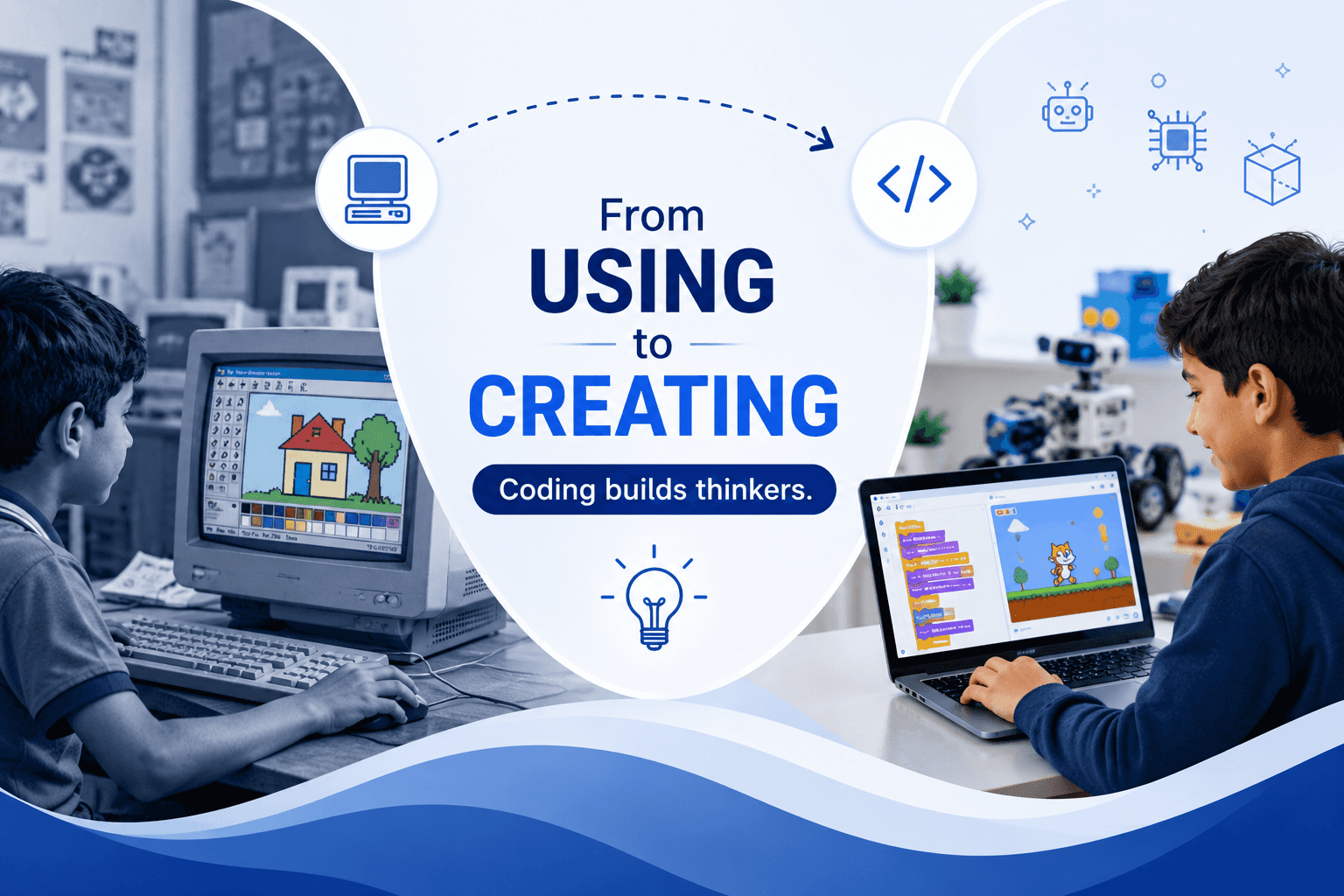

If you grew up in the 1990s or early 2000s, you probably remember computer period differently. The computer lab had bulky monitors, noisy keyboards, and a room full of children waiting for their turn with the mouse. For many of us, computer class meant opening MS Paint, choosing a colour and trying to fill a shape without accidentally colouring the whole screen. That moment when the bucket tool spilled colour everywhere? Almost every millennial who grew up with school computers knows it.
Back then, computers were something we visited at school. Today, children are growing up surrounded by technology. Smartphones, tablets, smart TVs, voice assistants and AI tools are already part of everyday life. They don't have to wait for computer period to meet technology; technology is simply part of the world they are born into.
That makes technology education different today. Children don't only need to know how to use technology. They also need opportunities to understand it, create with it, and solve problems through it. This is where coding becomes much more interesting than simply learning commands.
Also, we will take an example of one of the schools in Greater Noida West, Salvation Tree, to understand how this school is making the journey of such students easy and smooth in terms of technology learning.
From Using Computers to Creating With Them
The biggest change is the shift from consuming technology to creating with it. Earlier, a child might use Paint to colour a house on the screen. Today, another child might use coding to make that house appear, move a character around it or build a simple game.
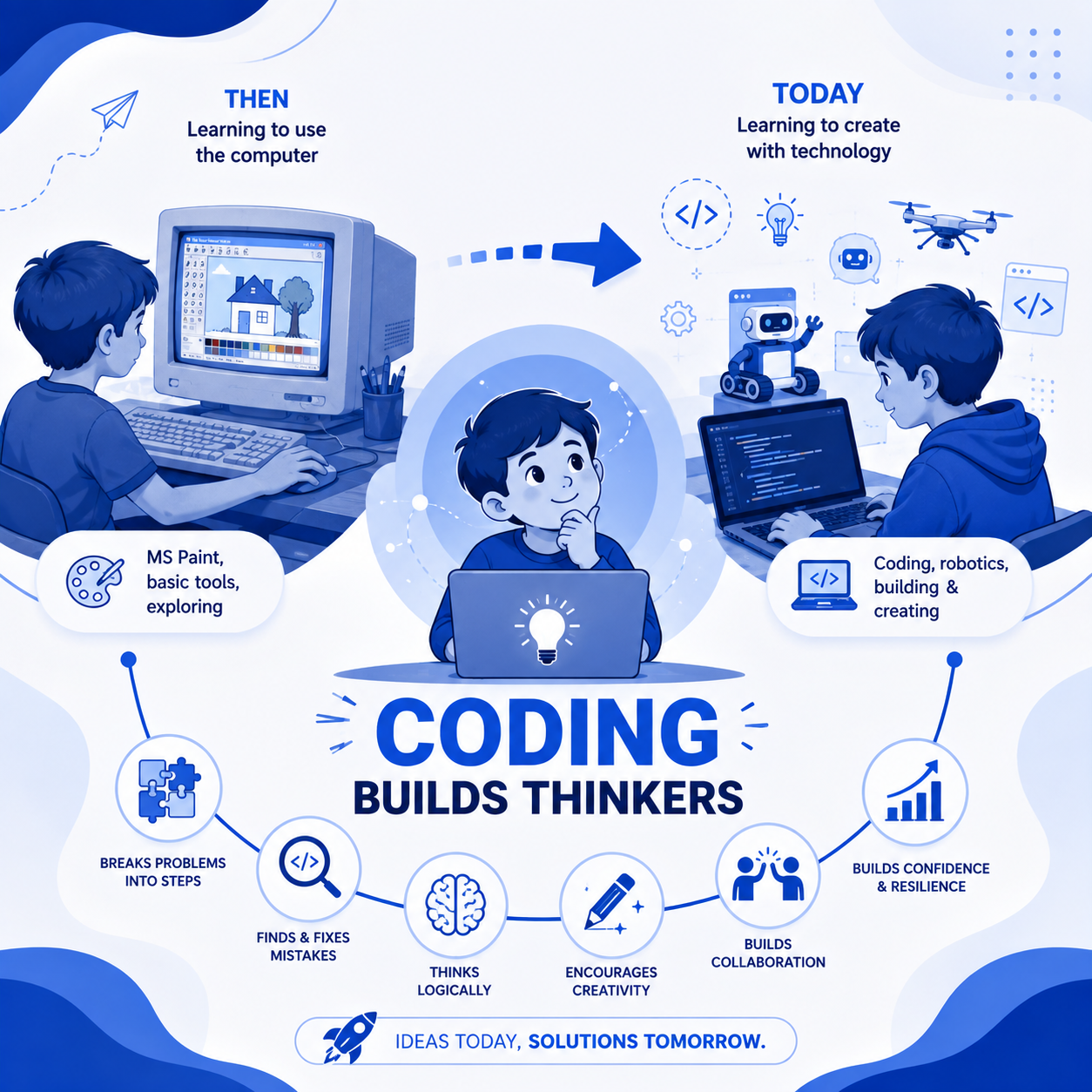
The tools have become far more powerful, but the basic learning process is surprisingly familiar: children experiment, make mistakes, discover what happens and try again.
Imagine a student trying to make a character move ten steps and turn around. The first attempt sends it in the wrong direction. The second makes it move too far. The third finally works. The child has not merely learnt a coding instruction. They have learnt to break a problem into steps, test an idea and change their approach when it doesn't work. That is a skill that can travel far beyond a computer screen.
Coding Teaches Children to Think Through Problems
Coding can make children unusually aware of how they think. A computer doesn't guess what a child meant to tell it; it follows the instructions it receives. If something goes wrong, the student has to investigate the reason.
This process is called debugging, but the idea is simple: something went wrong, so let's find out why.
|
Coding experience |
Skill behind it |
|
Breaking a task into steps |
Logical thinking |
|
Finding where the code went wrong |
Problem-solving |
|
Testing different solutions |
Analytical thinking |
|
Designing a game or project |
Creativity |
|
Working on a group project |
Collaboration |
|
Trying again after an error |
Resilience |
Think about learning to ride a bicycle. A child doesn't understand balance because someone gave them a perfect explanation. They wobble, adjust, fall, try again, and gradually figure it out. Coding can create a similar learning loop: try, test, understand, change, and try again.
And that is perhaps one of its biggest benefits. The computer does not make a child feel embarrassed about a mistake. The code simply doesn't work, so the child gets another chance to fix it.
Why Technology Learning Looks Different for Gen Alpha
For millennials, technology often felt exciting because it was new. Many children did not have a phone of their own, and the family computer might have been shared by everyone at home. Learning to operate a computer itself felt like an achievement.
Gen Alpha is growing up in the opposite situation. Screens are already familiar. A child may learn to swipe before learning to type. They see smartphones being used for payments, maps, entertainment, communication and work every day. So simply teaching children how to click, search or open an app is no longer enough.
The more important question is what they can create, question and solve with technology. That is why coding, robotics and other hands-on technology activities can have value even for children who never plan to become programmers. A future doctor, designer, entrepreneur, scientist or artist may still need to analyse problems, test ideas and work with digital tools.
What Does This Look Like at School?
The presence of computers alone does not make technology education meaningful. Parents should look at what students actually do with them. Are they simply consuming content, or are they building, experimenting, creating and solving problems?
At Salvation Tree School, one of the CBSE schools in Greater Noida West, the school's technology labs provide students with hands-on exposure to coding, robotics, AI and digital literacy. Its robotics programme includes coding and programming through platforms and languages such as Scratch, Python and C++, along with robotics, AI, drone technology and 3D printing. The school also has a Coding & Robotics Club involving coding, app development and robotics challenges.
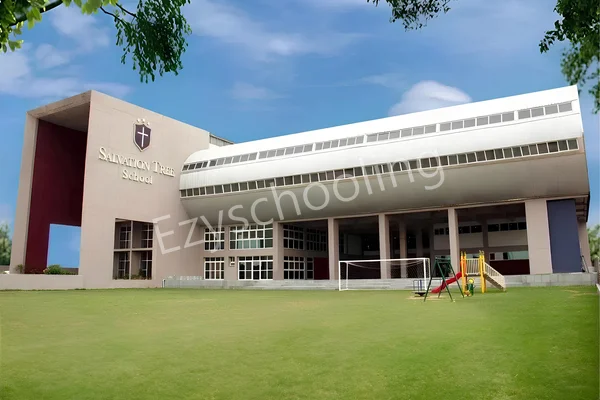
This fits into a broader approach the school describes around experiential and inquiry-based learning, where students are encouraged to investigate, solve problems and connect concepts with real-world situations. The point isn't that every child needs to become a programmer.
It is that technology can become a medium through which children learn to think.
The millennial child who once tried to colour inside a shape on MS Paint was learning how to use a computer. The child today who writes code to make something move is learning something more: how an idea can become a solution through logic, creativity and persistence.
And perhaps that is the real evolution of computer education—from teaching children how to operate technology to giving them the confidence to create with it.
For more information on this and similar schools, check out this list of the best schools in Greater Noida West.
 as a preferred source on