




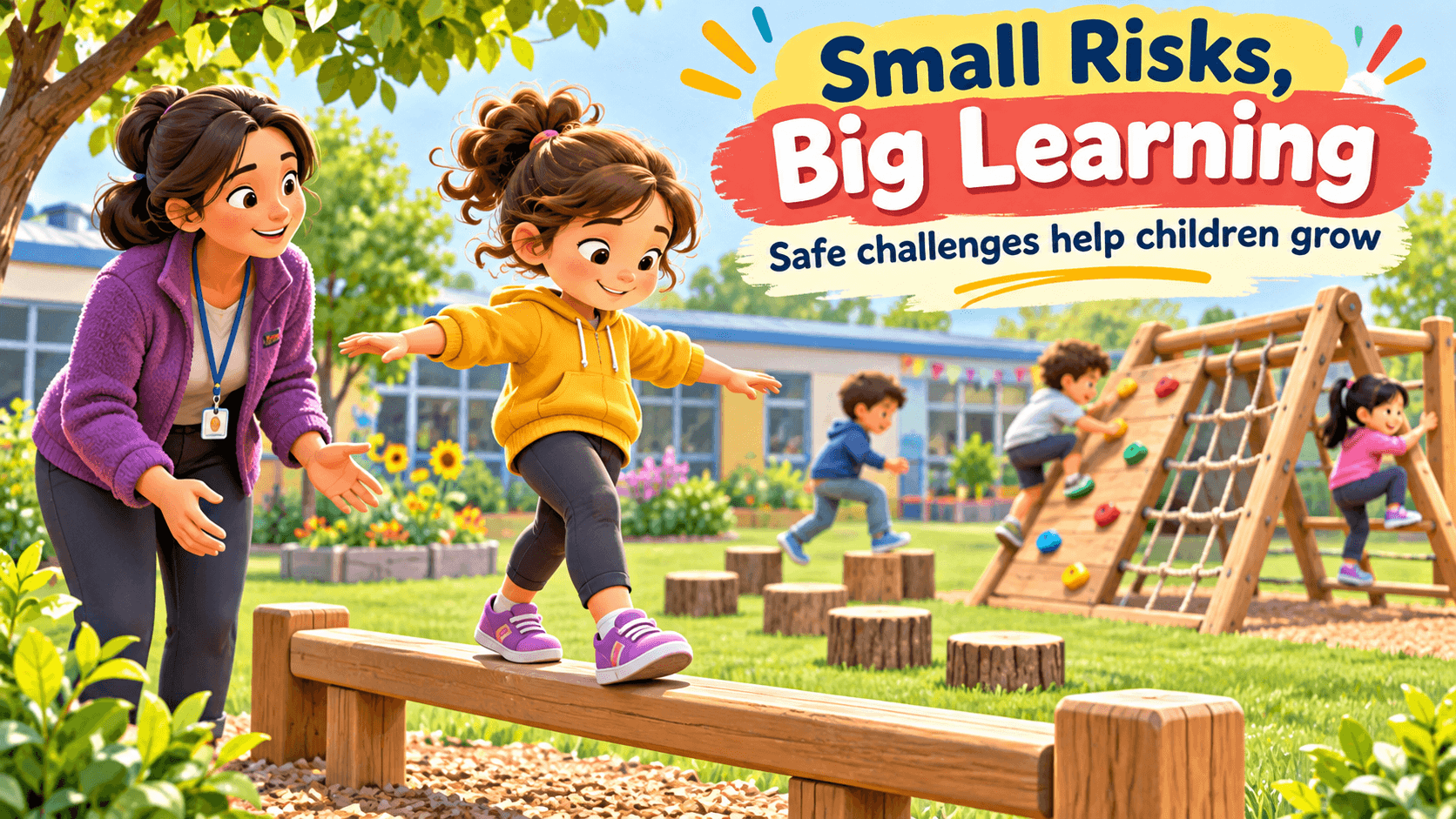

Your six-year-old is walking across a low balance beam at the playground. They hesitate halfway, trying to decide where to place their next foot. You immediately want to hold their hand, worried they might fall.
But what if they could manage that small challenge themselves?
For parents exploring top schools in Gurugram, understanding how children learn through physical play is worth considering. At The Beacon School, Sector 64, Gurgaon, outdoor learning spaces include opportunities for supervised challenging play.
The important question is not whether children should take risks, but how adults can help them explore safely.
1. Why Do Children Enjoy Activities That Feel a Little Challenging?
Have you noticed how children repeatedly climb the same structure, even after reaching the top successfully?
Sometimes, the excitement comes from testing what they can do.
A child learning to balance on a narrow surface must adjust their posture, judge distances, and decide whether to continue.
These small decisions are part of physical exploration.
A 2026 systematic review published in PLOS ONE examined 74 studies involving outdoor risky play among children aged 3–12. It identified generally positive associations between certain forms of challenging play and physical, social, and developmental outcomes.
However, this does not mean every risky activity benefits every child.
Consider two children approaching the same climbing structure. One confidently begins climbing, while the other prefers watching.
Both responses are reasonable.
Children develop at different speeds. Encouraging exploration means offering suitable opportunities, not pressuring children to attempt activities that frighten them.
2. What Is the Difference Between a Healthy Risk and a Dangerous Situation?
Not every activity involving uncertainty is unsafe.
The Canadian Paediatric Society distinguishes between risks children can recognise and manage, and hazards they may not be able to identify or control.
For example, climbing an age-appropriate playground structure may involve a manageable challenge.
A broken ladder, unstable platform, or damaged climbing frame presents a hazard that adults must address.
Imagine your child wanting to climb a low tree branch.
Before allowing it, consider whether the branch is strong, the landing area is safe, and your child has the ability to climb independently.
If these conditions are uncertain, choose a safer alternative.
The same principle applies to playgrounds, obstacle courses, and outdoor activities.
Children should not be exposed to dangerous heights, moving traffic, unsafe equipment, or other situations that could cause serious injury.
Protective equipment and appropriate supervision remain important.
The goal is to create an environment where children can experience manageable challenges without being exposed to hazards beyond their abilities.
3. How Can Small Challenges Help Children Make Decisions?
Imagine your child approaching an obstacle course with two possible routes.
One involves stepping across low platforms. The other requires climbing a slightly higher structure.
Your child studies both options and chooses the easier route first.
They are not simply exercising. They are observing, comparing choices, and deciding what feels manageable.
Later, they may try the more difficult route after gaining experience.
These moments create opportunities to practise decision-making.
Adults can support this process by asking questions such as:
- Which way would you like to try?
- Where could you place your foot next?
- Would you like some help?
- Do you feel comfortable continuing?
Allow children time to think before giving instructions.
Sometimes, a child may decide to stop. Respecting that decision is equally important.
Learning to recognise personal limits and request assistance is part of understanding risk.
Confidence should develop through experience and appropriate support, not pressure to complete every challenge.
4. When Should Parents Step In During Challenging Play?
Parents often face a difficult choice: Should they help immediately or allow their child to keep trying?
The answer depends on the situation.
Suppose your child is climbing a suitable playground structure and pauses because the next step looks difficult.
If the equipment is safe and your child remains in control, you might stay close and ask whether they need assistance.
But if they begin slipping, cannot maintain their grip, or face an immediate danger, intervene.
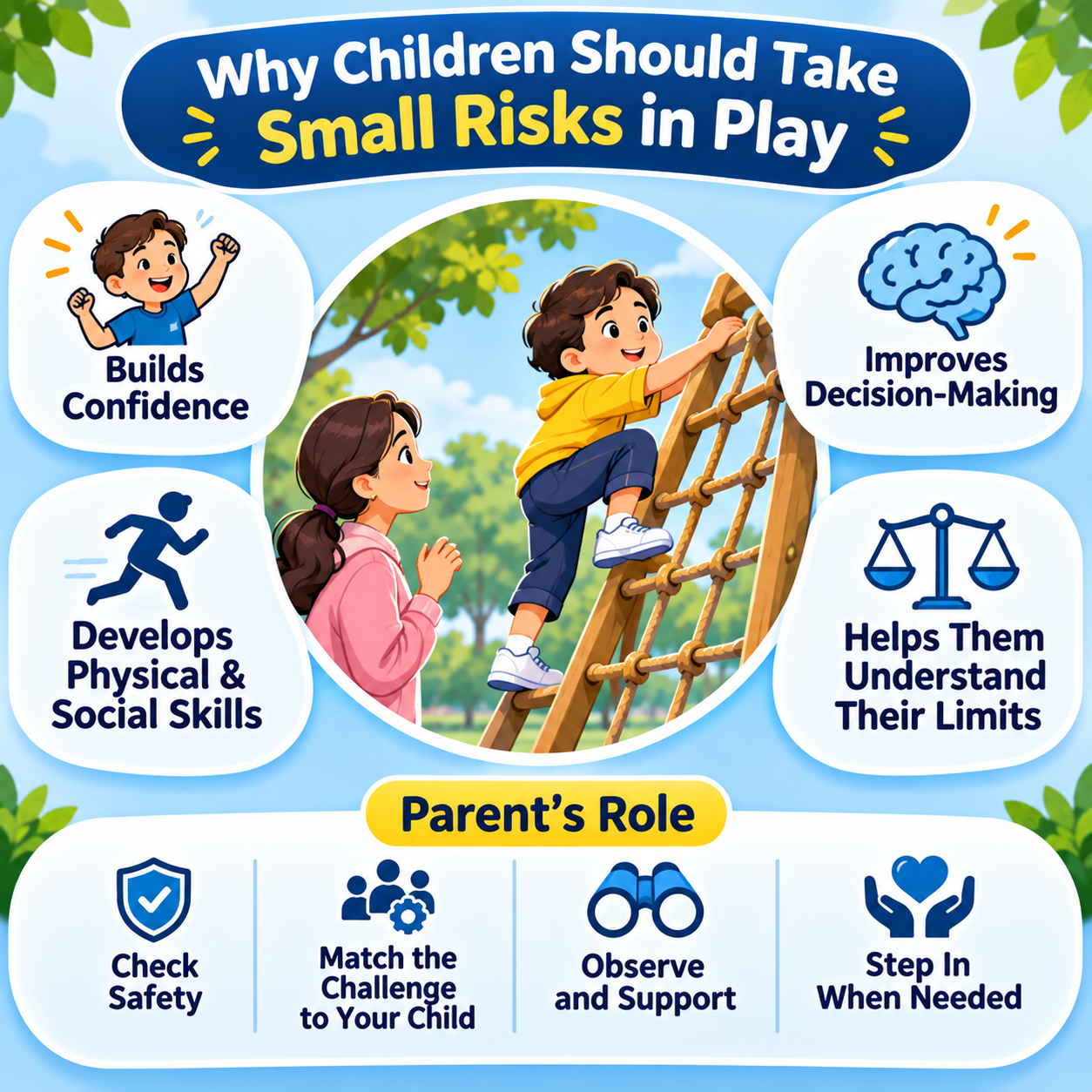
Before allowing challenging play, consider these points:
- Check the surroundings: Look for damaged equipment, sharp objects, unsafe surfaces, and other hazards.
- Consider your child's abilities: A suitable challenge depends on experience, coordination, and individual needs.
- Watch their response: Notice whether they appear comfortable, uncertain, overwhelmed, or frightened.
- Offer appropriate support: Let children make manageable decisions while remaining available.
- Act when necessary: Serious hazards require immediate adult intervention.
Children with disabilities or additional support needs should also have access to appropriate, adapted play opportunities.
Safe exploration is about providing meaningful choices while ensuring children receive the supervision and assistance they need.
Outdoor Exploration at The Beacon School, Sector 64, Gurgaon
When comparing the best schools in Gurugram, parents can look beyond sports facilities and consider how outdoor spaces support everyday exploration. At The Beacon School, Sector 64, Gurgaon, the campus includes adventure walks, playground structures, and an obstacle path designed for challenging and collaborative play. Its early-learning environment also incorporates supervised risky-play opportunities.

These spaces provide a relevant setting for activities involving movement, balance, and decision-making. Parents visiting the school can ask how challenges are adapted for different age groups, how children are supervised, and what safety procedures are followed during outdoor activities.
Conclusion
Children do not need dangerous situations to learn how to handle challenges.
They need suitable opportunities to explore, test their abilities, recognise uncertainty, and make decisions with appropriate adult support.
The next time your child approaches a manageable playground challenge, observe before immediately stepping in.
Sometimes, giving children a little space to try is an important part of helping them learn.
For more information on similar schools, check out this list of the best schools in Gurugram.
 as a preferred source on