





Your child calls home after their first week at boarding school. They sound upset and say, "I miss you. Can we talk again tomorrow?" You want to reassure them, but another question comes to mind: Will frequent calls help them settle in, or make separation harder?
For parents exploring a Top Boarding School in India, understanding parent-child communication is an important part of choosing a residential school. Schools such as Birla Public School Kishangarh (BPSK), Ajmer, have structured communication arrangements that families should understand before admission.
But how much contact does a child actually need?
1. Is Talking Every Day Helpful, or Can It Make Homesickness Harder?
There is no fixed number of phone calls that works for every boarding-school student.
Some children feel reassured after speaking with their parents. Others may become upset when conversations repeatedly focus on how much they miss home.
Imagine your child calling after an enjoyable football match. They excitedly describe scoring a goal. But when you repeatedly ask, "Are you lonely? Are you missing us?" the conversation shifts towards sadness.
This does not mean parents should avoid discussing feelings. Instead, allow conversations to include everyday experiences, friendships, achievements, and genuine concerns.
The American Academy of Pediatrics' 2007 report on homesickness discusses how scheduled communication may help during longer separations, although evidence about ideal calling frequency remains limited.
Parents should consider their child's needs alongside the school's communication rules.
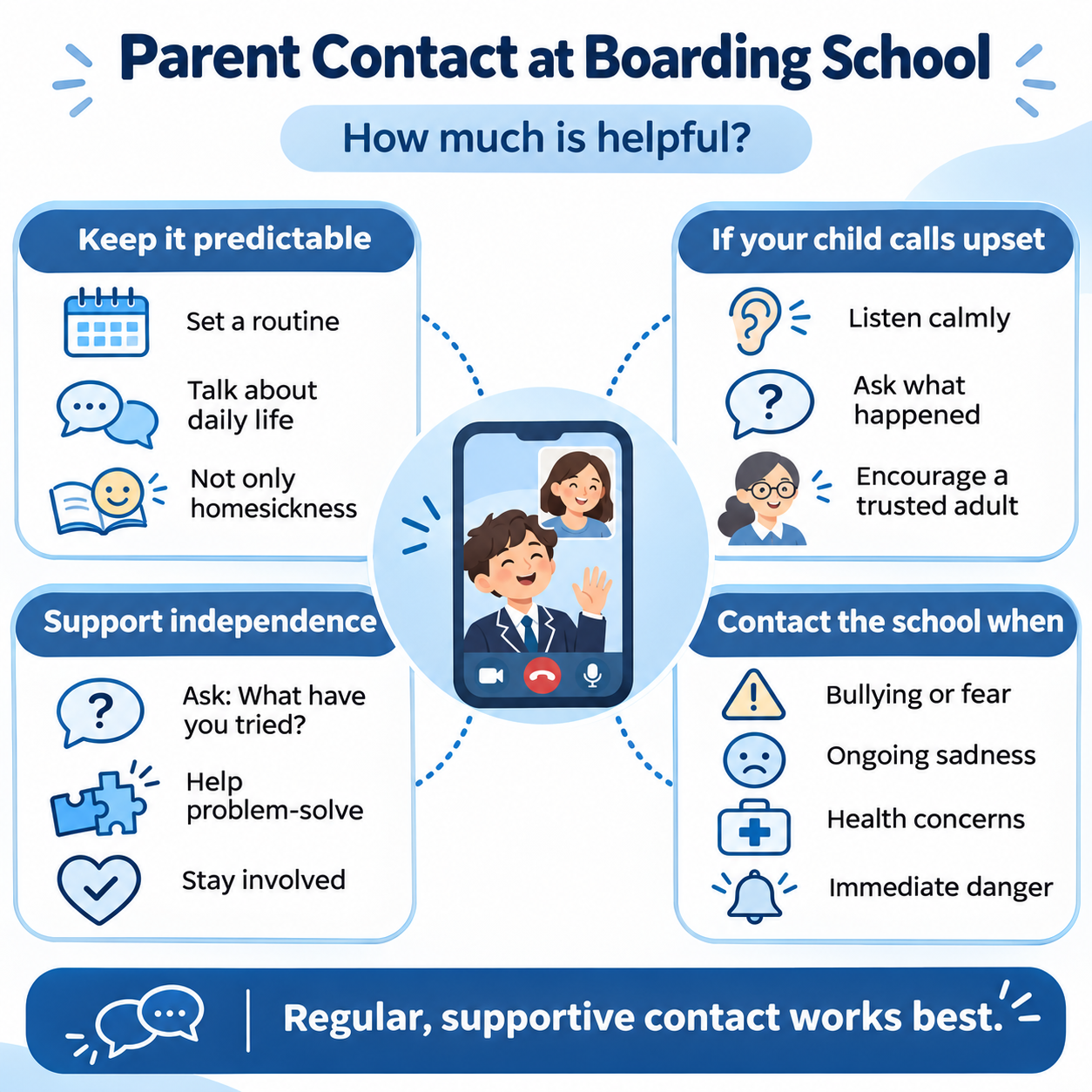
A predictable calling routine can provide reassurance without making every conversation revolve around separation.
2. What Should Parents Say When Their Child Calls Home Crying?
Imagine your child saying, "Nobody sits with me at dinner. I want to come home."
Your first reaction might be to promise an immediate visit. However, understanding the situation is important before deciding what to do.
Start by acknowledging their feelings.
You might say, "That sounds upsetting. Can you tell me what happened?"
Then ask whether the problem occurred once or has been happening repeatedly.
A child might be experiencing ordinary homesickness, difficulty making friends, exclusion, or bullying. These situations require different responses.
The American Academy of Child and Adolescent Psychiatry recommends responding to homesickness with reassurance and consistency rather than dismissing a child's distress.
Encourage your child to identify a trusted adult, such as a housemaster, teacher, or counsellor, who can help.
Avoid automatically promising to bring them home whenever they feel unhappy. At the same time, never dismiss reports of fear, mistreatment, or feeling unsafe as ordinary homesickness.
The goal is to understand what your child needs, not simply end the conversation positively.
3. How Can Parents Stay Involved Without Managing Every Problem?
Boarding-school children encounter everyday situations that require decisions, communication, and cooperation.
Suppose your child complains that their roommate repeatedly borrows belongings without permission.
Should you immediately contact the school?
First, understand the circumstances. If the situation is minor and your child feels safe, help them consider a respectful response.
For example, they could explain that they are uncomfortable sharing personal belongings without being asked.
If the problem continues, they should approach a responsible adult.
Parents can support independence by asking questions rather than providing every solution.
Try asking, "What have you already tried?" or "Who at school could help you?"
However, independence should never mean tolerating bullying, threats, or repeated violations of personal boundaries.
Stay interested in your child's friendships, studies, health, and everyday experiences. Remember details they share and follow up during later conversations.
Children need to know that growing independent does not mean losing their parents' support.
4. When Should Parents Contact the School Instead of Waiting for the Next Call?
Not every difficult conversation requires immediate intervention. However, some concerns should never wait until the next scheduled call.
Imagine your normally talkative child becoming unusually quiet during several conversations. They repeatedly mention being frightened of an older student but refuse to explain further.
Rather than assuming they are simply adjusting, contact the appropriate residential staff.
Parents should pay attention to:
- Repeated reports of bullying, threats, or feeling unsafe.
- Persistent sadness, fear, or withdrawal.
- Significant changes in sleep, appetite, or participation.
- Unexplained injuries or concerns about medical care.
- Difficulties that continue despite earlier requests for help.
The UK's National Health Service explains that anxiety may require professional support when it becomes persistent or interferes with everyday activities.
When contacting the school, describe specific incidents, ask who is responsible for investigating, and agree on a follow-up plan.
If your child reports immediate danger, seek urgent intervention rather than waiting for routine communication hours.
Regular contact arrangements are useful, but protecting a child's well-being must remain the priority.
Parent Communication at Birla Public School Kishangarh, Ajmer
For parents researching the Best Boarding School in India, understanding communication policies is an important part of evaluating residential care. At Birla Public School Kishangarh (BPSK), Ajmer, located on the Jaipur-Ajmer Highway, residential arrangements include scheduled telephone contact on Tuesdays, Thursdays, and Sundays, along with weekly supervised video calls.

The school also provides designated parent-visiting opportunities and communication channels through Housemasters for concerns involving boarding life and student welfare. These arrangements give families a starting point for understanding how contact is organised. Parents should confirm current calling schedules, emergency procedures, and how residential staff respond when a child needs additional support.
Conclusion
Staying connected with a child at boarding school is not simply about making frequent phone calls.
What matters is whether children feel heard, supported, and comfortable discussing difficulties.
Agree on realistic communication arrangements, encourage everyday problem-solving, and remain attentive when something seems wrong.
Children can gradually become more independent while knowing their parents remain available whenever genuine support is needed.
For more information about residential education, explore boarding schools in India.
For more information on this and similar schools, check out this list of the best boarding schools in India.
 as a preferred source on