




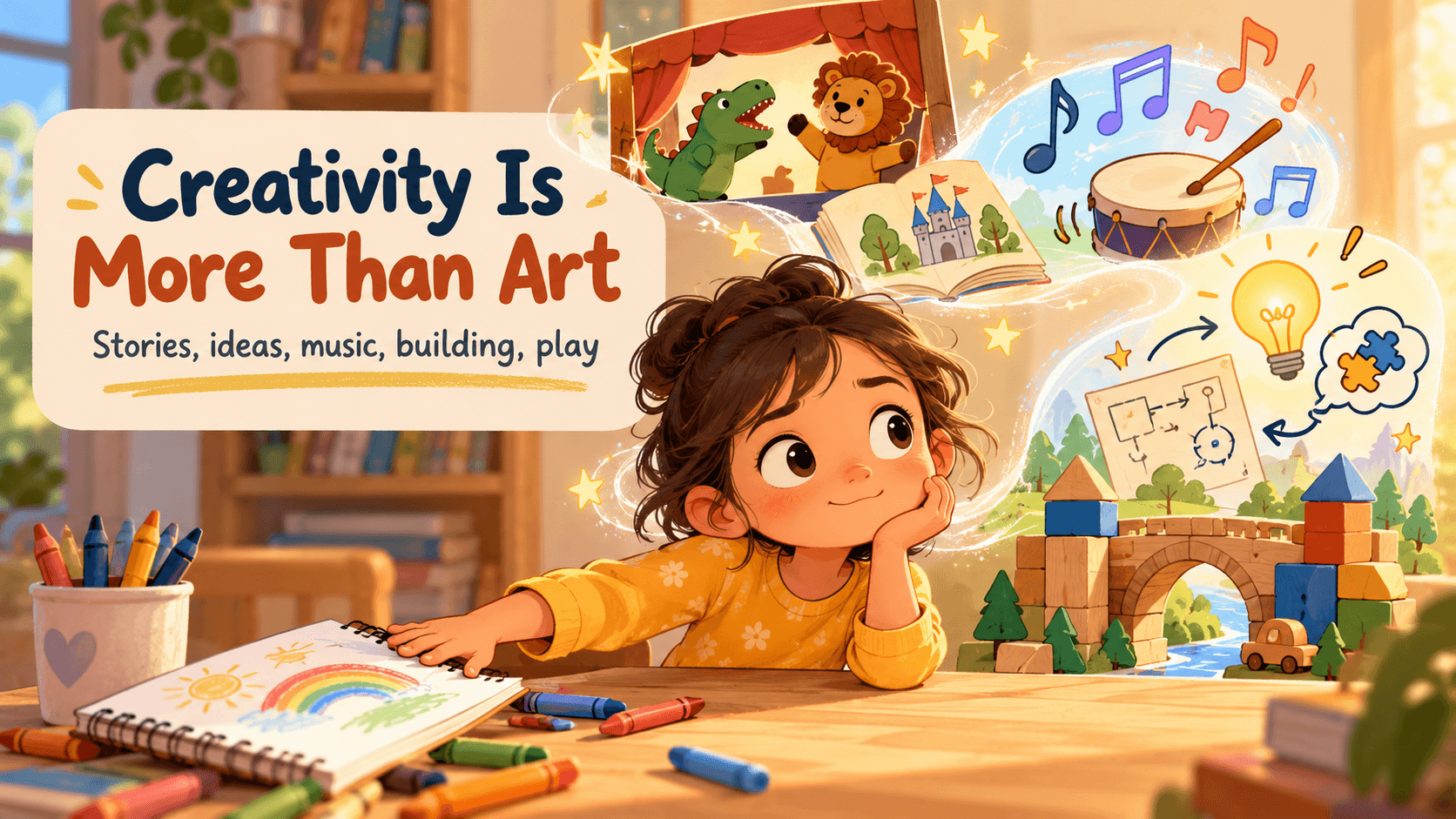

Your child pushes away their drawing book after ten minutes. "I am not good at art," they say. Yet the same child can invent a funny story, build elaborate structures with blocks, or find unusual ways to solve small problems.
A dislike of drawing does not mean a child lacks creativity.
For parents comparing Top Schools in Bangalore, including Navkis Educational Centre, Kogilu, Bangalore, a useful question is whether children have opportunities to explore ideas without always worrying about the final result.
Does Being Creative Mean Being Good at Drawing or Painting?
A neatly coloured picture is one way to show artistic skill. It is not the only sign of creativity.
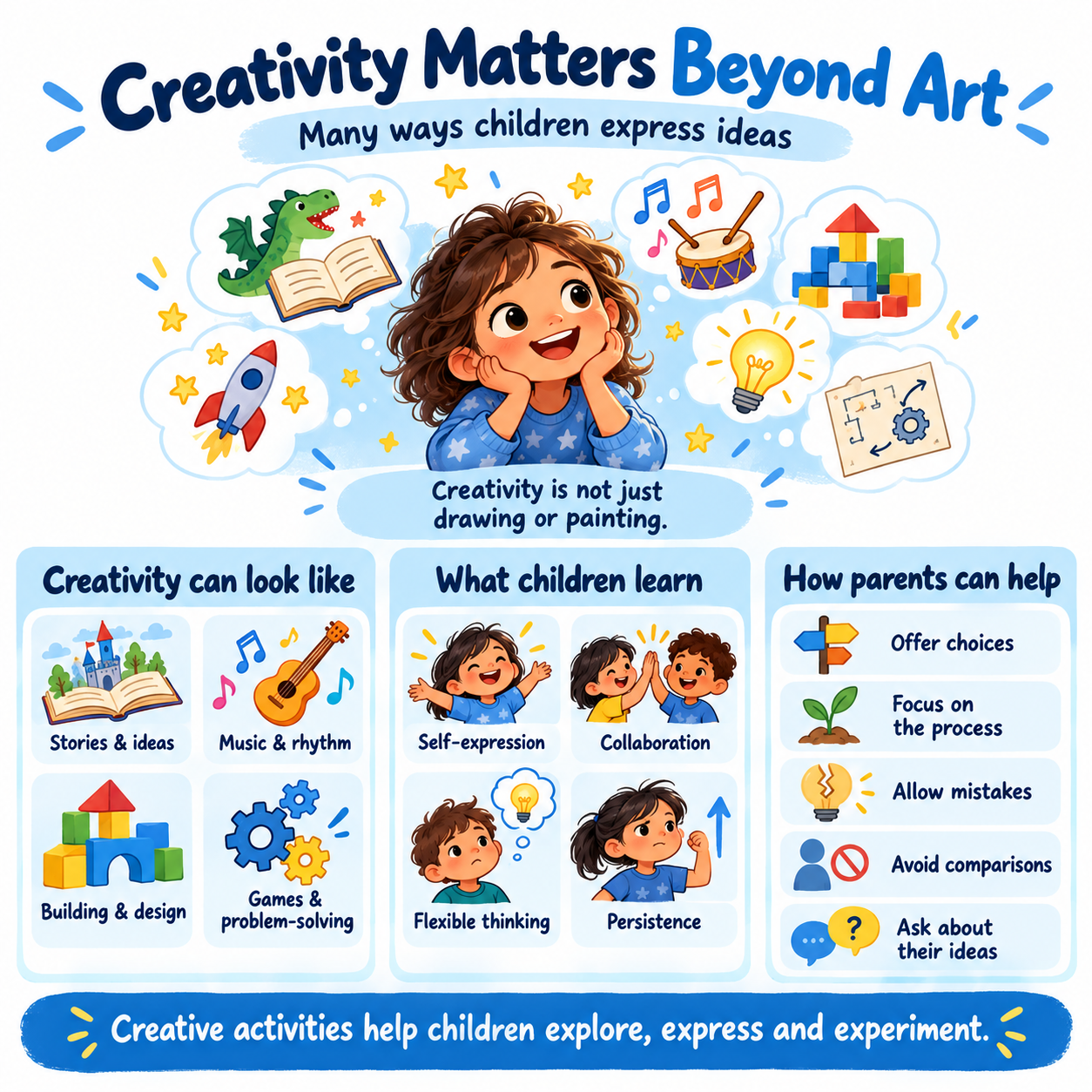
A child who invents a new ending for a story is using imagination. So is a child who builds a bridge from cardboard, devises a game for friends, or finds a fresh way to explain an idea. Some of these activities involve art; others involve language, movement, planning, or problem-solving.
UNESCO's Framework for Culture and Arts Education recognises many forms of expression, including music, dance, theatre, and visual arts.
This does not mean every child will enjoy every creative activity. A child who dislikes painting may enjoy puppetry or making up songs. Offering choices is more useful than deciding that a child is simply "not creative."
What Can Children Learn From Creative Activities?
Imagine a group of children preparing a five-minute play about a lost puppy. One writes the dialogue, another designs a simple backdrop, and two act out the story. They disagree about the ending and have to find a solution together.
The task can create opportunities to practise several skills:
- Self-expression: Children explore ways to communicate an idea or feeling, even when they struggle to put it into ordinary conversation.
- Collaboration: They listen to others, share roles, and negotiate different suggestions.
- Flexible thinking: When a planned scene does not work, they try another approach.
- Persistence: They practise lines, change details, and learn that improvement often takes several attempts.
These skills are not guaranteed results of every activity. Supportive guidance and feedback matter.
The Education Endowment Foundation's review of arts participation finds a moderate positive average effect on academic learning, while stressing that the arts have value beyond examination results. This is an average across studies, not a promise that joining a drama class will raise a particular child's marks.
Why Should the Process Matter More Than the Final Result?
Two children are asked to create a house using empty cardboard boxes. One follows an example and produces a tidy model. The other tries several layouts, finds that the roof keeps falling, and finally makes a less polished house that stands.
It would be easy to praise only the neater model. Yet both children have made decisions and practised skills. The second child has also had a chance to test ideas, notice a problem, and revise a plan.
Adults can acknowledge care and effort without pretending that every result is equally successful. Instead of saying, "Yours should look like your friend's," ask, "What did you change when the roof fell?"
A useful response focuses on what the child tried and what they might do next.
How Can Parents Encourage Creativity Without Forcing It?
Creative experiences do not require costly materials or packed after-school schedules. Small, relaxed opportunities can be enough to invite participation.
Offer genuine choices. A child could tell a story, create a rhythm, make a collage, or design an imaginary shop. Ask what interests them rather than insisting on a particular art form.
Try a three-object story. Choose a spoon, a key, and a toy car. Invite your child to invent a story connecting them. There is no single correct plot, which makes the activity approachable.
Make space for mistakes. If a paper tower falls, ask what might make it stronger. Resist completing the task for your child.
Avoid comparisons. A sibling's impressive painting says little about another child's ability to invent characters or solve design problems.
Respect preferences. Children can be encouraged to try something unfamiliar without being pressured to perform publicly or continue an activity they genuinely dislike.
Above all, ask about their choices: "What were you trying to make?" is often more inviting than "Is it finished yet?"
Understanding Creative Learning at Navkis Educational Centre
For parents exploring Best Schools in Bangalore, the place of creative expression in a child's education can be an important consideration. Navkis Educational Centre, Kogilu, Bangalore, is one of the schools families may consider when comparing educational options. Parents can ask how children are encouraged to share ideas, explore different interests, and participate without feeling that every activity must end in a perfect performance or finished product. Such questions help families consider whether an educational environment gives children room to discover what they enjoy and develop at their own pace.

Conclusion
A child who avoids drawing may still love storytelling, designing games, or imagining solutions. Creative activities are not tests of artistic talent; they are chances to experiment, express ideas, and learn alongside others.
Parents can help by offering different options, asking thoughtful questions, and noticing the effort behind a creation. The goal is to keep children curious enough to try.
For more information on this and similar schools, check out this list of the best schools in Bangalore.


 as a preferred source on